


Introduction
During the course of our lawsuit, one thing became painfully obvious from the outset: truth was often treated as optional.
Here at Justice-Denied.org, we have documented the pattern of perjury, deleted evidence, conflicting testimony, and evidence that simply disappeared when it mattered most. We have also documented false or misleading statements by the Court itself. See these articles:
- False or Misleading Statements by the Tribunal #1 (Craig’s Email)
- False or Misleading Statements by the Tribunal #2 (Clerk Morrison)
- False or Misleading Statements by the Tribunal #3 (Discovery)
We have documented the Court’s heavy use of ellipses, where key words and context were removed from quotes in ways that changed the meaning of the record.
But what about the attorneys?
The Burden of Correcting the Record
Craig and I routinely found ourselves stunned by defense filings that contained so many false or misleading statements that we could not possibly correct them all within the page limits of our response. We would read a memorandum and know, line by line, that the record did not say what the Defense claimed it said. But litigation does not give a party unlimited pages to correct every distortion. Once enough falsehoods are packed into a motion, the burden shifts unfairly to the opposing party to choose which ones to correct and which ones must be left unaddressed.
That is not how justice is supposed to work.
A motion should not become a game of whack-a-mole, where one side makes a series of inflammatory claims and the other side must spend its limited response pages simply proving that the record says something else.
The September 2023 Sanctions Motion
Take the September 1, 2023 Motion for Sanctions filed by the Defense team. Less than 90 days after summary judgment had been awarded by presiding Judge Kevin M. Miller, Defendants attempted to do some after-the-fact cost-shifting. That type of cost-shifting was not allowed under Minnesota law, but they tried it anyway.
And in the process, their motion papers became a striking example of how false statements can consume a motion.
False Statement #1: Sean’s Birthday
In what appeared to be an attempt to bias the judge against us and our attorneys, Defense Attorneys Kirsten Hansen and Ross Tentinger made the following statement in their September 1, 2023 motion papers:
This lawsuit was initiated by the service of the Summons and Verified Complaint on Sean Stevenson on November 20, 2020, Sean’s birthday.
(Doc. 444, at 2.) (emphasis added)
It sounded terrible.
It sounded planned.
It sounded cruel.
And it was totally false.
Sean was actually served on November 19, 2020, the day before his birthday.
The troubling part about this false statement to the Court was not merely that it was wrong. The troubling part was that Attorney Tentinger had already filed an affidavit earlier in the case, in support of Defendants’ demand for a change of venue, where he stated the correct date:
Defendant Sean Stevenson was served with the Summons and Complaint on November 19, 2020.
(Doc. 3, ¶ 3.)
In addition, the process server had signed a declaration stating:
that on Thursday, November 19, 2020 at 5:48 PM I served the Summons & Complaint upon Sean Christopher Stevenson, therein named, personally… by handing to and leaving with Sean Christopher Stevenson, a true and correct copy thereof.
(Doc. 9)
In other words, the correct date was not hidden. It was not ambiguous. It was not some obscure fact buried in a forgotten corner of the file. There were multiple sources in the Court record confirming the date of service – one signed by Defense Counsel.
Yet the Defense told the Court that Sean was served on his birthday.
During the September 25, 2023 hearing, our attorney corrected the record:
Additionally, contrary to the defendant’s claims in their memorandum, Sean was served with the summons and verified complaint on November 19th. It was not his birthday. This is sort of designed to inflame. This is not coordinated. It was not accurate.
(Doc. 469, Tr: 24:9-13) (emphasis added)
That should have been the end of it. Once a false statement to the Court has been identified, corrected, and shown to be contradicted by the record, the attorney who made the statement has an ethical duty to correct it.
But there is no evidence in the record that Attorneys Hansen or Tentinger ever corrected this false statement to the Court.
False Statement #2: The Non-Existent Deposition
As part of their effort to paint us as overly aggressive during discovery, Defendants then accused us of deposing both of Lisa Stevenson-Allen’s sons:
Not satisfied with the production from Lisa’s children, Plaintiffs then served a subpoena commanding Lisa’s sons, Nicholas Olson and Benjamin Olson, to appear for a deposition.
(Doc. 444, at 4.) (emphasis added)
It sounded aggressive, I suppose.
But there was one problem.
It was entirely fabricated.
It is true that we deposed one of Lisa’s sons after his answers to a subpoena appeared to quote questions from someone else’s document subpoena rather than his own. That deposition happened.
But we never issued a subpoena commanding Nicholas Olson to appear for a deposition, as the Defense attorneys told the Court.
Once again, during the September 25, 2023 hearing, our attorney corrected the record:
…we need to correct the record a little bit in that there was no subpoena for Nicholas Olson to appear at a deposition. There was a document-only subpoena. So that was misstated in their memorandum.
(Doc. 469, Tr: 28:3-7) (emphasis added)
This was not a minor wording issue. A document subpoena and a deposition subpoena are not the same thing. One asks for documents. The other commands a person to appear for questioning under oath. The Defense used the false deposition claim to portray us as excessive, intrusive, and punitive in discovery.
And once again, after the misstatement was corrected on the record by our attorney, there is no evidence that Attorney Hansen or Attorney Tentinger corrected the false statement to the Court.
False Statement #3: The Email I Didn’t Author
Defendants’ September 2023 sanctions memorandum kept going. Next, I was going to take it on the chin for my supposed duplicity.
The Defense wrote:
[Ashley] Anderson retained her own counsel and responded to the subpoena producing 58 pages of records. This production included an email Marie had sent to Anderson on June 6, 2020, shortly after learning that Sean had reached out to [Marie’s father]. In her email, Marie wrote “I realize that you might have been an unwilling or reluctant participant in the things that [Sean] has done, and perhaps even discouraged some of these actions . . . I find it extremely difficult to believe that you played an active role.” (Tentinger Aff., Ex. 8.) Despite Marie’s June 6, 2020, email, Plaintiffs persisted and proffered a claim based solely upon “information and belief.”
They continued:
…Plaintiffs were questioned at their depositions about what “information and belief” they possessed that Ashley Anderson conspired against them. Marie could only offer conjecture, contradicting her prior email to Ashley Anderson…
(Doc. 444, at 16.) (emphasis added)
Much was made of my supposed double-dealing ways. According to Defendants, I had allegedly written a sympathetic email to Ashley Anderson, then later contradicted myself in litigation.
But when Attorney Tentinger’s own affidavit exhibit is examined closely, it reveals that the email Defendants were protesting about was not written by me at all.
It was written by Craig.
That is not a small mistake. The entire argument depended on attributing Craig’s words to me and then using those words to accuse me of duplicity. Defendants were not merely misidentifying an exhibit. They were using the misidentification as a weapon against my credibility.
Our attorney pointed this out at the September 25, 2023 hearing:
Again, contrary to the defendant’s claim that in her 2022 deposition, Marie contradicted her June 6, 2020, email to Ashley and despite the fact that defendants quoted several statements from the email and quoted at least two paragraphs of their motion in an effort to portray Marie as complicitous, the plaintiff’s [sic] simply note that the June 6th email, this one that they say was being contradicted by — where Marie was contradicting herself, that was written by Craig, not Marie. So the facts are completely wrong in their memo.
Doc. 469, Tr: 24:20-25:4 (emphasis added)
Again, the record was corrected.
Again, the correction mattered.
Again, there is no evidence in the record that Attorneys Hansen or Tentinger ever corrected this false statement to the Court.
From Misstating the Record to Attacking the Victim
The first three examples involved objective facts: the date Sean was served, whether Nicholas Olson was subpoenaed for a deposition, and who authored the June 6, 2020 email. Each was verifiable from the record. Each was misstated to the Court. And each mattered because it helped Defendants build a narrative that we were unreasonable, aggressive, or dishonest.
But the next false statement went even further. It did not merely misstate a date, a subpoena, or the author of an email. It attacked my credibility as a victim. It took documented fear, documented trauma, and the very abuse-related evidence at the center of the case, and recast it as “embellishment.”
False Statement #4: Calling Documented Fear “Embellishment”
Attorneys Hansen and Tentinger continued their assault on my character later in the same motion papers. Apparently, my fear of my estranged father — a fear documented in childhood medical records and evidenced by panic attacks that were part of the cause of action in our lawsuit — needed to be called into question again.
Winning the case at summary judgment was not enough for them. Now, they needed to pour it on:
Marie’s 6-page letter again misrepresents the record and embellishes Marie’s allegations of abuse and fear of her father…
(Doc. 444, at 20.) (emphasis added)
The problem, of course, was that my allegations of abuse and my lifelong fear of my estranged father were not misrepresented in my 6-page letter.
For those of you who have not seen this tactic before, it has a name: victim-shaming.
It is the attitude that the victim is the problem. The victim’s fear is exaggerated. The victim’s trauma is inconvenient. The victim’s words are the real offense. Speaking up cannot be tolerated by perpetrators or by those defending them, so the victim is publicly humiliated for having made the accusation in the first place. For those of you who have not read it yet, please see my blog post on Writing Back Against Revictimization.
Attorneys are allowed to advocate. They are allowed to argue their client’s position. They are allowed to challenge claims they believe are unsupported.
But advocacy is not a license to misrepresent the record.
Attorneys Hansen and Tentinger had access to my medical records. They had access to evidence that I was “deathly afraid of returning home” as a teenager. They had access to testimony by my siblings and my mother. They had access to video footage of my panic attacks caused by Sean’s contact with my estranged father.
They had the record.
And the record did not support their decision to portray my statements about abuse and fear as embellishment.
False Statement #5: Calling the Deleted Evidence Claim “False”
In their September 2023 sanctions paperwork, Defense Counsel again objected to the same 6-page letter I authored to a third party:
Marie’s 6-page letter…falsely claims that Lisa “has deleted all of the evidence surrounding the contacts with my father.”
(Doc. 444, at 20.) (emphasis added)
Once again, the evidence supporting my statement was available to Attorneys Hansen and Tentinger.
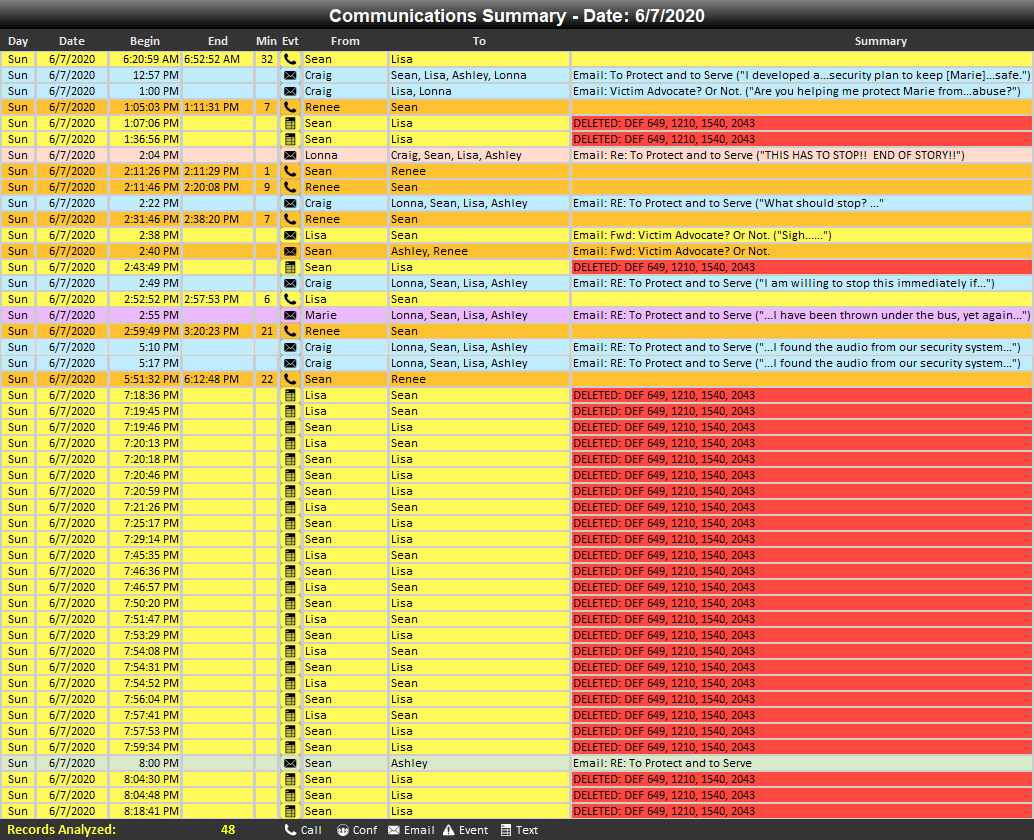
Sean’s AT&T call-detail records showed the dates and times of texts sent back and forth between Lisa and Sean, but none of the texts from May, June, or July 2020 were produced by either Sean or Lisa. When forensic examinations were commissioned, all of the deleted texts were unrecoverable from both phones.
The Evidence They Had in Front of Them
As I documented in A Judicial Blind Eye, the deletion was significant. The communications summary for June 7, 2020 alone shows a sea of red signifying deleted texts between these two Defendants:
Furthermore, Lisa did not produce a single email exchange between herself and the other Defendants from those three months. When asked about a particular email she did not disclose during her deposition, Lisa replied:
I would disclose the ones I have. I don’t – I’m not good at keeping emails, texts. I’m just not.
Lisa’s own testimony on her deletion of texts was even more revealing:
-
“They might have – they might have been deleted. I delete texts.”
-
“Well, I typically delete texts….”
-
“I don’t recall deleting those. I know there was one of [Plaintiffs’ daughter] on there, but I don’t recall deleting those, unless I didn’t get them or unless I did delete them.”
-
“…there’s a lot of texts that are just missing on my phone. I have deleted some, but there’s a whole – there’s months that are just gone, and I don’t know.”
-
“I have no idea other than I delete texts as part of my job. I automatically delete texts…”
-
“Yeah, I don’t know why I would delete ‘Again,’ the word ‘Again.’ It’s – my phone does those things. I – I could have deleted it, I might not have, and it could have just gone. I have no idea.”
-
“They could be deleted or gone like these were. I don’t know.”
-
“…but I do delete texts. You can see from my phone there’s problems with it. I don’t know.”
This was not a situation where there was no evidence of deletion. There were missing texts. There were missing emails. There were call-detail records showing communications that were not produced. There were forensic examinations that could not recover the deleted texts. And there was Lisa’s own testimony acknowledging that she deleted texts and that months of texts were missing.
To tell the Court that my claim was false was itself a misrepresentation of the record.
It was also an attempt to paint me as a liar to the Court.
When False Statements Become a Strategy
I understand that Defendants wanted to trigger cost-shifting. I understand that they wanted to recast the litigation as our fault, our excess, our aggression, and our misconduct. I understand that they wanted the Court to see us not as victims seeking accountability, but as unreasonable litigants who needed to be punished.
But using false statements and misrepresentations to do it is not ethical.
The Rules Are Not Suggestions
This is where the Minnesota Rules of Professional Conduct matter.
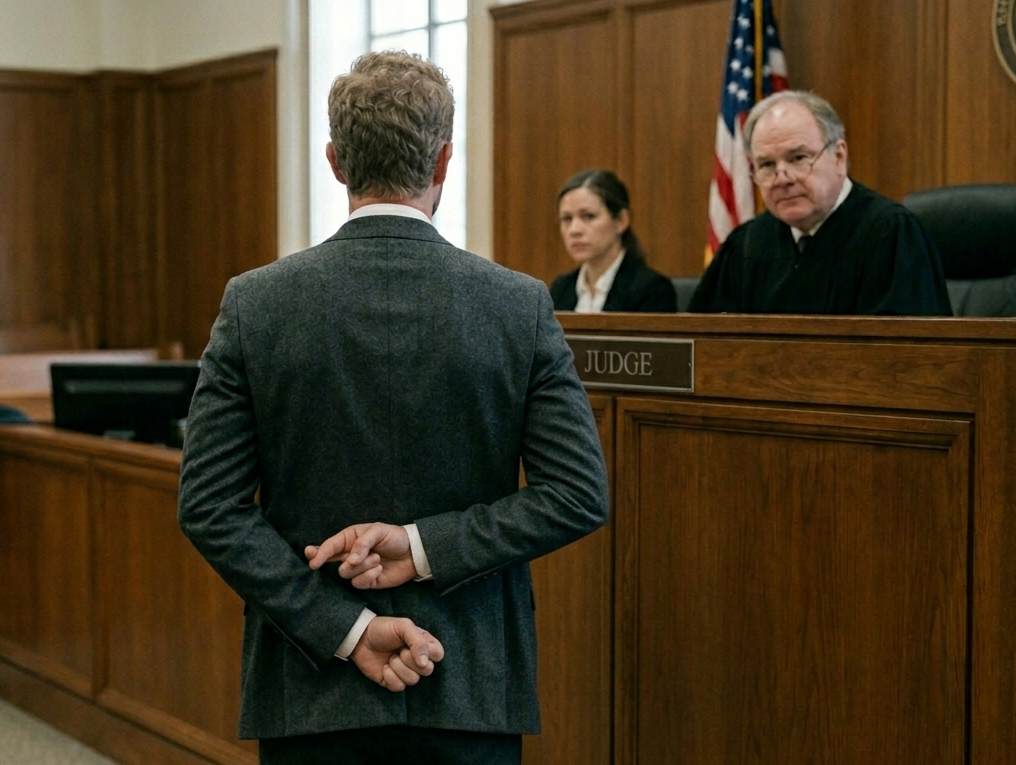
Minnesota lawyers are not merely hired guns. They are officers of the court. They have clients to represent, but they also have duties to the tribunal and to the integrity of the judicial process. Their job is not to win by any means necessary. Their job is not to inflame the judge with false facts, accuse an opposing party of conduct that did not happen, attribute one person’s email to another, or call a victim’s documented fear “embellishment” when the record says otherwise.
Rule 3.3 of the Minnesota Rules of Professional Conduct addresses candor toward the tribunal. It recognizes that a lawyer may advocate forcefully, but the lawyer may not knowingly make false statements of fact or law to a court or fail to correct false statements previously made. The comments to the rule explain why this matters: lawyers have special duties as officers of the court to avoid conduct that undermines the integrity of the adjudicative process.
That phrase — “the integrity of the adjudicative process” — is not just legal jargon. It is the foundation of the whole system.
Courts depend on lawyers to tell the truth about the record. Judges are not supposed to become private investigators, forced to compare every sentence in a motion against every exhibit, every transcript, every affidavit, and every prior filing. The system assumes that attorneys will not mislead the Court. It assumes that attorneys will not bury false statements in motion papers and then leave it to the opposing party to catch them. It assumes that when an attorney learns a statement is false, the attorney will correct it.
When those assumptions fail, the justice system fails with them.
A Duty to Check the Facts
Rule 3.1 also matters. Lawyers must have a basis in law and fact for the claims and contentions they present. That does not mean every argument must ultimately prevail. It does mean attorneys are supposed to inform themselves about the facts before making accusations in court papers.
When the record shows that Sean was served the day before his birthday, an attorney should not tell the Court he was served on his birthday.
When Nicholas Olson was served with a document-only subpoena, an attorney should not tell the Court he was commanded to appear for a deposition.
When Craig authored an email, an attorney should not attribute it to Marie and then accuse Marie of contradicting herself.
Misrepresentation Is Misconduct
Rule 8.4(c) is even more direct. It provides that it is professional misconduct for a lawyer to engage in conduct involving dishonesty, fraud, deceit, or misrepresentation. That rule is not limited to criminal conduct. It is not limited to lies told under oath. It goes to the heart of whether a lawyer is acting with the honesty the profession requires.
And Rule 8.3 recognizes that the profession is self-regulating. Lawyers who know that another lawyer has committed a violation raising a substantial question about honesty, trustworthiness, or fitness as a lawyer are required to inform the appropriate professional authority. That matters because ordinary litigants are not always in a position to police attorney misconduct. The system depends on lawyers and judges taking these obligations seriously.
But in our case, the false statements were not treated as a crisis of candor. They were treated as litigation tactics.
Why The Candor Files Matter
That is why this series matters.
The public rarely sees what happens inside motion practice. Most people never read the memoranda, affidavits, deposition excerpts, or hearing transcripts. They never see how easily a party’s reputation can be damaged by a sentence that sounds convicting but is not true. They never see how many pages it takes to correct one false statement, or how many false statements can be packed into a single motion.
They never see the exhaustion of having to prove, again and again, that the record says what it says.
The purpose of this series is not merely to revisit old litigation. The purpose is to show how false statements to a tribunal distort the search for truth.
They consume court resources.
They prejudice the opposing party.
They force victims to defend themselves against accusations that should never have been made. And when those statements are left uncorrected, they become part of the official story of the case.
That cannot be shrugged off as ordinary advocacy.
There is a difference between arguing hard and arguing falsely. There is a difference between interpreting the record and misrepresenting it. There is a difference between defending a client and misleading a court.
Attorneys know this. The Rules of Professional Conduct say it. The integrity of the justice system depends on it.
And when lawyers forget those obligations, the public has a right to know.