
The Disciplinary Files
Attorney Misconduct, Professional Accountability, and Minnesota’s Lawyer-Discipline System
The Disciplinary Files is a Justice-Denied.org series examining how Minnesota receives, investigates, reviews, and resolves allegations of attorney misconduct.
Lawyers occupy a position of unusual trust. They advise clients facing the loss of liberty, property, employment, family relationships, reputation, or financial security. They handle confidential information and client funds. They present evidence, describe the record, interpret the law, and make representations that courts and opposing parties may be expected to rely upon.
With that authority comes a corresponding obligation to act competently, diligently, honestly, and fairly.
But professional rules matter only if they are meaningfully enforced.
This series will examine Minnesota’s attorney-discipline system through its governing rules, annual reports, public disciplinary proceedings, Supreme Court decisions, and other available records. It will explain how the system is intended to work, examine how it operates in practice, and ask whether its processes provide the consistency, transparency, and accountability necessary to maintain public confidence.
This page will serve as the introduction and index for the series.
Why Attorney Discipline Matters
The legal profession is largely self-regulating under the authority of the judiciary.
Lawyers investigate other lawyers. Volunteer lawyers serve on District Ethics Committees (DECs). Lawyers and public members serve on the Lawyers Professional Responsibility Board. The Office of Lawyers Professional Responsibility evaluates and prosecutes alleged misconduct. The Minnesota Supreme Court ultimately determines whether public discipline should be imposed.
That structure places substantial responsibility in the hands of the profession itself.
A credible disciplinary system must protect several interests at the same time. It must protect the public from serious misconduct. It must protect clients and the judicial system. It must provide accused lawyers with fair procedures. It must distinguish legitimate ethical concerns from dissatisfaction with a legal result. It must preserve appropriate confidentiality while also making public accountability visible when serious misconduct is established.
Those interests can sometimes pull in different directions.
The investigation of an attorney by the OLPR is a confidential process, designed to protect lawyers from reputational damage caused by unsupported accusations. But confidentiality also limits the public’s ability to evaluate how nonpublic complaints were screened, investigated, dismissed, or privately resolved.
Professional independence can protect lawyers from retaliatory complaints. But independence must not become insulation from meaningful review.
Efficiency is necessary in a system receiving more than a thousand complaints per year. But efficiency must not come at the expense of careful record review when the allegations involve dishonesty, evidence, confidentiality, client funds, or the integrity of a judicial proceeding.
Attorney discipline therefore deserves examination not only as a professional-regulation issue, but as a public-confidence issue.
Who Regulates Minnesota Lawyers?
The Minnesota Supreme Court has ultimate authority over the licensing and discipline of Minnesota attorneys.
The Court has adopted two principal sets of rules governing the system:
- The Minnesota Rules of Professional Conduct establish the ethical obligations lawyers must follow.
- The Rules on Lawyers Professional Responsibility establish the procedures for receiving complaints, conducting investigations, reviewing dispositions, seeking public discipline, and imposing sanctions.
The system includes three principal regulatory bodies.
The Office of Lawyers Professional Responsibility
The Office of Lawyers Professional Responsibility, commonly known as the OLPR, receives complaints, conducts preliminary reviews, investigates alleged misconduct, supervises investigations assigned to District Ethics Committees, issues certain private dispositions, and prosecutes matters in which public discipline is sought.
The OLPR describes itself as an independent agency of the Minnesota Supreme Court. It does not represent a complainant as a private attorney and does not serve as a substitute for an appeal, malpractice action, fee dispute, or other legal remedy.
The Lawyers Professional Responsibility Board
The Lawyers Professional Responsibility Board, or LPRB, is appointed by the Minnesota Supreme Court and includes both lawyers and nonlawyer public members.
The Board administers the procedural rules, establishes policies governing the discipline system, reviews certain appeals by complainants and lawyers, conducts panel proceedings, makes probable-cause determinations in public matters, and participates in reinstatement proceedings.
The Board does not ordinarily perform the underlying investigation or prosecute disciplinary charges.
District Ethics Committees
District Ethics Committees consist of volunteer lawyers and public members located throughout Minnesota. The OLPR may refer a complaint to a committee for investigation and a recommendation.
The committee’s recommendation is not binding. The Director of the OLPR reviews the investigation and determines the disposition, subject to the review procedures established by the Rules on Lawyers Professional Responsibility.
A more detailed official description of the system is available through the OLPR’s Discipline System and Process page.
How a Complaint Moves Through the System
A disciplinary matter may begin with a complaint from a client, opposing party, lawyer, judge, or other person. The Director may also initiate an investigation under circumstances authorized by the rules.
The first stage is generally a preliminary review. The OLPR examines the allegations and may review available court records or request additional information.
A complaint may then follow several paths:
- It may be closed without investigation because the allegations do not create a reasonable belief that professional misconduct may have occurred.
- It may be dismissed under a policy or jurisdictional rule.
- It may be investigated directly by the OLPR.
- It may be referred to a District Ethics Committee for investigation.
- It may result in a determination that discipline is not warranted.
- It may result in private discipline.
- It may proceed to a Lawyers Professional Responsibility Board panel.
- It may result in a public petition filed with the Minnesota Supreme Court.
When public discipline is contested, the Supreme Court may appoint a referee to conduct a hearing, receive evidence, make findings, and recommend a disposition. The Supreme Court independently determines the appropriate result and is not bound by the referee’s recommended sanction.
Public sanctions can include:
- a public reprimand;
- probation;
- suspension from the practice of law; or
- disbarment.
The Court may also address reinstatement, disability-inactive status, temporary suspension, resignation, probation violations, and other matters affecting a lawyer’s authority to practice.
Not Every Complaint Establishes Misconduct
A complaint is an allegation, not a finding.
Clients may misunderstand a legal result. Opposing parties may disagree strongly with legitimate advocacy. A lawyer may make a mistake that constitutes negligence but not an ethical violation. Some complaints concern matters outside the OLPR’s jurisdiction. Others may lack sufficient factual support or involve disputes that cannot be resolved through the disciplinary process.
For the same reason, a public disciplinary petition is not a final determination. It presents allegations that must be admitted, stipulated, proven, or otherwise resolved through the procedures governing public discipline.
But the opposite distinction is also important.
A dismissal is not necessarily a public, adversarial adjudication of every factual issue raised by the complainant.
Many dispositions occur within a confidential administrative system. The public ordinarily cannot inspect the underlying complaint, the lawyer’s response, the investigative materials, the evidence considered, or the reasoning supporting a nonpublic outcome.
That does not establish that a dismissal was incorrect. It establishes a limit on what an outside observer can independently verify.
The Disciplinary Files will preserve these distinctions. Allegations will be identified as allegations. Findings will be distinguished from charges. Private administrative dispositions will not be described as public judicial determinations. And disputed matters will be described as disputed unless an authorized decision-maker has resolved them.
A Discipline System Under Record Pressure
The 2026 Annual Report of the Lawyers Professional Responsibility Board and Office of Lawyers Professional Responsibility describes a system handling historically high complaint volume.
Although titled the 2026 Annual Report, most of its statistical information concerns calendar year 2025.
During 2025:
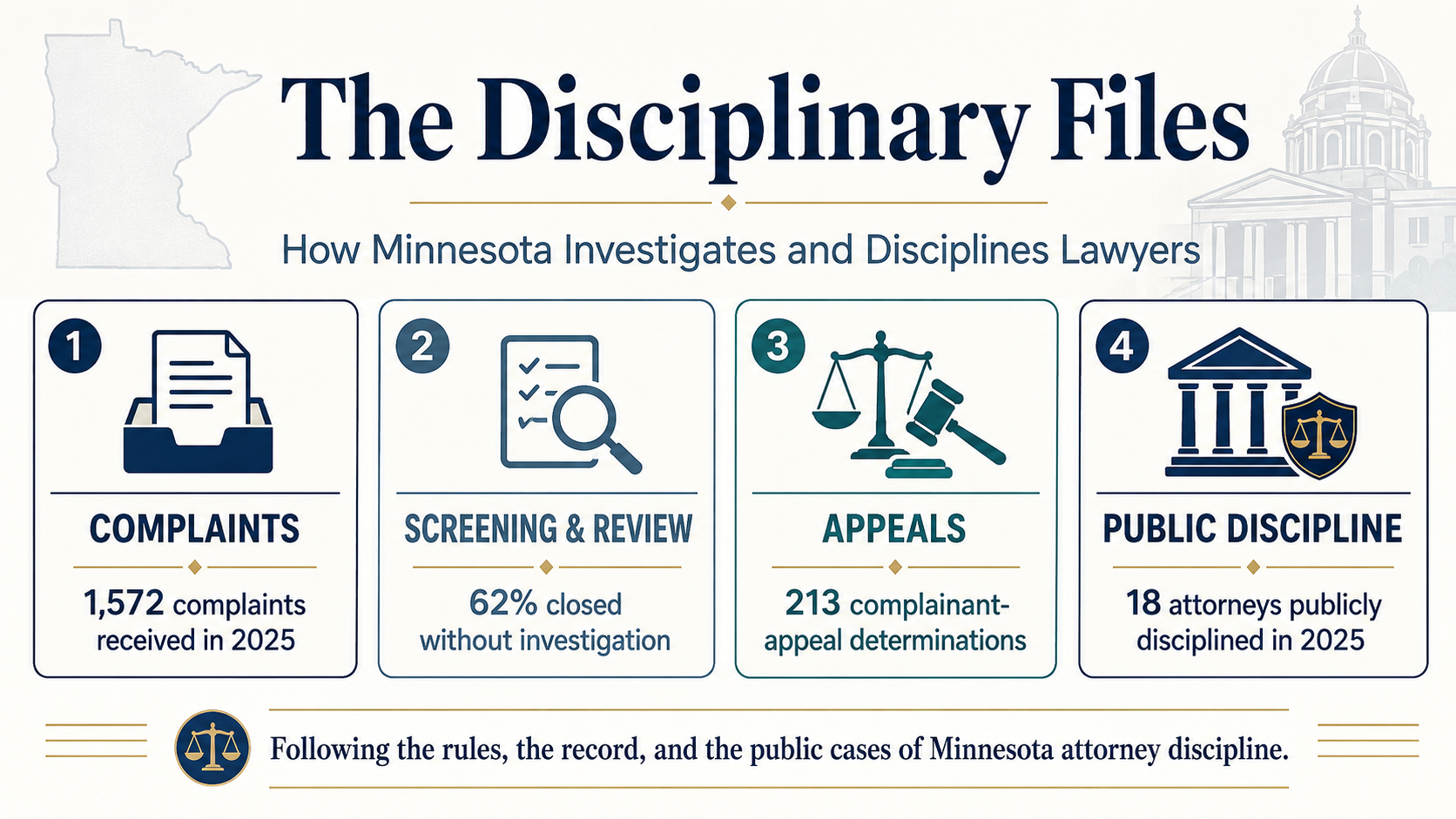
- The OLPR received 1,572 complaints, compared with 1,278 in 2024—an increase of approximately 23 percent.
- The report states that no year in the preceding 25 years produced more complaints.
- The Office closed 1,491 files.
- The reported year-end inventory reached 681 open files.
- 261 files had been open for at least one year, compared with 218 at the end of 2024 and 122 at the end of 2021.
The report states that a record 62 percent of complaints were closed without investigation because the complaint did not provide a reasonable belief that misconduct may have occurred or because an applicable policy required dismissal.
The Board issued 213 complainant-appeal determinations during 2025. The Director’s disposition was approved in 188 matters. Six were returned for further investigation, one resulted in a direction to issue an admonition, one resulted in a new file, and the remaining matters were withdrawn, untimely, nonappealable, or otherwise procedurally resolved.
At the disciplinary end of the process, the report states that:
- 18 attorneys received public discipline in 2025;
- six were disbarred;
- eight were suspended;
- one received a reprimand and probation;
- three received public reprimands; and
- the OLPR issued 92 private admonitions.
These figures should not be converted into a simple discipline rate.
Complaints received, files closed, lawyers disciplined, rule violations, Supreme Court proceedings, and disciplinary decisions are different units. One lawyer may be associated with multiple complaint files. A public disciplinary proceeding completed in one year may have begun with complaints filed years earlier. One disposition may involve multiple rules or multiple clients.
The numbers nevertheless reveal the operating environment: record intake, a growing inventory, more aging files, a high level of preliminary dismissal, and a comparatively small public portion of the disciplinary system.
The Confidentiality Boundary
Most of Minnesota’s lawyer-discipline system operates outside public view.
Under Rule 20 of the Rules on Lawyers Professional Responsibility, pending complaints, dismissed matters, investigative files, private admonitions, and private probation generally remain confidential unless a specified exception applies.
Confidentiality serves legitimate purposes. A lawyer should not suffer public reputational harm merely because someone submitted an unsupported complaint. Clients and witnesses may also provide sensitive information that should not automatically become public.
But confidentiality creates an unavoidable information gap.
The public receives annual totals and descriptions of the system, but ordinarily cannot examine the records behind individual dismissals, private dispositions, or pending investigations. It may be impossible to determine from public information:
- what evidence was submitted;
- what additional evidence was requested;
- which documents or transcripts were reviewed;
- how disputed facts were evaluated;
- why one allegation was investigated while another was not;
- how similar allegations were treated in different matters; or
- whether an appeal involved a genuinely independent reconsideration of the record.
The Disciplinary Files will not treat that lack of public information as proof of wrongdoing.
It will treat it as a transparency limitation that must be acknowledged whenever conclusions are drawn from aggregate statistics or nonpublic outcomes.
The Public Record: OLPR Lawyer Search and P-MACS
Public attorney-discipline matters can be researched through two important Minnesota resources.
OLPR Lawyer Search
The OLPR Lawyer Search allows the public to determine whether a Minnesota lawyer has received public discipline, has been placed on disability-inactive status in lieu of discipline, or has a public disciplinary petition pending.
It does not disclose private discipline, dismissed complaints, or confidential pending investigations.
P-MACS
The Minnesota Appellate Courts Case Management System—Public View, commonly known as P-MACS, provides docket information for proceedings before the Minnesota Court of Appeals and Minnesota Supreme Court.
To locate public attorney-discipline proceedings, a useful search is:
- Case Type: Attorney
- Case Subtype: Discipline
P-MACS ordinarily excludes closed or archived cases from a search unless the user clears the “Exclude Closed/Archived” option. Deselecting that option makes it possible to locate a broader historical set of disciplinary proceedings.
A P-MACS case record may identify:
- the lawyer and appellate case number;
- the date the proceeding was opened;
- the attorneys appearing in the matter;
- petitions, answers, motions, and other docket entries;
- referee appointments and reports;
- hearing or argument information;
- Supreme Court orders and opinions; and
- the final disposition of the proceeding.
Not every listed document is necessarily available for remote download. Some public appellate documents may require access through a courthouse terminal, the State Law Library, or a records request.
P-MACS nevertheless provides an important window into the portion of Minnesota’s disciplinary system that has become public.
What Public Discipline Cases Can Teach Us
Attorney-discipline decisions do more than determine whether one lawyer may continue practicing law.
They show how Minnesota interprets the ethical obligations governing the profession. They identify conduct the Supreme Court considers serious. They explain how prior discipline, multiple offenses, client harm, cooperation, remorse, restitution, mental-health concerns, experience, and other aggravating or mitigating circumstances affect the sanction.
The cases can help answer questions such as:
- What conduct results in private rather than public discipline?
- When does neglect become serious enough to warrant suspension?
- How does the Court address false statements to clients, courts, investigators, or opposing parties?
- What sanctions follow the mishandling or misappropriation of client funds?
- How are confidentiality violations treated?
- What happens when a lawyer fails to cooperate with a disciplinary investigation?
- How does the system address evidence destruction, discovery misconduct, or disobedience of court orders?
- When is probation considered sufficient?
- When does repeated misconduct lead to suspension or disbarment?
- Are comparable forms of misconduct treated consistently across cases?
No single case provides a complete answer. Discipline is highly dependent on the facts, the lawyer’s disciplinary history, the number of clients or matters involved, the harm caused, and the presence of aggravating or mitigating circumstances.
But patterns become visible when cases are examined together.
Why Discipline Deserves Its Own Series
Justice-Denied.org already examines several related parts of the justice system.
The Candor Files examines whether statements made to a tribunal fairly match the law, evidence, and record.
The Fairness Files examines whether courts apply legal standards, procedural protections, evidentiary rules, and opportunities to be heard consistently and impartially.
The Privacy Files examines the treatment of confidential records, medical information, genetic data, and other sensitive materials brought into litigation.
The Disciplinary Files addresses a different question:
What happens when alleged attorney misconduct enters Minnesota’s professional-accountability system?
That question includes far more than the final sanction.
It includes how complaints are screened, how evidence is gathered, how lawyers respond, how complainants are informed, how appeals are reviewed, when a matter becomes public, what is placed before the Supreme Court, and how the final discipline compares with sanctions imposed in similar cases.
It also includes the cases that do not reach a public decision—and the limits confidentiality places on understanding why.
How This Series Will Work
Articles in The Disciplinary Files may focus on a particular disciplinary case, a category of misconduct, a procedural rule, a statistical pattern, or a broader question about Minnesota’s regulatory system.
Where appropriate, articles will examine:
- The issue: What conduct or disciplinary process is being examined?
- The governing rules: Which Rules of Professional Conduct and Rules on Lawyers Professional Responsibility apply?
- The procedural path: How did the matter move from complaint, investigation, or petition to its eventual disposition?
- The public record: What do the petition, response, motions, referee findings, orders, and opinions show?
- The findings: Which allegations were admitted, stipulated, proven, rejected, or left unresolved?
- The sanction: What discipline was imposed, and what reasons did the Court provide?
- The comparison: How have similar forms of misconduct been treated in other Minnesota cases?
- The transparency question: What can the public verify, and what remains confidential or unavailable?
- The public-interest question: What does the matter reveal about protection of clients, integrity of the courts, consistency of enforcement, and confidence in the legal profession?
The goal will not be to begin with a desired conclusion and search for supporting examples.
The goal will be to follow the rules, the docket, the documents, and the findings.
What This Series Does — and Does Not — Claim
The Disciplinary Files will be based primarily on public records, official reports, court rules, disciplinary petitions, referee findings, Supreme Court orders and opinions, and other identifiable sources.
The series does not claim that every dissatisfied client has a valid ethics complaint. It does not assume that every legal error is professional misconduct. It does not treat every aggressive argument as dishonesty, every missed deadline as neglect warranting discipline, or every adverse result as evidence that the opposing lawyer acted improperly.
It will also not assume that every disciplinary allegation has been proven merely because the OLPR filed a public petition.
The series will attempt to distinguish among:
- an allegation of misconduct;
- a disputed factual claim;
- a private administrative disposition;
- a referee’s finding;
- a stipulation between the parties;
- a Supreme Court determination;
- a reasonable inference from the public record; and
- a question the available evidence does not answer.
Those categories are not interchangeable.
At the same time, the existence of a disciplinary system should not place that system beyond examination. The OLPR, the LPRB, District Ethics Committees, disciplinary referees, and the Minnesota Supreme Court all exercise responsibilities that affect lawyers, clients, courts, and public confidence.
Their work should be examined carefully, accurately, and fairly.
What Professional Accountability Requires
Professional accountability requires more than the existence of ethical rules and a process for receiving complaints. It requires a system whose methods and public results demonstrate that the rules are applied carefully, consistently, and fairly.
At a minimum, professional accountability requires this:
- If serious misconduct is alleged, the available record should be examined carefully enough to determine what actually occurred.
- If a complaint does not warrant investigation, the disposition should rest on an accurate understanding of the allegations, evidence, and governing rules.
- If additional information is reasonably necessary to evaluate a complaint, the complainant should receive a meaningful opportunity to provide it.
- If an attorney disputes an allegation, that attorney should receive fair notice and a meaningful opportunity to respond.
- If comparable misconduct receives different treatment, the material differences should be identifiable and the resulting discipline should be explainable.
- If misconduct affects a court proceeding, client property, confidential information, or the truthfulness of the record, the response should reflect the seriousness of the harm.
- If a complainant seeks review of a disposition, the review should provide genuine, independent consideration of the issues raised.
- If confidentiality prevents public examination of individual matters, aggregate reporting should be sufficiently clear, complete, and internally consistent to permit meaningful evaluation of the system.
- If public discipline is imposed, the public record should explain what occurred, which rules were violated, and why the sanction protects the public and the integrity of the profession.
- If the discipline system itself appears inconsistent or incomplete, its public rules, reports, proceedings, and decisions should remain open to careful, evidence-based scrutiny.
Professional accountability is not preserved by assuming that every complaint is valid, every accusation is proven, or every disciplinary decision is mistaken.
Neither is it preserved by treating the lawyer-discipline system as an internal professional matter that should be accepted without examination.
It is preserved by demonstrating—through fair procedures, accurate record review, consistent enforcement, and understandable public decisions—that the ethical rules governing Minnesota lawyers protect clients, courts, and the administration of justice.
