

Distorting the Law
Defamation Per Se Is Not a Criminal Pleading Exercise
Judge Kevin Miller suggested that whether a statement accuses someone of a crime “naturally turns” on the actual elements of that crime. Minnesota law says otherwise.
In our case, Stevenson v. Stevenson (56-CV-20-2928), Judge Kevin Miller did not merely decide that certain statements fell short of defamation per se. He adopted a much broader and more troubling premise: that whether a statement is reasonably understood as accusing someone of a crime “naturally turns, in part, on the actual elements of that crime.” That may sound subtle. It is not. It changes the question entirely.
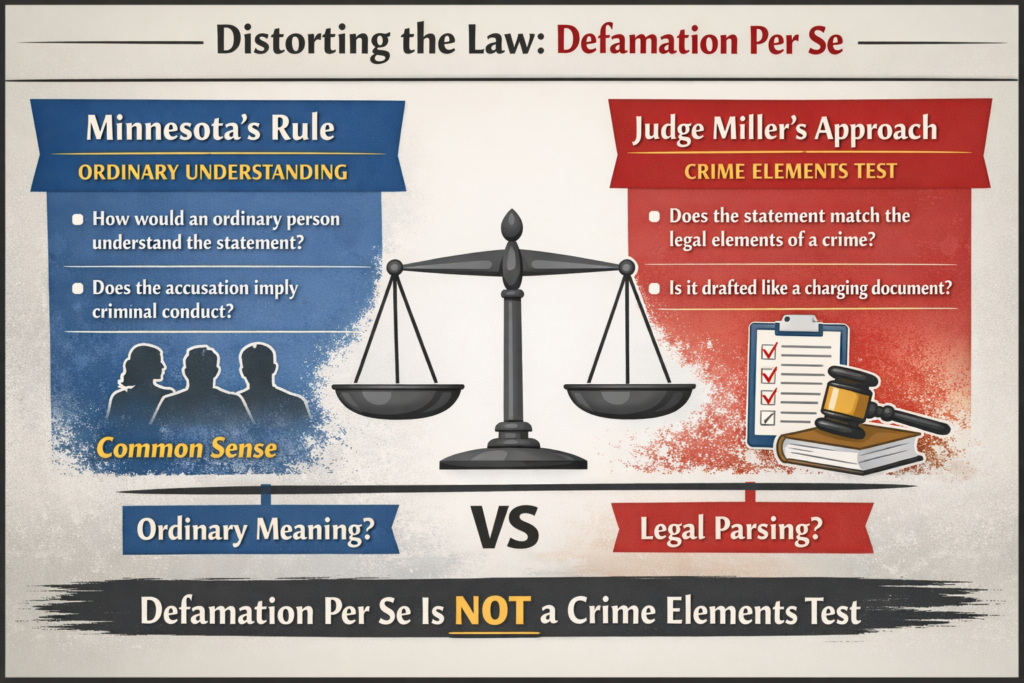
Under that approach, defamation per se begins to look less like defamation law and more like a criminal pleading exercise. Instead of asking how ordinary people would naturally understand the accusation, the court starts asking whether the challenged words neatly line up with enough statutory elements of a specific offense. That is not the governing Minnesota rule. It is a distortion of it.
This issue arose openly at the summary judgment hearing. Judge Miller asked whether courts, after determining what an ordinary person would infer from a statement, then look to the “particular elements of a crime” to decide whether the statement is actionable per se as an accusation of crime. Plaintiffs’ counsel answered directly that the statement does not need to “set forth the full definition of the crime itself,” and that a defamatory statement can imply crimes such as false imprisonment, murder, or conspiracy to commit murder without reading like a charging document.
THE COURT: “… courts have looked to the particular elements of a crime to determine if what is stated or implied is actionable per se on the basis that it alleges a crime. Is that the correct standard…?”
MR. SCHAAP: “The statement alleges or implies a crime. So, if the statement itself doesn’t need to set forth the full definition of the crime itself…. the statement itself is not as rote as the elements of a crime. That is not the … required.”
Despite that warning, Judge Miller embraced the very framework Plaintiffs had rejected. And once that framework was adopted, the rest of the analysis became much easier to shrink, compartmentalize, and dismiss.
Minnesota’s Actual Test: Ordinary Meaning, Context, and the Reasonable Reader
Minnesota defamation law does not begin with a checklist of criminal elements. It begins with common sense.
More than a century ago, the Minnesota Supreme Court explained the rule in plain language in Stroebel v. Whitney: courts are to understand allegedly defamatory words as other people would. The question is how ordinary people would naturally understand the language. The Court went even further and rejected the notion that words must necessarily bear a criminal import in some rigid technical sense in order to be actionable per se. If, in ordinary usage and in context, the words would naturally and presumably be understood as charging a crime, that is enough.
That is the core principle. Not statutory parsing. Not element-by-element criminal analysis. Not whether the speaker happened to phrase the accusation with the precision of an indictment. The controlling question is what the words would mean to ordinary listeners or readers in the real world.
That principle did not disappear with time. Minnesota cases continued to frame the issue in terms of ordinary acceptance, context, and what a reasonable person would understand. In Longbehn v. Schoenrock, the Minnesota Court of Appeals reiterated that words need not directly impute a crime if they would naturally and presumably be understood as doing so. In Anderson v. Kammeier, the Minnesota Supreme Court treated the issue as one of how ordinary listeners would understand the challenged words, not whether the speaker had neatly supplied the statutory elements of an offense.
That is precisely why Judge Miller’s formulation is so consequential. Once the court says the issue “naturally turns” on the actual elements of the crime, the center of gravity shifts. The ordinary reader moves out of focus. Technical legal parsing moves in.
When the Current Law Was Easy to Find
This was not a situation where the governing law was obscure, buried, or difficult to locate. Plaintiffs’ research showed that a simple Westlaw search limited to Minnesota cases for “defamation per se” returned dozens of results, with Longbehn v. Schoenrock appearing at the top.

More importantly, Plaintiffs had already cited Longbehn in their briefing. The problem, then, was not that current Minnesota law was unavailable. The problem was that it was available, cited, and then not meaningfully applied.
Judge Miller’s own order confirms the point. Before announcing his “actual elements of a crime” formulation, the order cited modern and longstanding Minnesota authority recognizing the ordinary-meaning test, including Longbehn, Ernster, Larson, Stroebel, and Anderson. Those cases ask how an objectively reasonable person would understand the words in context. Yet after citing that rule, the order pivoted to a different one: that whether a statement alleges a crime “naturally turns, in part, on the actual elements of that crime.” That was not a faithful application of the rule he had just summarized. It was a substitution.
That is what makes the issue more than a disagreement over old versus new cases. Judge Miller did not merely overlook modern authority. He cited it. Then he effectively bypassed it. A court does not apply controlling law simply by naming it before moving on to something else.
What Schmidt v. Witherick Actually Shows
Judge Miller relied on Schmidt v. Witherick, an 1882 case involving an accusation that someone had “sworn falsely” in court. The order treated Schmidt as though it stood for a broad rule: that courts must look to the elements of a crime, and that if enough of those elements are not apparent, there is no defamation per se.
That is too much weight to place on a very narrow case.
Schmidt addressed a peculiar accusation tied to the crime of perjury. The problem there was that saying someone “swore falsely” does not necessarily mean the person committed perjury. A witness can say something false and still be mistaken rather than deliberately lying. Because perjury requires willfulness, the Court concluded that the phrase used in that case did not necessarily accuse the plaintiff of that crime.
That is a narrow ambiguity problem. It is not a general rule that defamation per se always rises or falls on a formal crime-elements checklist.
In fact, Schmidt itself undercuts the sweeping use Judge Miller made of it. The case acknowledged that saying a person “swore falsely” may be intended to convey the imputation of perjury and, when so understood, may be actionable. In other words, even Schmidt did not reduce the inquiry to mechanical element counting. Meaning still depended on how the accusation would be understood.
So yes, a court in a narrow case may consult the substance of a crime to decide whether a particular phrase actually conveys that accusation. But that is very different from saying that defamation per se generally “naturally turns” on the actual elements of the crime. The former is limited and contextual. The latter is a distortion.
Even Minnesota’s Older Cases Do Not Support Judge Miller’s Broad Rule
The problem with Judge Miller’s analysis is not merely that he cited old cases. Old cases can still be good law. The problem is that he used those cases to support a proposition broader than they support.
Minnesota’s older decisions repeatedly return to the same idea: ordinary understanding. They do not require the plaintiff to prove that the defendant’s words recited each element of a crime in technical terms. To the contrary, Minnesota precedent recognizes that words can be actionable if they would naturally and presumably be understood, under the circumstances in which they are used, as charging criminal conduct. That same ordinary-meaning approach appears in Larson v. R.B. Wrigley Co. as well.
That is exactly what makes Judge Miller’s formulation so revealing. If Minnesota law already supplied the ordinary-meaning rule, why replace it with an “actual elements” rule? Why shift from what ordinary people hear to what lawyers can dissect?
The answer is not flattering. A rigid element-based approach makes dismissal easier. It narrows the claim before the facts are ever viewed through the eyes of ordinary readers. It substitutes technicality for common sense.
Other Courts Have Discussed Crime Elements—But That Does Not Save the Analysis
To be completely fair, Judge Miller was not drawing on a concept that appears nowhere in American law. Some courts outside Minnesota have discussed whether allegedly defamatory statements include the essential elements of a crime. But that does not establish that Minnesota uses that as its governing rule, and it certainly does not justify elevating that idea above Minnesota’s ordinary-meaning cases.
Rhode Island, for example, has language suggesting that when a statement does not expressly accuse someone of a crime, courts may ask whether the essential elements are alleged. See Marcil v. Kells. But even there, later decisions recognized an important limitation: when the speaker expressly accuses the plaintiff of a crime, the law does not require the accusation to spell out each element with technical precision. See Brown v. West Warwick Housing Authority. That alone shows how limited the “all elements” concept really is.
Virginia cases cut even more sharply against Judge Miller’s framework. They recognize that statements can be defamatory per se when they naturally and presumably would be understood as charging a crime, even if the speaker did not draft the accusation like a criminal statute. See Schnupp v. Smith and Hatfill v. New York Times Co.. The point is implication and understanding, not rote recitation.
Illinois has perhaps explained the problem best. In Dobias v. Oak Park, the court recognized both sides of the issue. A statement need not state the elements of a crime with the precision of an indictment so long as it fairly imputes a crime to the reasonable reader. And conversely, just because a statement might technically line up with the elements of an offense does not automatically mean a reasonable reader would understand it as a criminal accusation. That is exactly the insight missing from Judge Miller’s analysis.
So the better, more accurate conclusion is not that no court has ever discussed crime elements in a defamation-per-se context. The better conclusion is this: some courts have discussed that issue in narrow settings, but Minnesota’s governing rule still turns on ordinary meaning, context, and the reasonable reader. Judge Miller elevated a limited and highly qualified concept into a broad rule that Minnesota law does not adopt.
Why This Distortion Matters
This is not a mere academic disagreement over wording. The legal frame matters because it determines what gets dismissed and what reaches a jury.
If the test is ordinary meaning and context, then the court must confront how real people would understand the accusation. Would ordinary readers understand the words as accusing someone of theft? Abuse? False imprisonment? Violent criminal conduct? That is the real reputational question.
If the test instead “naturally turns” on the actual elements of the crime, the inquiry becomes narrower, colder, and easier to manipulate. The court can take an accusation that is plainly defamatory in ordinary life and dissolve it into technical fragments. It can say, in effect, that because the speaker did not supply enough legal detail, the accusation no longer counts as an accusation of crime at all.
And that is exactly why defamation law traditionally focuses on ordinary meaning. Because reputational harm occurs in the world of ordinary understanding, not in the artificial world of post hoc statutory parsing.
The Real Limitation Here Is Narrower
There is, however, an important distinction worth acknowledging. Not every sinister statement about crime qualifies as defamation per se. Some courts have distinguished between accusing someone of having committed a crime and saying only that the person had the intent, design, or capacity to commit one. That is a real limitation, and it can matter in close cases. See, e.g., Clemente v. Espinosa.
But that is a much narrower issue than the one Judge Miller framed. A court may legitimately debate whether saying someone was “capable” of murder is the same as accusing that person of murder. That is a specific question about the content of a specific accusation. It does not justify replacing Minnesota’s broader ordinary-meaning framework with a general rule that defamation per se turns on the actual elements of the crime.
In other words, the harder question in this case may have been how particular statements should be understood. The distortion occurred when Judge Miller changed the governing lens through which those statements were analyzed.
Distorting the Law
Judge Miller’s order gave lip service to Minnesota’s ordinary-meaning cases, but then shifted the real work of the analysis onto something else entirely: the actual elements of a crime. That is not a faithful application of Minnesota defamation law. It is a reframing of it.
And that reframing matters because once the court adopted it, Plaintiffs were no longer arguing on the field Minnesota law actually provides. The ordinary reader was sidelined. Technical criminal parsing took center stage. The result was predictable: accusations that would naturally strike ordinary people as criminal were treated as legally insufficient because they did not read enough like statutory elements.
That is not neutrality. That is not common sense. And it is not the Minnesota rule.
Defamation per se is not supposed to be a criminal-law pleading contest. It is supposed to ask a simpler and more honest question: what would ordinary people understand the accusation to mean?
Judge Miller changed that question. Then he answered the one he had invented.
That is why this belongs in the Distorting the Law series.
What Judicial Fairness Requires
In the end, judicial decisions do not preserve public trust merely by reaching an outcome. They preserve it by showing the parties — and the public — that justice was done.
Minnesota’s own Code of Judicial Conduct sets that expectation. It requires judges to perform their duties fairly and impartially, and explains that fairness requires a judge to be objective and open-minded.
That is not a technicality. It is the foundation of public trust. The Minnesota Supreme Court has said the same in equally clear terms: a judge must promote public confidence in the judiciary, avoid impropriety and the appearance of impropriety, and perform judicial duties in a way that assures parties their case is being fairly judged.
“[I]mpartiality is the very foundation of the American judicial system.”
“To maintain public trust and confidence in the judiciary, judges should avoid the appearance of impropriety and should act to assure that parties have no reason to think their case is not being fairly judged.”
Greer v. State, 673 N.W.2d 151, 155 (Minn. 2004);
Pederson v. State, 649 N.W.2d 161, 164–65 (Minn. 2002).
And fairness is impossible when a judge stops being objective, stops being open-minded, or gives the parties reason to doubt that the law was applied with impartial care.
This article is part of Justice-Denied.org’s ongoing Distorting the Law series examining how legal standards, quotations, and precedent were handled in Stevenson v. Stevenson.
