

“We Told the Other Side to Pound Sand”
Sean Stevenson’s Deleted Patrick Burns Review
Sometimes a single document reveals far more than the party who created it ever intended.
In our case, one of those documents was a public Google review that Sean Stevenson of Rosemount, Minnesota, posted about attorney Patrick C. Burns before this lawsuit began — and later tried to hide before ultimately deleting it after litigation started.
That review mattered for several reasons.
It was relevant. It was discoverable. It was never produced by Defendants. And when Sean was finally confronted with it under oath, his testimony exposed yet another gap between what Defendants had said during discovery and what the evidence actually showed.
On November 20, 2020 — just one day after this lawsuit began — we independently discovered that Sean had posted a public review discussing the dispute.
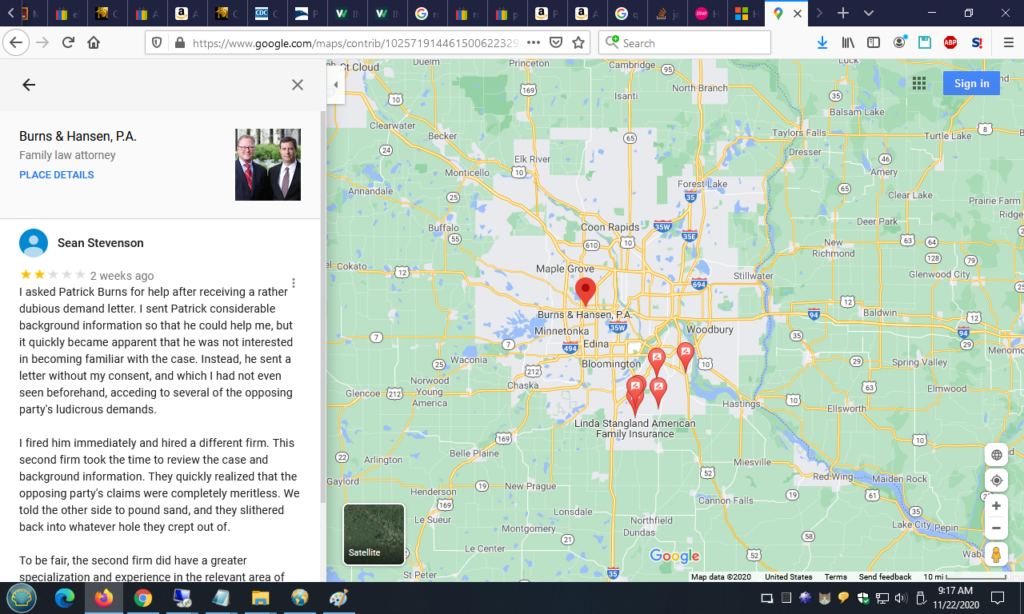
On November 22, 2020, we preserved it in a date-and-time-stamped screenshot and waited to see whether Sean, Lisa, Renee, or Ashley would disclose it during discovery.
Not Sean. Not the other Defendants. Not anyone.
And this was not some trivial side issue. The review directly referenced the demand letter that preceded the lawsuit — including demands Sean mockingly described as “ludicrous.” One of those demands was that he stop contacting Marie’s estranged and abusive father, conduct that had deeply frightened and traumatized her.
The irony is impossible to ignore. If Sean had listened to Patrick Burns instead of ridiculing the demand letter as “ludicrous,” there likely would have been no lawsuit at all. The review showed more than contempt — it showed that an opportunity to stop the conduct, prevent further harm, and avoid litigation was deliberately rejected. Sean did not describe an effort to resolve the matter. He bragged that “we told the other side to pound sand.”
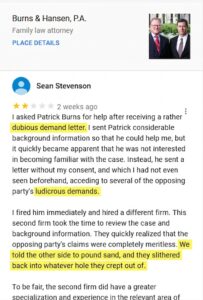
Sean’s own words were revealing:
“We told the other side to pound sand, and they slithered back into whatever hole they crept out of.”
That was not the language of someone acting cautiously, neutrally, or independently. It was the language of contempt.
It was also the language of someone speaking in the plural.
“We told the other side to pound sand.”
Who was “we”?
During his deposition, Sean later admitted that this statement referred generally to the Defendants. He also admitted that “they slithered back into whatever hole they crept out of” referred to the Plaintiffs — Craig and Marie. In other words, this was not vague commentary about a law firm. It was a public statement about us and about the underlying dispute. It was evidence. And it should have been produced.
According to the evidence we preserved, Sean first attempted to hide the review from public view on or about December 6, 2020. After that failed to remove it entirely, he deleted it on or about December 14, 2020 — after the lawsuit had already begun and months after the duty to preserve evidence had attached.
Sean Was Caught Lying Under Oath
That timing matters.
It matters because when Sean was finally questioned under oath on February 28, 2022, he did not simply fail to remember the review. He denied in substance at least three times that he had made any public post about Plaintiffs or the subject matter of the case. He also denied deleting evidence repeatedly throughout his deposition before the record forced admissions he could no longer avoid.
The impeachment sequence was stark:
Q. Did you post any public comments on the internet regarding Craig and Marie or the subject matter of this litigation?
A. I don’t believe I did.Q. You were asked as part of the discovery requests to produce any articles or public comments that you made to the public that included statements made by you about plaintiffs or the subject matter of the civil action, and your response was “None.”
A. Correct.Q. Is it true that you never made a public post about this case or the subject matter or the underlying facts?
A. I don’t remember doing so.
Sean was then shown Plaintiffs’ copy of the Patrick Burns review.
Q. Are you the Sean Stevenson that’s shown as the author of this review of the Burns & Hansen law firm?
A. Yes.Q. And you posted this review on this law firm’s website?
A. Yes.Q. Did you attempt to hide this review?
A. No.Q. Did you delete this review?
A. Yes.
That testimony did not expose a misunderstanding. It exposed a pattern: denial first, admission only when confronted with the document itself.
The False Testimony Was Not Promptly Corrected
That timing problem did not end with Sean’s first deposition.
Sean was first deposed on February 28, 2022. Yet months passed before Defendants formally disclosed to the Court that his testimony about deleted messages had been false. In the meantime, discovery continued.
That delay is especially striking because Plaintiffs had already pointed out the forensic red flags. In a June 22, 2022 letter, Plaintiffs identified messages marked with trash can icons in the forensic production — visual indicators that some messages had been deleted. Five days later, on June 27, 2022, attorney Ross Tentinger acknowledged in writing that several text messages had in fact been deleted after litigation began. He also stated that he was reviewing Sean’s deposition testimony and interrogatory answers for what needed to be revisited, and that Sean would have to be placed back on the record to correct it.
But the Court was not informed until September 14, 2022. In his letter to Judge Miller on that date, Mr. Tentinger stated that, following Sean’s February 28 deposition, Sean had informed him that some of his answers about deleted messages were “not accurate.”
That chronology matters. According to the deposition schedule, eight other depositions took place between Sean’s first deposition and Mr. Tentinger’s June 27 letter (four of which were for the other Defendants in the case), and nine took place before his September 14 letter to the Court. Sean’s second deposition did not occur until October 12, 2022.
In other words, Sean’s false testimony was not promptly corrected when the issue first arose. The correction came only after Plaintiffs highlighted the forensic evidence and after months of discovery had continued under a false record.
The “No Knowledge” Claim Collapsed
Defendants’ own limited production included a September 18, 2020 text exchange between Renee and Sean about the review. Renee told him, “Dont [sic] write the review until after you get the bill.” Sean responded, “Not planning on doing it for a while. No hurry on my end.”
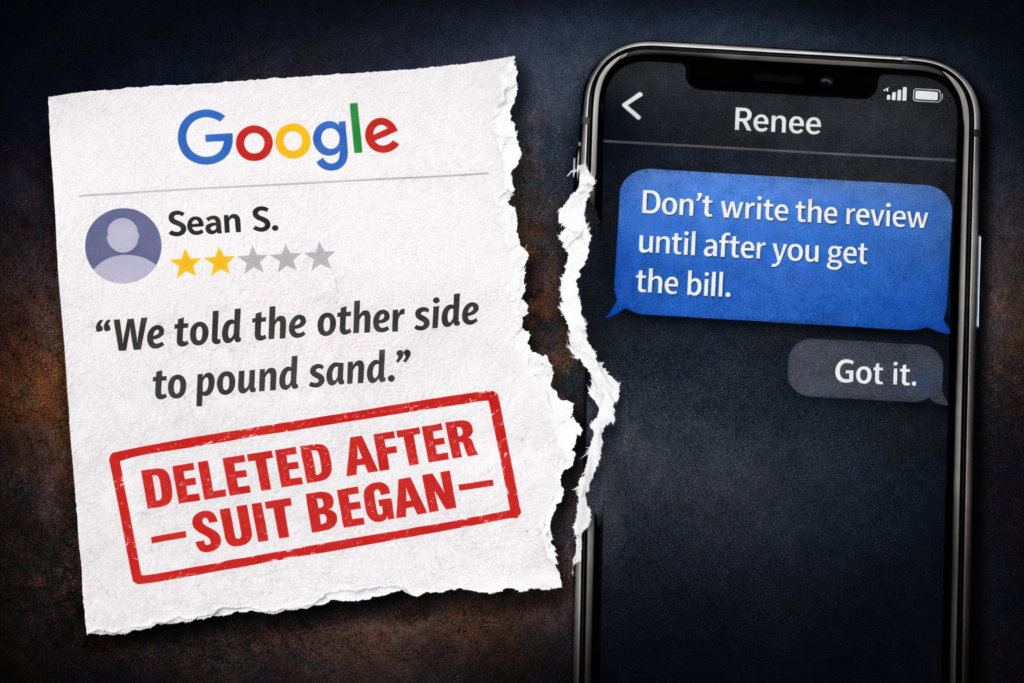
That text was devastating for a simple reason: it showed that Sean’s claim that the other Defendants knew nothing about the review was not true.
It also raised an obvious question: if that one text existed, what else existed?
The Review Opened the Door to a Bigger Spoliation Question
By the time Defendants finally produced those review-related texts on May 4, 2022, they had already withheld them for roughly 17 months. That delay was not harmless. It suggested that relevant inter-defendant communications existed, were responsive, and were not being fully disclosed. It also strengthened the inference that other messages we were seeking likely still existed at that time — and may have been deleted later.
We were not seeking them out of curiosity. We were seeking them because they could have helped establish when the pre-litigation texts were deleted, who knew about the deletions, and whether evidence preservation obligations were being ignored in real time after litigation began.
That is not a fishing expedition. That is how spoliation is investigated.
At the November 7, 2022 hearing, Plaintiffs’ counsel made the point directly: if parties talked after the case began about deleted evidence, or about whether someone had deleted text messages, those communications were not beyond legitimate inquiry simply because they occurred after the complaint was filed.
Yet even with this evidence in the record — a preserved public review, a hide-and-delete timeline, sworn deposition admissions, and a text proving at least one other Defendant knew about the review before it was posted — Otter Tail County District Court Judge Kevin M. Miller still refused to allow us any access to the post-litigation inter-defendant text messages that could have helped answer the most important question:
That refusal speaks volumes.
The Court Recognized Sean’s Misconduct — But Still Closed Off the Trail
Judge Miller’s December 6, 2022 order did not exonerate Sean Stevenson. It granted Plaintiffs’ spoliation motion against Sean in part, ordered Sean to pay the costs and fees incurred in Plaintiffs’ forensic examinations of Renee’s and Lisa’s phones, and stated that the Court found it “especially significant” that Sean had lied under oath about deleting text messages.
The order also acknowledged that Sean’s prior testimony that he had not intentionally deleted text messages was inaccurate, and that he later testified he deleted messages in the weeks after receiving Plaintiffs’ initial complaint because he felt I would “twist” them.
That should have mattered more than it did.
Because even after recognizing that misconduct, the Court still described Plaintiffs’ evidentiary prejudice as “minimal or nonexistent,” denied an adverse-inference instruction, and refused to allow the broader access to post-litigation inter-defendant communications that could have helped determine whether the deletion of earlier messages was later discussed, coordinated, or concealed.
That is what makes the ruling so troubling. Once a party admits deleting messages after litigation begins, and once the Court finds that he lied under oath about it, the obvious next question is whether those deletions were later discussed among the Defendants. That was the trail Plaintiffs were trying to follow — and it was the trail the Court kept closed.
Because once the review surfaced, this was no longer about speculation. We were no longer asking the Court to act on instinct, suspicion, or unsupported belief. We had concrete evidence that relevant communications existed, that relevant evidence had been withheld, that Sean had deleted a public review after litigation began, and that his sworn testimony did not align with the record.
Even so, Judge Miller continued portraying Defendants as if they were acting in good faith, while portraying us as overly aggressive for pursuing discovery.
That inversion is one of the most troubling patterns in this case.
When litigants produce evidence that a party withheld relevant documents, deleted discoverable material, and gave false or misleading testimony about both, courts should tighten scrutiny — not relax it. Discovery is supposed to uncover the truth, not protect parties from uncomfortable questions once the record starts pointing in the wrong direction.
Sean’s deleted Patrick Burns review was not just a nasty public insult. It was a window into coordination, concealment, and credibility. It showed that Defendants’ discovery conduct could not simply be taken at face value. It showed that their narrative was incomplete at best. And it showed why access to later inter-defendant communications was so important.
Because the truth was not in what Defendants chose to produce or what they told the Court.
