

Distorting the Law: Antiquated Cases
This post examines an Otter Tail District Court judge’s use of antiquated case law in his opinions and why it conflicted with newer, better-fitting Minnesota authority.
Not every old case is bad law.
Courts sometimes rely on older decisions because they remain relevant, controlling, and on point. Age alone is not the problem. The problem arises when a court reaches past newer, better-fitting Minnesota authority and instead leans on antiquated, marginal, or ill-fitting cases to justify a desired result.
That is what appears to have happened in our case.
As my research and sworn declaration show, Judge Kevin M. Miller repeatedly cited extremely old authorities—including cases from the 1800s—while newer, prevailing Minnesota law was readily available on the same subjects.
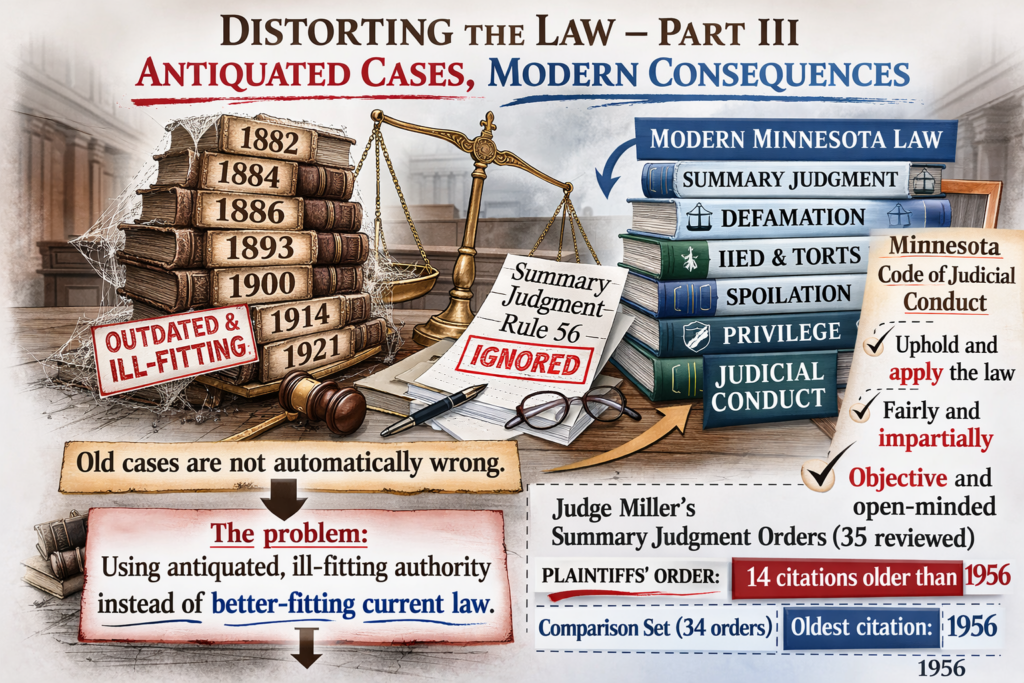
Minnesota’s Code of Judicial Conduct does not permit judges to choose authorities based on convenience or preference. Rule 2.2 states that a judge must “uphold and apply the law” and perform judicial duties “fairly and impartially.” The comment to the rule further explains that, to ensure impartiality and fairness, a judge must be “objective and open-minded.”
That principle matters here because the issue was not simply that Judge Miller cited old cases. The issue was that he appears to have relied on old and ill-fitting cases instead of newer, better-fitting law.
December 6, 2022: Antiquated Cases Used in Key Pretrial Rulings
In the Court’s December 6, 2022 order, Judge Miller cited Hutchins v. Hutchins, 7 Hill 104 (N.Y. 1845) in denying Plaintiffs’ motion to extend discovery.
Whatever place Hutchins may hold in old New York inheritance-related tort law, it is an 1845 New York case from a very different subject area. Its use in a modern Minnesota civil discovery dispute raises an obvious question:
In the same order, Judge Miller cited McGinness v. Sch. Dist. No. 10, 41 N.W. 103 (Minn. 1888) in denying Plaintiffs’ request for an adverse jury instruction tied to spoliation. He also cited State v. Madigan, 68 N.W. 179 (Minn. 1896) in addressing spousal privilege.
But McGinness was not a modern Minnesota spoliation case, and Madigan did not involve spousal privilege. Madigan concerned attorney-client privilege in a very different context. That is the real problem. When a court uses old cases for issues they did not actually address, the problem is not merely historical age. The problem is analytical mismatch.
June 16, 2023: Summary Judgment Built on Antiquated Authority
The concern became even more striking in the Court’s June 16, 2023 summary-judgment order. There, Judge Miller relied on a string of nineteenth- and early twentieth-century cases, including:
- Pratt v. Pioneer Press Co., 28 N.W. 708, 709-10 (Minn. 1886)
- Stroebel v. Whitney, 18 N.W. 98, 98 (Minn. 1884)
- Schmidt v. Witherick, 12 N.W. 448, 449 (Minn. 1882)
- Radke v. Kolbe, 82 N.W. 977, 977 (Minn. 1900)
- Beek v. Nelson, 147 N.W. 668, 669 (Minn. 1914)
- Ernster v. Eltgroth, 182 N.W. 709, 710 (Minn. 1921)
- Bohn Mfg. Co. v. Hollis, 55 N.W. 1119, 1121 (Minn. 1893)
Each of these citations is more than a century old.
Meanwhile, more modern Minnesota authority was available. My research identified Longbehn v. Schoenrock and Maethner v. Someplace Safe, Inc. as prevailing Minnesota authorities for defamation, and Cafferty v. Garcia’s of Scottsdale, Inc. as a leading Minnesota case on intentional infliction of emotional distress.
That is not a trivial difference. The choice of authority shapes the entire analysis. It influences which facts are treated as material, which inferences are permitted, and whether genuine disputes are recognized or explained away.
When a court reaches backward to antiquated or poorly fitting cases instead of applying newer, governing Minnesota authority, the legal analysis itself becomes distorted.
That raises a deeper concern. To an ordinary observer, this pattern does not look like a neutral application of law to fact. It raises an obvious question:
Even the Older Cases Do Not Support the Court’s Rule
The problem runs even deeper. Even the old cases cited by the Court do not support the sweeping rule the Court appeared to announce.
In its June 16, 2023 order, the Court wrote that whether a statement is reasonably construed as alleging a crime “naturally turns, in part, on the actual elements of that crime,” and then relied on Schmidt v. Witherick to support that view. But the Court omitted a critical sentence from Schmidt itself: “Of course, to say that a man swore falsely may be intended to convey to the minds of the hearers the imputation of perjury.”
That omission matters. It shows that Schmidt did not adopt the rigid 19th-century rule the Court seemed to derive from it. Rather, even Schmidt recognized that meaning depends on how words would actually be understood by hearers in context.
Two years later, in Stroebel v. Whitney, the Minnesota Supreme Court explained the governing principle in more practical terms: courts should understand words “as other people would.” The question, the Court said, is “how would ordinary men naturally understand the language?” Stroebel rejected the idea that words must necessarily bear a criminal import in order to be actionable per se, and instead focused on ordinary meaning and common understanding.
That approach did not disappear. In Johnson v. Force (1900), the Minnesota Supreme Court described the Stroebel rule as “very sensible” and reaffirmed that words are actionable per se if, in their ordinary acceptation, they would naturally and presumably be understood as charging a crime. And in Larson v. R.B. Wrigley Co. (1931), the Court again explained that words need not directly state the crime on their face if, in their ordinary acceptance and under the circumstances used, they would naturally be understood as imputing a charge of crime.
That is also the rule reflected in modern Minnesota authority. In Longbehn, the court explained that for a statement to amount to a false accusation of crime, “the words need not carry upon their face a direct imputation of crime” so long as, in their ordinary acceptance and under the circumstances in which they are used, they would naturally be understood as imputing a charge of crime.
In other words, the actual thread running through Minnesota law is not the Court’s hyper-literal, element-by-element approach. It is the opposite: ordinary meaning, context, and how reasonable listeners would naturally understand the words.
The Court’s reliance on Radke is particularly revealing. Radke itself involved alleged slander spoken in German and translated into English in the pleadings. Its historical setting was far removed from a modern defamation dispute. Yet even Radke did not adopt the rigid rule used here. Instead, it framed the question in terms of whether, in the ordinary acceptation of the language, the words would reasonably be understood as imputing a criminal charge.
So the problem is not merely that Judge Miller cited very old cases. The problem is that he cited old cases while ignoring newer, governing law—and in doing so, he used even those old cases more rigidly than Minnesota law itself allowed.
This Was Not Typical
To determine whether Judge Miller’s use of very old case law was typical, I analyzed 35 summary judgment orders he issued between June 1, 2018 and December 31, 2023.
Excluding Plaintiffs’ summary-judgment order, the oldest case cited in the other 34 orders was from 1956. By contrast, Plaintiffs’ summary-judgment order contained 14 citations older than 1956, including 4 citations from the 1800s.
Those older citations were from the following years: 1882, 1884, 1886, 1893, 1900, 1914, 1921, 1927, 1931, 1931, 1934, 1942, 1943, and 1950.
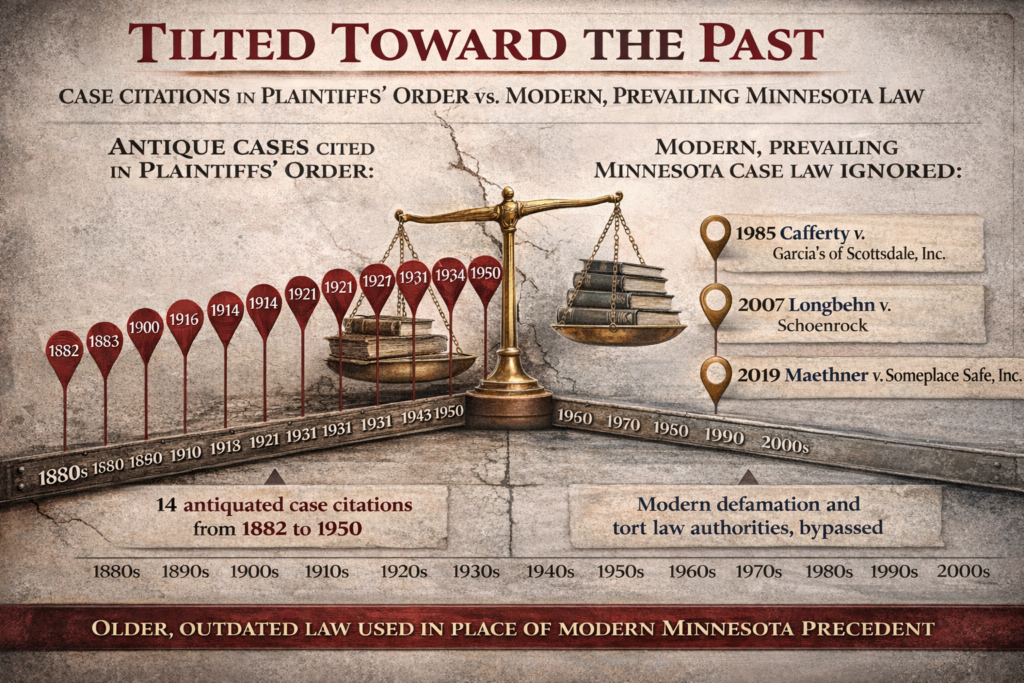
That discrepancy is not subtle. It strongly suggests that Judge Miller’s treatment of Plaintiffs was not typical, even when measured solely by the age of the case law he chose to rely upon.
And that, in turn, raises another unavoidable question:
What Minnesota Law Says About This
This issue should be discussed carefully. Not every legal error is judicial misconduct, and not every citation to an old case is improper. But Minnesota law still provides useful guidance.
In Inquiry into the Conduct of the Honorable John P. Dehen, the Minnesota Supreme Court made clear that legal error does not automatically become misconduct. But the Court also explained that legal error may cross that line when a judge acts contrary to “clear and determined law” and the error is egregious, made in bad faith, or part of a pattern or practice.
The Minnesota Supreme Court also emphasized that treating every judicial mistake as misconduct would go too far: “Something more is required.”
That is an important distinction, and it actually strengthens the point here.
The problem is not that Judge Miller cited an old case once or twice. The problem is that he appears to have bypassed newer, better-fitting, governing authority and instead relied on antiquated and mismatched cases in ways that favored dismissal of Plaintiffs’ claims.
Why This Matters at Summary Judgment
Under Rule 56 of the Minnesota Rules of Civil Procedure, summary judgment is proper only when there is no genuine issue of material fact and the moving party is entitled to judgment as a matter of law.
The court’s role at summary judgment is not to weigh evidence, not to resolve credibility, and not to quietly reshape the law to fit a preferred result. It is to determine whether genuine factual disputes exist under the governing legal standards.
That is why the selection of authority matters so much. If the governing framework is distorted at the outset—by reaching for antiquated or ill-fitting law while overlooking modern, applicable authority—the entire summary-judgment analysis can be skewed from the beginning.
Distorting the Law
Sometimes distortion is obvious. Sometimes it takes the form of a misquotation, an omission, or a concealed inconsistency.
But sometimes distortion begins more quietly.
Sometimes it begins when a judge reaches past modern, better-fitting law and instead excavates something old enough, remote enough, or vague enough to be bent toward a preferred outcome.
That is what makes antiquated citations dangerous in the wrong hands.
The concern in our case is not that Judge Miller cited old cases merely because they were old. The concern is that antiquated and mismatched authorities appear to have been used instead of prevailing or better-fitting Minnesota law.
And when that happens, the law is not being applied fairly. It is being distorted.
What Judicial Fairness Requires
In the end, judicial decisions do not preserve public trust merely by reaching an outcome. They preserve it by showing the parties — and the public — that justice was done.
Minnesota’s own Code of Judicial Conduct sets that expectation. It requires judges to perform their duties fairly and impartially, and explains that fairness requires a judge to be objective and open-minded.
That is not a technicality. It is the foundation of public trust. The Minnesota Supreme Court has said the same in equally clear terms: a judge must promote public confidence in the judiciary, avoid impropriety and the appearance of impropriety, and perform judicial duties in a way that assures parties their case is being fairly judged.
“[I]mpartiality is the very foundation of the American judicial system.”
“To maintain public trust and confidence in the judiciary, judges should avoid the appearance of impropriety and should act to assure that parties have no reason to think their case is not being fairly judged.”
Greer v. State, 673 N.W.2d 151, 155 (Minn. 2004);
Pederson v. State, 649 N.W.2d 161, 164–65 (Minn. 2002).
And fairness is impossible when a judge stops being objective, stops being open-minded, or gives the parties reason to doubt that the law was applied with impartial care.
This article is part of Justice-Denied.org’s ongoing Distorting the Law series examining how legal standards, quotations, and precedent were handled in Stevenson v. Stevenson.
