

Distorting the Law:
The Common Interest Doctrine (2021)
There’s a particular kind of judicial error that isn’t just “wrong.”
It’s the kind that changes the rules midstream—the kind that converts discovery into a guessing game, and turns the words “privilege” and “confidential” into a one-way shield for coordinated defendants.
This post traces a sequence:
- (1) the rule Minnesota courts were applying in 2021,
- (2) how it was applied here, and
- (3) how later orders described that decision.
It focuses on a single discovery ruling in our case—Judge Kevin M. Miller’s December 21, 2021 Order denying all three of our motions to compel (Doc. 154)—and the legal mechanism the Court used to slam the door: the “common interest doctrine.”
Note: This post discusses Minnesota civil discovery rules and the publicly filed court record. It is not legal advice.

What we asked for—and why it mattered
We brought three motions to compel—one for each defendant—after extensive meet-and-confer efforts.
The core problem was simple: the defendants’ discovery responses and privilege logs were thin, vague, and evasive, while objective phone records suggested improper withholding of evidence and extensive behind-the-scenes coordination tied to key events in the case.
It’s to prevent one side from hiding the ball while shaping the record.
What the “common interest doctrine” is supposed to be
In jurisdictions that recognize it, the common-interest doctrine is generally described as a narrow rule about waiver: if a privileged communication is shared with a third party who shares a common legal interest and the disclosure is made to pursue a common legal strategy, the privilege may not be deemed waived by that disclosure.
That matters because it’s not a magic wand that makes everything “privileged.” It’s typically an exception to waiver—and it presupposes an existing attorney-client privileged communication (or work product) in the first place.
But in Minnesota—at the time of Judge Miller’s December 2021 order—the Court of Appeals had already spoken directly and clearly. In Energy Policy Advocates v. Ellison (June 1, 2021), the Court of Appeals stated plainly that the common-interest doctrine was not recognized in Minnesota.
What the defendants argued in our case
In Doc. 154, Judge Miller recited the defendants’ position in sweeping terms:
- Sean: communications among joint defendants are privileged and need not be disclosed.
- Renee: communications between defendants become privileged once litigation begins.
- Lisa: the doctrine applies here and makes post-suit conversations undiscoverable.
At the hearing, defense counsel also attempted to cast Energy Policy Advocates as a “government context” decision—implicitly suggesting it didn’t matter in ordinary civil litigation.
What Judge Miller did with that argument
Judge Miller didn’t just accept the doctrine.
He used it as a blanket bar to discovery into inter-defendant communications—regardless of when they occurred or what they contained—and he cited two cases for the proposition that “the common interest doctrine does apply,” including In re Lawrence.
Then comes the move that defines this series of posts.
Judge Miller attributed this sweeping line to In re Lawrence:
“Conversations amongst joint defendants are privileged and as such the subject of those conversations will not be disclosed.”
In the order, that sentence functions like a holding—used to justify shielding “co-parties conversations” through attorney-client privilege.
Visual comparison (stacked):
1) What Judge Miller’s Order attributes to In re Lawrence (Doc. 154)
“Conversations amongst joint defendants are privileged and as such the subject of those conversations will not be disclosed.”
2) What In re Lawrence actually says (syllabus)
“When an attorney represents more than one client related to a matter, the clients hold a joint attorney-client privilege. Waiver of a joint attorney-client privilege requires consent by all joint clients.”
This is not a “minor cite issue.”
Where that “quote” came from—and why it matters
According to the record summarized in our materials, the “Lawrence quote” wasn’t pulled from Lawrence at all.
It was pulled from defendants’ interrogatory answers, echoed in their opposition memoranda, and then reappeared in a judicial order as though it were Minnesota appellate law.
And the bigger problem: precedential appellate guidance already existed
At the time of Judge Miller’s December 2021 decision, the Minnesota Court of Appeals had already stated in a precedential opinion that the common-interest doctrine was not recognized in Minnesota (in Energy Policy Advocates v. Ellison, filed June 1, 2021).
And it wasn’t just “precedential in theory.” The Court of Appeals later denied an effort to stay the opinion’s precedential effect—confirming that its precedential force was immediate and could not be put “on pause” simply because further review was pending.
The application to our case couldn’t be clearer:
We asked the Court to fix it (Reconsideration #1 — January 2022)
A ruling like that is supposed to be correctable.
So we did what litigants are told to do: we asked the Court to reconsider—politely, directly, and with the controlling Minnesota authority in hand.
On January 7, 2022, our counsel requested leave to file a motion for reconsideration under Minn. Gen. R. Prac. 115.11. The letter explained two core problems:
- The Court’s order did not address Energy Policy Advocates—a precedential Court of Appeals opinion stating repeatedly that the common-interest doctrine was not recognized in Minnesota.
- The Court’s order relied on a misquotation—a sentence attributed to Lawrence that does not appear in that decision and does not describe what Lawrence actually held.
The letter also addressed something that matters in practice: the defendants’ attempt to downplay Energy Policy Advocates by calling it “unpublished,” even though it was precedential.
Not just precedential—immediately precedential
Defendants’ “unpublished” spin matters because it points to a deeper fact: the Minnesota Court of Appeals itself was asked to pause the precedential effect of Energy Policy Advocates—and refused.
In July 2021, the Court of Appeals denied a motion to stay the precedential effect of its June 1, 2021 opinion, and explained that a precedential opinion has immediate precedential force—even while further review is pending.
Defendants’ response (January 10, 2022) did not defend the doctrine as applied. Instead, defense counsel reframed the issue as a “straw man,” asserting that defendants were not claiming the common-interest doctrine shielded pre-litigation communications at all.
On January 18, 2022, Judge Miller denied reconsideration—while adding a clarification: the common-interest ruling “will not apply” to pre-litigation communications between defendants. Access to post-litigation communications between defendants remained blocked.
Another Minnesota court confronted the same issue—and compelled discovery
This wasn’t an unsettled mystery in Minnesota trial courts. During the same time period, another Minnesota district judge faced a similar common-interest claim in a civil case—and handled it very differently.
In Delamarter v. Supercuts (27-CV-19-19280, Hennepin County), the defendant asserted a common-interest / joint-defense privilege to withhold documents. The court did not treat “common interest” as a blank-check privilege shield. It treated it as a waiver doctrine that Minnesota had not yet adopted.
“As the law stands now, Minnesota does not recognize the common interest doctrine.”
And the court drew the practical conclusion that follows from that premise:
“This Court has no option but to grant Plaintiff’s Motion to Compel Discovery.”
Just as importantly, the court treated privilege as something that must be demonstrated—not assumed by labeling:
A document is “not cloaked with the privilege merely because it bears the label ‘privileged’ or ‘confidential.’”
Instead of granting a blanket shield to withheld communications, the court emphasized the burden of proof and the mechanics that make privilege reviewable—privilege logs, and if needed, neutral review. Recognizing that the Minnesota Supreme Court had granted review in Energy Policy Advocates, the court stayed implementation temporarily to avoid irreversible disclosure, but still compelled discovery on existing law and directed the parties to be prepared for special-master review if the Supreme Court later defined the doctrine.
Then the factual foundation cracked (Reconsideration #2 — August–September 2022)
By mid-2022, the story didn’t just remain about legal theory. It became about what the Court was told—and what later evidence suggested was not true.
On August 8, 2022, we submitted a second request for leave to file a motion for reconsideration—this time grounded in new documentary evidence.
The letter explained that the Court’s denial of the motions to compel had relied, in part, on defendants’ representations that they did not have additional written communications in their possession. But after that ruling, a forensic examination of Sean’s phone revealed relevant responsive messages that had not been produced earlier—along with indications that an online review and text messages had been deleted after litigation began.
We also informed Judge Miller that Sean made false statements during his deposition about whether he had posted any public comments about Plaintiffs or deleted any evidence.
We backed it all up with 74 pages of exhibits.
Defendants opposed reconsideration again, arguing we were trying to relitigate old issues and asserting that subsequent forensic production made the dispute “moot.”
The Court denied reconsideration again—refusing permission to file a motion for reconsideration of the December 21, 2021 order.
Then the law changed (Reconsideration #3 — October–December 2022)
On September 28, 2022, the Minnesota Supreme Court issued its decision in Energy Policy Advocates v. Ellison.
That mattered here for one simple reason: the Supreme Court did recognize a common-interest doctrine—but it recognized it in a limited form.
It did not create a blanket rule that “conversations amongst joint defendants are privileged.” It articulated a doctrine tied to otherwise privileged communications—communications protected by attorney-client privilege or work product—and only when made in furtherance of a joint legal strategy.
So we wrote again.
On October 4, 2022, our counsel filed a letter asking the Court to harmonize its December 2021 discovery ruling with the Supreme Court’s newly articulated limits. The request was straightforward:
- Defendants may share otherwise privileged material without waiving privilege,
- but not every post-litigation conversation between co-defendants is “privileged” by default,
- and non-privileged communications about plaintiffs—communications not involving counsel and not reflecting protected legal advice—remain discoverable if relevant and proportional.
This time, Judge Miller granted limited permission to move for reconsideration.
But the permission was narrow: reconsideration would be confined to post-litigation communications between defendants only. The Court required a focused explanation of relevance, discoverability, and proportionality under the Supreme Court’s test.
After the November 7, 2022 hearing and the Court’s later written order, the Court ultimately denied the limited reconsideration request anyway.
Not by reaffirming a blanket “all co-defendant conversations are privileged” rule—but by denying discovery on other grounds: relevance, proportionality, and discretion.
Proportionality—added later
In its December 6, 2022 order, the Court later described its December 2021 motions-to-compel decision this way:
“The Court denied Plaintiffs’ motions, resting its decision, in part, upon the common-interest privilege, and in part on considerations of proportionality.”
That statement matters because the December 2021 order does not actually analyze proportionality. In fact, the word “proportionality” is not used in the entire order. It cites broad-discovery principles, but it does not weigh burden versus benefit, walk through proportionality factors, or explain why the request was disproportionate.
And that omission isn’t academic. Plaintiffs’ motions were not built on speculation; they included evidence that inter-defendant texts existed and were being withheld—especially around key events—based on third-party carrier records that could show that messages were exchanged (but not their contents). Those messages were unavailable from any other source.
“Not available”
In its December 6, 2022 order, the Court offered an explanation for why it permitted a limited reconsideration motion after the Minnesota Supreme Court’s Energy Policy Advocates decision:
“Because arguments stemming from Energy Policy Advocates had not been available at the time of the prior motions, the Court permitted Plaintiffs to move for reconsideration.”
That line is worth pausing on—because the Minnesota Court of Appeals issued a precedential Energy Policy Advocates opinion on June 1, 2021, months before the Court denied our motions to compel in December 2021.
And when Defendants tried to downplay that Court of Appeals opinion as “unpublished,” we didn’t just argue about it—we attached the decision and the Court of Appeals’ later order confirming its immediate precedential effect.
The missing sentence that matters
This is where the “distortion” gets quieter—but more consequential.
In its December 6, 2022 order, the Court quoted the Minnesota Supreme Court’s newly adopted common-interest test and framed the dispute as turning “only” on whether post-litigation inter-defendant communications were “otherwise privileged” and made “in furtherance of formulating a joint legal strategy.”
But the Supreme Court’s discussion didn’t stop at the six-factor list. It added a guardrail that is supposed to prevent exactly what happened here.
1) The Court’s framing (Doc. 366)
“[T]he common-interest doctrine applies when … (6) they make an otherwise privileged communication in furtherance of formulating a joint legal strategy.”
2) The missing guardrail (Minnesota Supreme Court)
“[T]he party asserting the protection of the common-interest doctrine has the burden of proving its application.”
That sentence is not filler. It is the operating instruction.
And the Court’s own order illustrates why the distinction matters. In the same discussion, the Court acknowledges that defendants at times appeared to argue that any communications between them after they hired joint counsel were automatically privileged—then concedes that view “goes slightly too far,” because people can “gossip” or talk about lawsuit-related events without actually formulating a joint legal strategy.
That’s the point. The Supreme Court’s definition doesn’t hand out blanket privilege for “co-defendant communications.” It requires an otherwise privileged communication, made in furtherance of a joint legal strategy—and it places the burden on the party withholding discovery to prove those elements apply.
In our case, that burden was never meaningfully enforced. There was no document-by-document showing. No testing of the claim. No real mechanism to separate “legal strategy” from ordinary coordination—especially when plaintiffs presented evidence that the communications existed and were being withheld.
The bottom line?
“I can limit discovery.” (May 27, 2021)
There’s a moment in litigation when a judge stops sounding like a neutral referee and starts sounding like the gatekeeper of what you’re allowed to learn.
Months before the motions-to-compel ruling at the center of this post, Judge Miller said it plainly in a discovery hearing:
“I can limit discovery.”
That sentence matters because it frames the public question this case now raises:
Marie wrote about that moment separately in “I Can Limit Discovery”, because once you hear a judge say it, you can’t un-hear it—especially when later rulings function exactly that way.
Discovery isn’t supposed to work like this
On the discovery side, the practical effect is predictable: if inter-defendant communications become categorically “privileged” once suit is filed, discovery into coordination becomes functionally impossible—especially when privilege logs are vague and the court declines to test them.
That is precisely why privilege logs exist: to make privilege claims reviewable without revealing privileged substance. When courts don’t enforce that mechanism, “privilege” stops being a defined protection and becomes a black box.
It didn’t just block documents—it blocked testimony
This wasn’t just a fight over paper.
Once the Court treated “common interest” as a shield for post-litigation inter-defendant communications, that shield didn’t stay confined to any proper discovery mechanism—it wasn’t even confined to a privilege log. It became a blanket barrier.
And it didn’t stop with written discovery. It moved into sworn testimony.
In depositions, defendants repeatedly refused to answer questions about their post-litigation activities and inter-defendant communications after counsel was retained—invoking privilege/common-interest objections to avoid explaining what they did, what they discussed, and why.
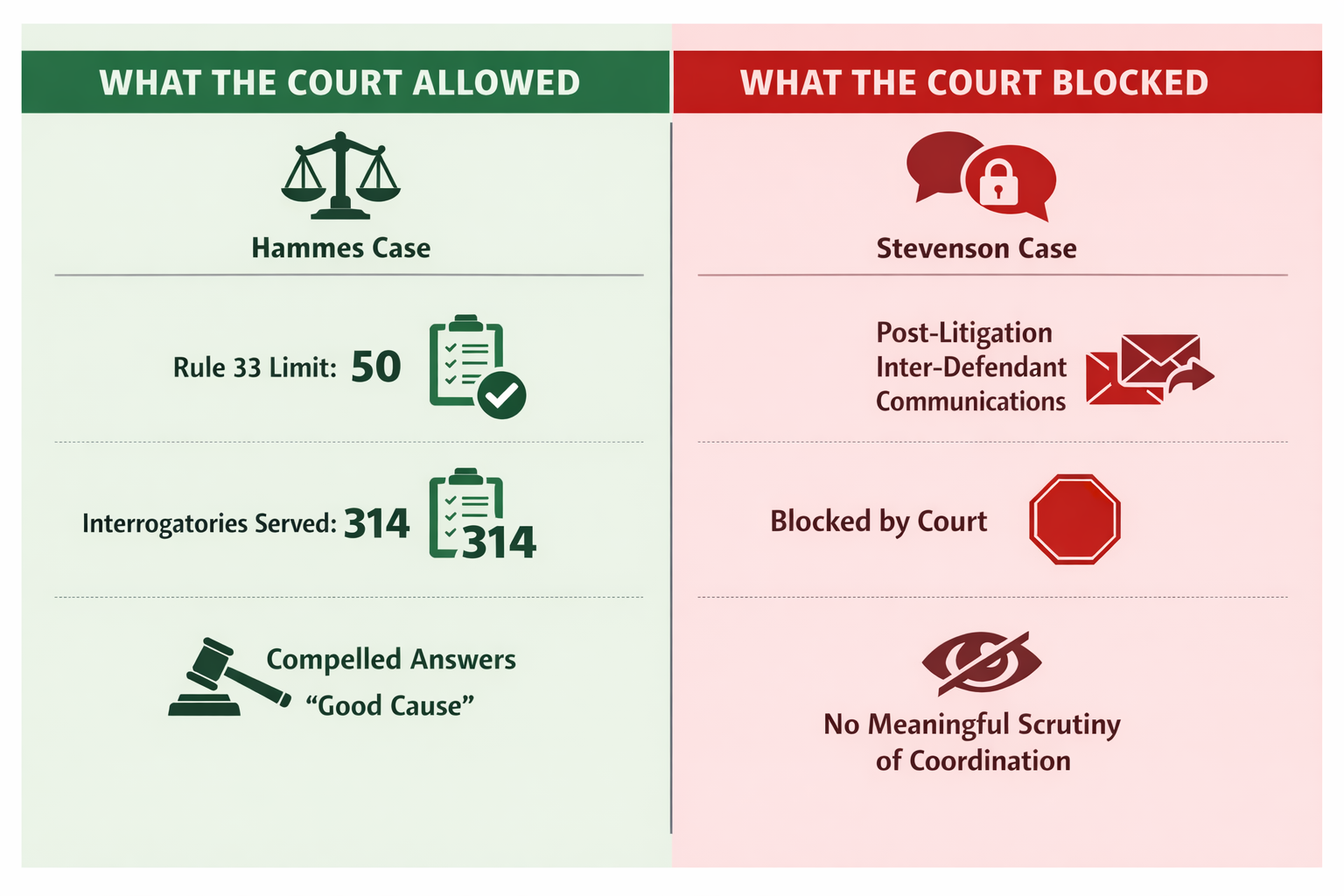
A contrast from Otter Tail County: the Hammes discovery order
To understand how discretionary discovery can become, compare Judge Miller’s approach in another Otter Tail County civil case (Hammes, 56-CV-20-794).
In Hammes, the dispute centered on a hard numerical limit in Minnesota discovery rules. Defense counsel put the numbers in plain terms:
“By serving 314 interrogatories, Plaintiffs have grossly exceeded the 50 interrogatory limit imposed by Minnesota Rules of Civil Procedure Rule 33.01(a).”
That’s not a borderline issue. It’s not “a few over.” It’s over six times the rule’s stated limit.
And yet Judge Miller compelled discovery anyway. In his order, he rejected the idea that the numeric objection justified refusing to answer and wrote:
“Defendant’s refusal to respond to the interrogatories is in conflict with both the Minnesota Rules of Civil Procedure and the general principles of discovery.”
He also declined to require a painstaking interrogatory-by-interrogatory accounting, explaining:
“The Court will not engage in the tedious task of explaining whether each interrogatory is appropriate on a line-by-line, question-by-question basis.”
And then, even assuming the 50-interrogatory limit had been exceeded, he emphasized the policy behind discovery:
“[T]he discovery process is best accomplished by the liberal exchange of information.”
“Therefore, assuming arguendo that Plaintiffs did exceed the 50 interrogatory limit, there was good cause to do so.”
Now place that next to what happened here.
In our case—where the issue was not “too many interrogatories,” but withholding, deletion, and coordination—the Court accepted an unrecognized doctrine, attributed a non-existent quotation to a precedential case, and shut down discovery into post-litigation inter-defendant communications in one stroke.
If you want the contrast in one image, here it is.
What this communicates to the public
If you want to know why litigants lose faith in the courts, look at what this sequence teaches.
- A party can invoke a doctrine the Court of Appeals said is not recognized,
- treat “joint defendants” as if they were “joint clients,”
- convert advocacy language into a supposed appellate “holding,”
- and then block discovery into coordinated communications that go to the heart of a case.
The result is:
When privilege doctrine is applied without a provable record—no log, no testing, no burden enforcement—the public is asked to accept an outcome the rules were designed to prevent.
And when later judicial orders retell the story—adding “proportionality,” saying key arguments weren’t “available,” narrowing the Supreme Court’s test by omission—the result is the same:
What Judicial Fairness Requires
In the end, judicial decisions do not preserve public trust merely by reaching an outcome. They preserve it by showing the parties — and the public — that justice was done.
Minnesota’s own Code of Judicial Conduct sets that expectation. It requires judges to perform their duties fairly and impartially, and explains that fairness requires a judge to be objective and open-minded.
That is not a technicality. It is the foundation of public trust. The Minnesota Supreme Court has said the same in equally clear terms: a judge must promote public confidence in the judiciary, avoid impropriety and the appearance of impropriety, and perform judicial duties in a way that assures parties their case is being fairly judged.
“[I]mpartiality is the very foundation of the American judicial system.”
“To maintain public trust and confidence in the judiciary, judges should avoid the appearance of impropriety and should act to assure that parties have no reason to think their case is not being fairly judged.”
Greer v. State, 673 N.W.2d 151, 155 (Minn. 2004);
Pederson v. State, 649 N.W.2d 161, 164–65 (Minn. 2002).
And fairness is impossible when a judge stops being objective, stops being open-minded, or gives the parties reason to doubt that the law was applied with impartial care.
This article is part of Justice-Denied.org’s ongoing Distorting the Law series examining how legal standards, quotations, and precedent were handled in Stevenson v. Stevenson.
