

“I Can Limit Discovery”
What happens when judicial triage becomes a substitute for truth-finding?
During our lawsuit in Otter Tail County District Court, one question kept returning—quietly at first, then relentlessly: were we being denied justice because the judge was simply too busy?
I don’t ask that lightly. I understand what Minnesota courts carried after COVID—backlogs, staffing shortages, and the prioritization of criminal matters over civil cases. But what I saw in our case felt less like careful adjudication and more like triage: decisions made fast, discovery treated as a burden, and the factual record left unexamined when it mattered most.
A Pattern We Couldn’t Ignore
On Justice-Denied, we have documented many of the irregular decisions and orders that came out of Judge Kevin M. Miller’s chambers—rulings that, in our view, defied logic, reason, and the governing rules. Here are just a few examples:
- Hundreds of missing texts on key dates between defendants Sean Stevenson and Lisa Stevenson-Allen, reflected in AT&T call-detail records—yet our motions to compel were denied.
- An admission of false statements under oath and deletion of evidence after litigation began—yet the court refused to reconsider discovery relief.
- A legal citation used to justify a discovery ruling that did not come from Minnesota case law at all, but from defendants’ interrogatory answers—yet our request for the judge to correct this faulty ruling was denied.
- A sweeping shield over inter-defendant communications—without in-camera review—through a “common interest” theory.
- At summary judgment, core evidence went unaddressed, including medical records, three independent medical examinations (IMEs), security videos of panic attacks, missing backups and perjury evidence, contradictory testimony, and communications suggesting a “Revenge” campaign by the defendants.
These details are specific, but the question behind them is simple: what was happening in chambers that made the court unwilling—or unable—to slow down and engage the factual record?
Then the Judge Said It Out Loud
Over time, Judge Miller made a series of statements on the record that, taken together, explained the pressure he was under.
“This is the second dispute I’ve had in discovery already in this matter… I want to find a way that we can get this done without me seeing you guys every couple months…” (Doc. 228, Tr. 12:24–13:3)
“I’m going to disagree… I can limit discovery.” (Doc. 228, Tr. 13:15–19)
He described his “personal challenges” of spending over forty percent of a recent month and a half in jury trials, facing strict deadlines in termination-of-parental-rights matters, and operating in “a tough spot” as he tried to get “some daylight.” (Doc. 225, Tr. 6:21–7:8)
“There’s almost a triage of what we’re trying to do… it’s not perfect, and it’s not the way I like to do it…” (Doc. 225, Tr. 7:15–21)
“…a drag upon the Court’s own limited resources.” (Doc. 464, at 15.)
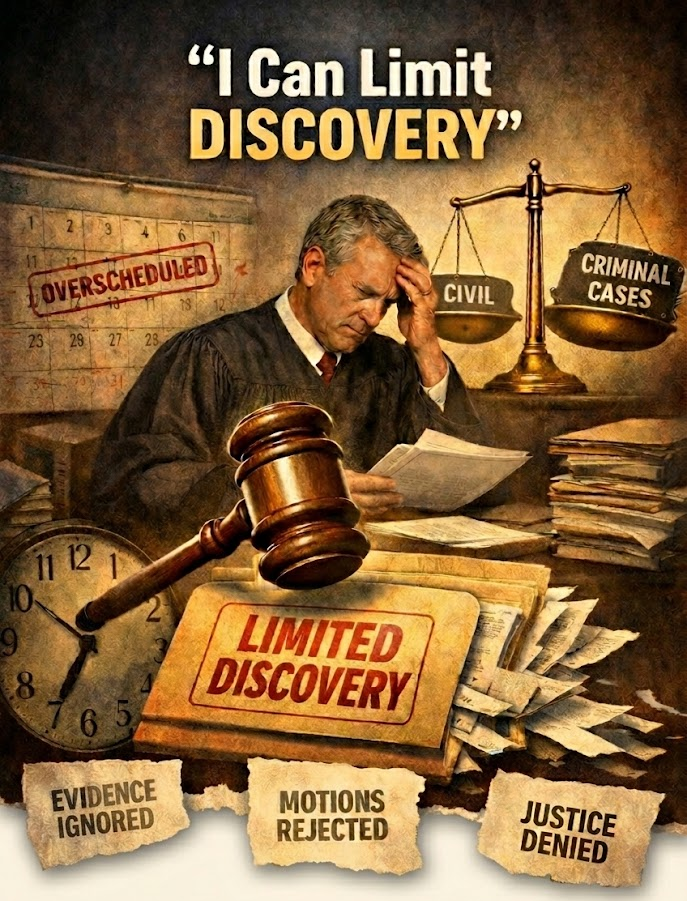
There it was, in the judge’s own language: “triage,” “limited resources,” “personal challenges.” And the line that stuck with me most—because it sounded like a solution—was this: “I can limit discovery.”
Court Triage Has a Human Cost
Discovery is not a hobby for litigants. In civil cases like ours, it’s the mechanism that allows ordinary people—without a badge or subpoena power—to uncover the truth.
In our case, the imbalance was stark. I was compelled to provide expansive access to my medical records—up to the minute—relevant or not. I underwent three separate independent medical examinations. Yet the court prevented meaningful access to inter-defendant communications after the lawsuit began.
If a civil litigant must open every drawer in their life to prove harm, but the opposing side can keep key communications locked away, then the result is not a neutral search for truth. It’s a one-way mirror.
A McLawsuit
When we investigated why our discovery motions were denied in the fall of 2021, we looked at the court’s schedule. What we found felt like a clue to everything that followed.
Our motion papers exceeded 620 pages. More than 45 pages of evidence were filed shortly before midnight the night before the hearing—summaries of AT&T call-detail records showing extensive undisclosed communications on key dates.
And yet, MCRO reflected that between September 3, 2021 and December 21, 2021, Judge Miller participated in 1,242 hearings over 73 workdays—an average of more than 17 hearings per workday. The order came 88 days after the hearing—two days before the 90-day deadline.
When a judge is operating at that pace, something has to give. In our case, it looked like the answer was: discovery.
The Easiest Way to Clear a Calendar
Judges face real deadlines and real consequences for missing them. But when time pressure becomes the dominant force, the system starts to reward outcomes that reduce workload rather than outcomes that reflect a careful review of the evidence.
One way to move cases off a docket is to limit discovery, then dispose of the case at summary judgment. Do it enough times, and the backlog shrinks—on paper.
But the cost is borne by the litigants whose cases require time, patience, and a willingness to confront an uncomfortable record. Expediency becomes the goal. And justice becomes optional.
What I Hope Minnesotans Will Ask
If courts are so overburdened that “triage” is the norm, Minnesotans deserve honesty about what that means in practice:
- How often is discovery curtailed not because it is improper, but because it is inconvenient?
- How often do civil litigants lose because the record was never fully developed?
- How many people walk away believing the system is fair—when they never had a meaningful chance to prove their case?
A court system that cannot afford the time to examine the facts is not merely overworked. It is, by design or by drift, denying people the process that makes justice possible.
