

Panel Shopping in Plain Sight?
When the rule is “bright-line,” outcomes shouldn’t depend on who shows up at the last minute.
The uncomfortable question
Appellate courts insist that justice is not personalized—that it does not turn on who is assigned, who is presiding, or who happens to be available on a given day. We are told, repeatedly, that judges apply rules, not preferences.
But when a panel changes again and again, right up to oral argument—especially in a case raising structural due-process concerns—the public is entitled to ask a simple question:
Were these substitutions routine… or were they outcome-protective?
We cannot prove the answer from the outside. But we can document what happened, compare it to a visible pattern on the same legal issue, and explain why the appearance alone is corrosive.
What changed in Stevenson—four substitutions, one direction
Our case, Stevenson v. Stevenson (A25-0186), was set for oral argument on June 11, 2025. The initial notice listed the panel as:
- Judge Rachel F. Bond
- Judge Randall J. Slieter
- Judge Keala C. Ede
Then the substitutions began:
- May 5, 2025: Judge Matthew E. Johnson substituted for Judge Ede.
- May 5, 2025: Chief Judge Jennifer Frisch substituted for Judge Bond.
- June 6, 2025: Judge Elizabeth G. Bentley substituted for Judge Johnson.
- June 6, 2025: Judge Tracy M. Smith substituted for Judge Bentley.
The Minnesota Appellate Courts Case Management System shows this activity:

The opinion ultimately reflects the final panel as:
Notably (and relevant to appearances), Judge Slieter is the only judge who did not change from the originally noticed panel to the final panel, and he was also the presiding judge in the Court of Appeals’ denial of our 2023 summary-judgment appeal.
Watching these substitutions arrive in real time, we had no way to know what was driving them. All we could see was the churn—and like any litigant would, we wondered: what is going on, and why are these changes being made?
At first, we assumed the substitutions were routine. But after oral argument, the opinion, and our subsequent research, we began to see how panel churn can matter in cases where the rule is supposed to be bright-line.
To be clear: substitutions can be legitimate—illness, conflicts, emergencies, workload balancing. Courts are human institutions with real scheduling constraints. But when substitutions stack up like this, the public cannot be blamed for wondering whether “random” is doing a lot of work.
Why this case is especially sensitive to panel composition
Not every appeal is equally vulnerable to “who you draw.”
Some issues are discretionary. Others are technical. But some are supposed to be non-negotiable—what courts often call structural: impartial tribunal, due process, decision-making confined to the record.
If the rule against independent investigation / extra-record factfinding is truly bright-line, then outcomes should not depend on whether a panel is willing to:
- call the error what it is, or
- explain it away as “unique facts,” “implied consent,” or “no objection.”
And yet, in Minnesota case law, we see decisions that cut in meaningfully different directions—often based on how a panel frames preservation, consent, or context.
The waiver pivot—what the judges asked at oral argument
This is where the transcript matters. It doesn’t “prove” anything about motive—but it does show what the panel saw as a critical exit ramp.
At oral argument, the court pressed the preservation question directly:
Judge Frisch: “Did you object to the judge invoking those new facts?”
Counsel: “…I did not object, no.”
That exchange previews the procedural move that later becomes outcome-determinative: forfeiture. A bright-line rule that depends on a contemporaneous objection is not bright-line in the way ordinary people understand that phrase. To the public, the line isn’t bright—it’s conditional, and therefore dim. And that is exactly what the opinion does with the independent-investigation issue.
Stevenson and the “one out of 192” problem
According to our Minnesota Law Library research, out of 192 Minnesota appellate decisions using “independent investigation” / “own investigation” terminology, Stevenson appears to be the only case in which the core independent-investigation issue is expressly disposed of as forfeited (1 out of 192).
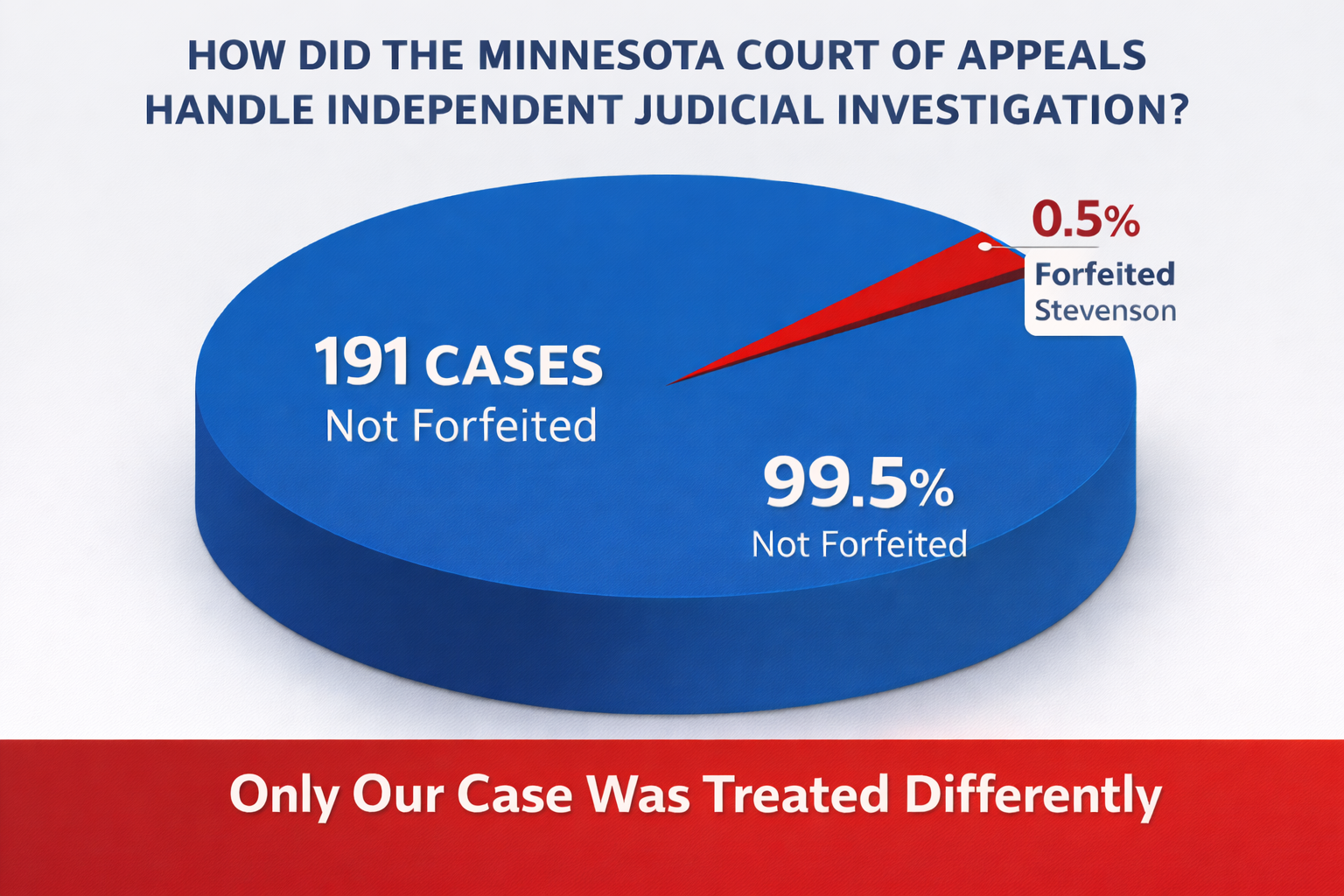
That uniqueness matters. If the rule is genuinely bright-line—if it truly polices the boundary between adjudication and investigation—why does only one case require a contemporaneous objection to avoid forfeiture?
If the answer is “because the facts are different,” fine. But then the judiciary owes the public a candid explanation of how a bright-line principle turns into a one-off waiver rule in precisely the case where it matters most.
The pattern we can’t ignore: same issue, repeat players, repeat outcomes
Consider a 5-year cluster of Minnesota Court of Appeals cases addressing versions of the same principle: a judge may not independently investigate facts or rely on extra-record information.
1) Leckner (2020): when the court treats the rule as truly bright-line
In State v. Leckner (A19-1007), the court reversed and remanded because the district court “impermissibly based its sentencing decision on information obtained during its independent investigation of facts outside the record.”
Leckner is a reminder that the Court of Appeals knows how to treat independent investigation as dispositive when it chooses to.
2) Leonida (2021): “unique facts,” implied consent, and “I’ll look right now.”
In State v. Leonida (A20-1059), the court acknowledged the bright-line principle but still affirmed “under the unique facts of this case.”
Leonida is also notable for an on-the-record moment that captures how easily “outside the record” can become normalized:
THE COURT: “I’ll look right now. If he did that, is the request to use that PSI for this sentencing, which is an update?”
That line matters—not because it proves motive, but because it illustrates how quickly extra-record information can become a practical shortcut when a court and counsel treat it as convenient rather than disqualifying.
During our review of the Minnesota Appellate Courts Case Management System, we also looked at panel stability in the same cluster of “independent investigation / extra-record” cases. In Leonida, the case-management history reflects two panel substitutions before decision—one of which substituted Judge Tracy M. Smith onto the panel (replacing Judge Lucinda E. Jesson), and another substituting Judge Carol A. Hooten (replacing Judge Diane B. Bratvold).
Leonida ultimately affirmed. We cannot know the reasons for substitutions from the outside, and we are not claiming improper intent. But when another key case in this doctrine shows panel churn that results in the same judge being added—followed by an affirmance—it reinforces the appearance problem: for the public, “bright-line” protections can start to feel contingent on who ends up on the panel.
(For context, our review found no substitutions in Jones or Knopik, and two substitutions in Leckner as well.)
3) Knopik (2023): disclosure + no objection becomes the escape hatch
State v. Knopik (A22-0766) fits the same broader theme: once the judge discloses the issue on the record and the parties respond without objection, the analysis can shift from a bright-line prohibition to a “context and participation” rationale that supports affirmance.
4) Jones (2025): “unique circumstances” and distinguishing structural error
In State v. Jones (A24-1451), the state argued forfeiture, yet the court still reached the appearance-of-bias issue and affirmed, distinguishing cases often cited for structural-error principles. Jones again shows how bright-line language can coexist with outcome-preserving reasoning in practice.
And here is the pattern point that cannot be waved away as coincidence: in the specific list of cases we compiled (Leckner, Leonida, Knopik, Jones, and Stevenson), Judge Tracy M. Smith appears in all five—and only one (Leckner, from 2020) did not affirm the district court.
Update: On January 21, 2026, the Minnesota Supreme Court granted review of Issue 1 (independent judicial investigation) in State v. Jones.
Foote (2020): the State argued forfeiture — and the Court said no
In State v. Foote (A19-0838), the State tried a familiar procedural move: it characterized the defendant’s claim as “judicial bias” and argued it was forfeited because he did not request recusal. The Court of Appeals rejected that framing. It explained that a bias claim is distinct from a due-process claim that the judge deprived the defendant of an impartial fact-finder, and it noted the State identified no authority for the proposition that failing to move for recusal forfeits that constitutional claim. Most importantly, the court pointed to Dorsey itself—where the Supreme Court reversed based on unobjected-to judicial conduct that deprived the defendant of an impartial fact-finder. In other words: even when the State presses forfeiture, some Minnesota appellate courts have recognized that Dorsey-type impartiality violations do not neatly fit a “you didn’t object, so you lose” rule.
Scudder (2022): No objection — and still structural error / automatic reversal
A recent Court of Appeals decision shows why Stevenson’s forfeiture framing is so hard to square with the “bright-line” principle. In State v. Scudder (A21-1081), the district court judge disclosed during the restitution hearing that she had performed “a simple Google search” to investigate a disputed valuation issue and described the results in open court. The opinion explicitly notes that Scudder did not object to the judge’s disclosure at the hearing. But the State’s attempt to convert that silence into a waiver did not succeed: the Court of Appeals declined to treat the issue as a mere unpreserved error and instead held Scudder was denied the constitutional right to an impartial judge because the judge independently investigated facts and revealed the results in court. The court then stated the key point plainly: because that denial is structural error, it reversed and remanded for a new hearing—without requiring a contemporaneous objection to preserve the claim.
Scudder is not unique—what’s unique is Stevenson: if a contemporaneous objection were truly required to avoid forfeiture in independent-investigation cases, we would expect to see that rule applied more than once.
Blanshan (2015): Even inadvertent extra-record reliance still requires reversal
In State v. Blanshan (A14-1065), the Court of Appeals reversed a bench-trial conviction because the district court inadvertently relied on evidence that was not introduced during trial—and the remedy was not “harmless error,” but automatic reversal and a new trial. Even more importantly for the “bright-line” principle, Blanshan rejects the idea that the outcome turns on how the judge acquired the out-of-record information: “How the district court comes to possess the out-of-record knowledge is not relevant… the relevant inquiry is what the district court subsequently does with the knowledge….” And it rejects prejudice-balancing for this category of error: when a defendant is deprived of an impartial adjudicator, automatic reversal is required. The court even acknowledges the human reality—trial judges must evaluate a record unfolding “in real time”—yet still reverses because the constitutional boundary is non-negotiable. Blanshan is unpublished, but its reasoning is still useful as a real-world illustration of how strictly some Minnesota appellate courts say this rule must operate.
So—was the Stevenson panel selected in advance?
Here is the responsible way to say what we believe, based on what we can observe:
- The repeated substitutions in A25-0186 are real and documented.
- The final panel included judges who, across multiple decisions touching the same due-process boundary, have sometimes resolved “independent investigation / extra-record” concerns through contextual or procedural rationales rather than bright-line enforcement.
- The transcript shows the preservation question—Did you object?—was a central pressure point at oral argument.
- The opinion then disposes of the independent-investigation issue through forfeiture framing.
From those premises, a plausible hypothesis emerges:
In high-risk cases—especially those that could force a court to confront structural error—panel composition can function as a pressure valve. If the “wrong” panel draws the case, substitution solves the problem.
We are not claiming proof of intentional selection. We are saying the visible pattern makes the question unavoidable—and that public confidence depends not only on actual fairness, but on the appearance that outcomes are not being managed through process.
The innocent explanations—and why they still don’t fix the optics
Yes, there are innocent explanations: illness, emergencies, conflicts, workload balancing, scheduling logistics, internal administrative policies.
But that’s the point: we cannot see them. And when the issue is impartiality, “trust us” is not enough.
And that is why, to the public, repeated last-minute panel substitutions can be summarized in a cynical but understandable way: “Choose the panel you need to get the result you want.” We are not claiming that is what happened here; we are saying the process can look that way when the reasons for substitutions are opaque and the outcome turns on a waiver pivot.
If courts want people to stop asking whether panel composition is being used as an outcome tool, they must provide transparency that makes such suspicions unreasonable.
What transparency would look like
Reforms that would reduce suspicion without compromising operations include:
- Publishing a plain-language panel assignment policy (including substitution triggers).
- Logging substitutions with a non-private reason category (conflict, illness, scheduling).
- Publishing aggregate statistics on substitutions by case type (civil, criminal, family, etc.).
- Using randomization with auditable assignment, with narrow, defined exceptions.
Closing
Maybe the substitutions in our case were routine. Maybe they were inevitable.
But when a panel changes repeatedly right up to argument, and the deciding panel then resolves a supposedly bright-line judicial-limits issue through forfeiture, the substitutions stop looking like an administrative footnote.
They become a credibility event.
Until the courts are willing to show their work—not just in opinions, but in process—Justice-Denied will keep asking what the public has every right to ask:
Was this justice… or was this case management?
