
A Judge’s Most Sacred Responsibility
People often speak of a judge’s authority.
That is the wrong place to begin.
The defining feature of judicial office is not power. It is duty.
A judge is given extraordinary authority over the lives of others—their rights, property, liberty, reputation, family, and future. But that authority is legitimate only so long as it is exercised with fidelity to law, impartiality, and fairness.
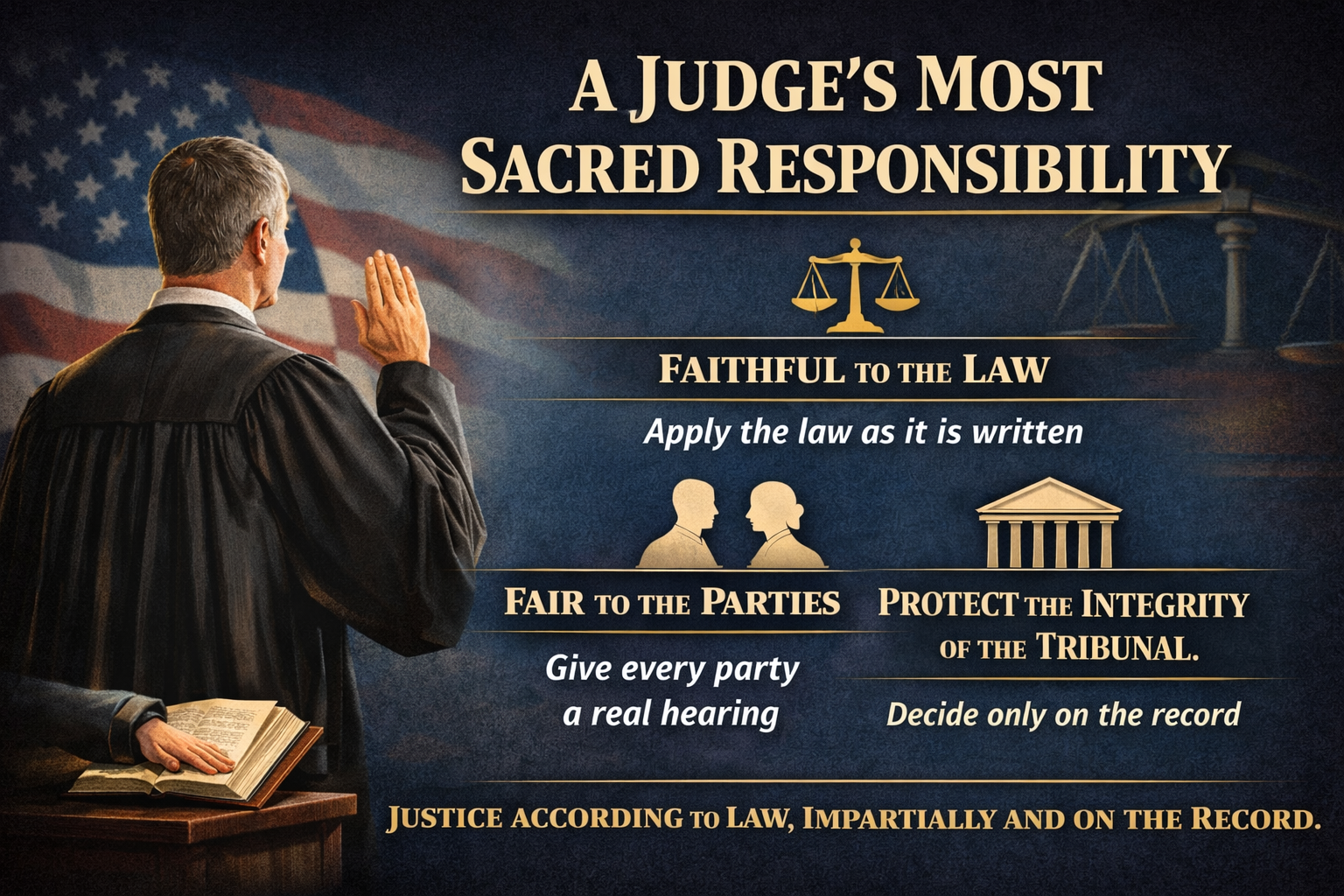
Not Ceremony. A Promise.
In Minnesota, that duty begins with the oath itself. A judge does not merely step into a job. A judge enters an office bound by constitutional obligation.
The oath is not ceremonial language. It is not a photo opportunity. It is not a line to be recited and forgotten.
It is a promise.
It is a promise to support the Constitution. A promise to discharge the duties of office faithfully. A promise to exercise power under law—not above it, around it, or in spite of it.
What the Code Demands
The Minnesota Code of Judicial Conduct gives substance to that promise. It requires judges to uphold and promote the independence, integrity, and impartiality of the judiciary. It requires judges to comply with the law. It requires judges to act in a manner that promotes public confidence in the courts. And it warns that confidence is damaged not only by actual misconduct, but also by conduct that creates the appearance of impropriety.
That is not a technicality. That is the foundation of public trust.
If the public cannot trust that judges are neutral, honest, disciplined, and faithful to law, then the legitimacy of the judiciary begins to collapse—one case, one ruling, one excuse at a time.
What a Judge Is Not
A judge is not sworn to personal preference.
A judge is not sworn to convenience.
A judge is not sworn to protect favored parties.
A judge is not sworn to rescue weak arguments, ignore inconvenient facts, or reach first for a preferred outcome and only later search for a justification.
A judge is sworn to the law.
And under Minnesota’s Code, “law” is not whatever a judge wishes it to mean in the moment. It includes constitutional provisions, statutes, court rules, and decisional law. That matters, because it means a judge’s duty is one of disciplined obedience—not personal improvisation.
Law Without Due Process Is Not Justice
Minnesota’s Code requires more than the appearance of judging. It requires the real thing.
That means giving each party the right to be heard according to law.
That means hearing and deciding assigned matters.
That means competence, diligence, thoroughness, and preparation.
That means deciding cases on the lawful record—not on private assumptions, outside information, or undisclosed influences.
A judge’s sacred duty is not satisfied by merely issuing an order.
A judge must actually do the work of judging.
That includes listening.
That includes understanding the record.
That includes applying the correct law.
That includes giving both sides a meaningful hearing.
That includes deciding the case that was actually presented—not some easier substitute.
A Bright Line
Minnesota draws a bright line where every judge should draw one: a judge may not independently investigate facts and may consider only the evidence presented and facts properly subject to judicial notice.
That rule exists for a reason.
A judge does not get to step outside the record and still call the result justice.
A judge does not get to rely on private impressions, undisclosed communications, or extra-record information and still claim neutrality.
A judge does not get to become a silent witness, private investigator, strategist, or advocate while wearing the robe of a neutral decision-maker.
Once that line is crossed, the problem is no longer merely a disputed ruling. The problem is that the judicial role itself has been compromised.
When Impartiality Is in Doubt
The duty of a judge is not simply to remain on a case at all costs. Minnesota’s Code requires disqualification whenever a judge’s impartiality might reasonably be questioned, including when the judge has personal bias or personal knowledge of disputed facts.
That rule protects more than appearances. It protects the integrity of the tribunal itself.
Because justice cannot command respect when the neutrality of the decision-maker is reasonably in doubt.
Why This Matters
This is why judicial misconduct is so serious.
When a judge fails in this duty, the damage is not confined to one bad ruling. The harm reaches beyond the parties. It reaches the public. It corrodes confidence in the courts. It teaches people that outcomes may matter more than process, that power may matter more than principle, and that the oath may be treated as symbolic rather than binding.
That is precisely backward.
The oath is supposed to restrain power.
The Code is supposed to discipline discretion.
The courtroom is supposed to be a place where law governs people in authority—not a place where people in authority govern the law.
When judges treat procedure as optional, the record as secondary, and impartiality as aspirational, the courtroom ceases to be a place of justice. It becomes a place of power.
What a Judge Should Be
So when we ask what a judge should be, the answer is not mysterious.
A judge should be faithful to the law.
A judge should be fair to the parties.
A judge should protect the integrity of the tribunal.
A judge should decide only on the lawful record.
A judge should step aside when impartiality cannot reasonably be trusted.
That is the office.
That is the promise.
That is a judge’s most sacred responsibility.
