

The Truth is in the Gaps
How Leonida and Stevenson show where Minnesota’s “bright-line” rules bend—and where missing context does the real work.
For years, I’ve used a simple phrase to teach my family something that applies far beyond the courtroom:
The truth is in the gaps.
Because the truth is often hidden in what’s left out.
Not always in what is said, but in what is omitted, softened, reframed, or relegated to a footnote—especially when those omissions change how a reader understands “what really happened.”
It’s true in daily conversation, in interpersonal relationships – and even at the Minnesota Court of Appeals.
Two Minnesota Court of Appeals decisions in particular—State v. Leonida 🔗 and Stevenson v. Stevenson 🔗—illustrate that dynamic in striking ways. Both involve a judge relying on information that did not come from the parties’ presentation of evidence in the normal adversarial process. Both opinions acknowledge the governing rules. And yet both cases reveal something else: the outcome often turns on “gap facts”—late-emerging context, procedural framing, or selective preservation doctrines—rather than the bright-line rule itself.
The bright-line rule Minnesota courts say they follow
Minnesota appellate courts repeatedly acknowledge a bedrock principle: a judge must decide cases based only on the record made by the parties, not on outside information gathered independently.
In Leonida, the Court of Appeals quotes the Minnesota Supreme Court’s warning in State v. Dorsey 🔗 that independent judicial fact-gathering “open[s] Pandora’s box” and is prohibited.
That’s the rule as stated.
The real question—what these two cases expose—is when the bright-line rule is enforced… and when it becomes “contextual.”
Leonida: the Court identifies the violation—then resolves the case in the “gaps”
What happened
In Leonida, the sentencing judge relied on a detail about how the defendant contacted a witness (the “method-of-contact”) that was not established in the sentencing record. The Court of Appeals acknowledged that this kind of fact-finding outside the record implicates the bright-line prohibition.
The outcome pivoted on a late-raised factual framing
At oral argument, the state advanced a new, highly consequential point: Mr. Leonida himself had asked the district court to look at a prior PSI (presentence investigation) from another case.
The Leonida opinion openly discloses that this point was raised at oral argument, not framed as a centerpiece of the written decision from below:
“At oral argument, the state points out…”
And the oral-argument transcript confirms something even more direct: when asked whether that was an argument that had been made in their brief, the state answered:
“It is not.”
So, one of the most outcome-driving facts in the case was, by the state’s own admission, not briefed—and yet it became central to how the court affirmed.
Was Mr. Leonida’s request made to the same judge who denied the departure?
No. The transcript reflects that the PSI request occurred before a different judge, not the sentencing judge (Judge Meslow). And the Leonida opinion itself states that the conditional-release proceeding (where the PSI issue arose) was before “a different judge.”
But then, in the decisional analysis, the court uses broader phrasing—suggesting the “district court” relied on the PSI after Leonida urged it—without clearly re-connecting that key nuance (different judge; different hearing; different context).
That is a classic “gap” problem: the opinion contains the facts, but not in a way that forces the reader to see how the facts undercut the rationale.
Was Leonida decided correctly?
That depends on whether courts mean what they say about the bright-line rule.
- If the rule is truly bright-line—no independent extra-record factfinding, period—then an affirmance that leans on contextual rationales (invited review of PSI; no objection; forfeiture) is difficult to reconcile with the rule’s stated purpose.
- If instead the rule is functionally contextual, then Leonida becomes a preview of something bigger: how appellate courts can acknowledge the prohibition while still affirming based on procedural “escape hatches.”
That’s not just a dispute about sentencing. It’s about whether the judiciary’s legitimacy comes from consistent enforcement of the adversarial process—or from explaining away departures when the context is convenient.
Stevenson: Thiele as a trapdoor—and why timing matters
In Stevenson v. Stevenson (A25-0186), the Court of Appeals addressed a different setting: a civil case involving a motion to disqualify and vacate orders, where the district court judge injected extra-record facts about chambers staffing and law-clerk timelines after argument.
The Court of Appeals disposed of the “independent investigation” issue as forfeited under Thiele, stating that the issue was not preserved because appellants did not object in district court.
Thiele’s core rule is familiar: appellate courts generally consider only issues presented to and considered by the district court.
But here’s the procedural “gap” Stevenson reveals
At oral argument in Stevenson, one judge pressed the point directly:
“Did you object to the judge invoking those new facts?”
Counsel answered: “I didn’t object…”
That single moment became the foundation for forfeiture.
But compare that with what the district-court hearing transcript shows (and what Judge Miller did): after the court stated it would take the matter under advisement, the court then provided “additional context” by narrating facts about authorship metadata terminology and law clerk timelines—facts not developed through sworn testimony or adversarial testing. (This is the moment where a real-world litigant confronts an impossible question: How do you object, and when, after the judge says the proceeding is effectively over?)
And the Court of Appeals opinion itself quotes that the court’s timeline narration occurred “After argument”—meaning after the parties had completed their presentations.
Was a contemporaneous objection realistically “appropriate” after the matter was under advisement?
This is the heart of the problem.
A “contemporaneous objection” doctrine assumes a live, ongoing adversarial exchange where:
- a party can object,
- the court can rule,
- and the parties can build a record.
But Stevenson’s hearing posture raises a practical fairness question:
When a judge says, “I will take this under advisement” and then immediately adds extra-record factual narrative, the parties are no longer in normal argument mode. The hearing is functionally ending.
Yes, a lawyer can interrupt, but the system should not require litigants to risk antagonizing the court and incurring possible sanctions by objecting after the judge has announced the decision will be issued later—especially when the judge is supplying facts about the judge’s own chambers and staffing in a matter that challenges the integrity of those chambers.
That’s why it matters that the Court of Appeals itself also “emphasize[d] the unique nature of a motion to disqualify, where a judge must necessarily consider information about their own conflict or a conflict within their chambers.”
If it’s “unique” enough to justify the court doing some information-gathering, then it’s also unique enough to raise a serious question whether standard preservation rules should operate like a trapdoor.
Another data point (Minnesota Law Library research)
During oral argument in Leonida, Judge Hooten paused on a point that usually ends the debate:
“But structural error is a whole different ball game, isn’t it?”
That question matters because Minnesota appellate decisions have historically treated extra-record judicial fact-finding as the kind of impartiality problem courts address head-on—often in structural-error terms—rather than as something that lives or dies on a contemporaneous objection.
My Minnesota Law Library research reinforces that pattern. In 192 Minnesota appellate decisions using the terms “independent investigation” or “own investigation,” I found only one case in which the court required a contemporaneous objection to avoid forfeiture—and only one case in which the issue was actually forfeited: Stevenson.
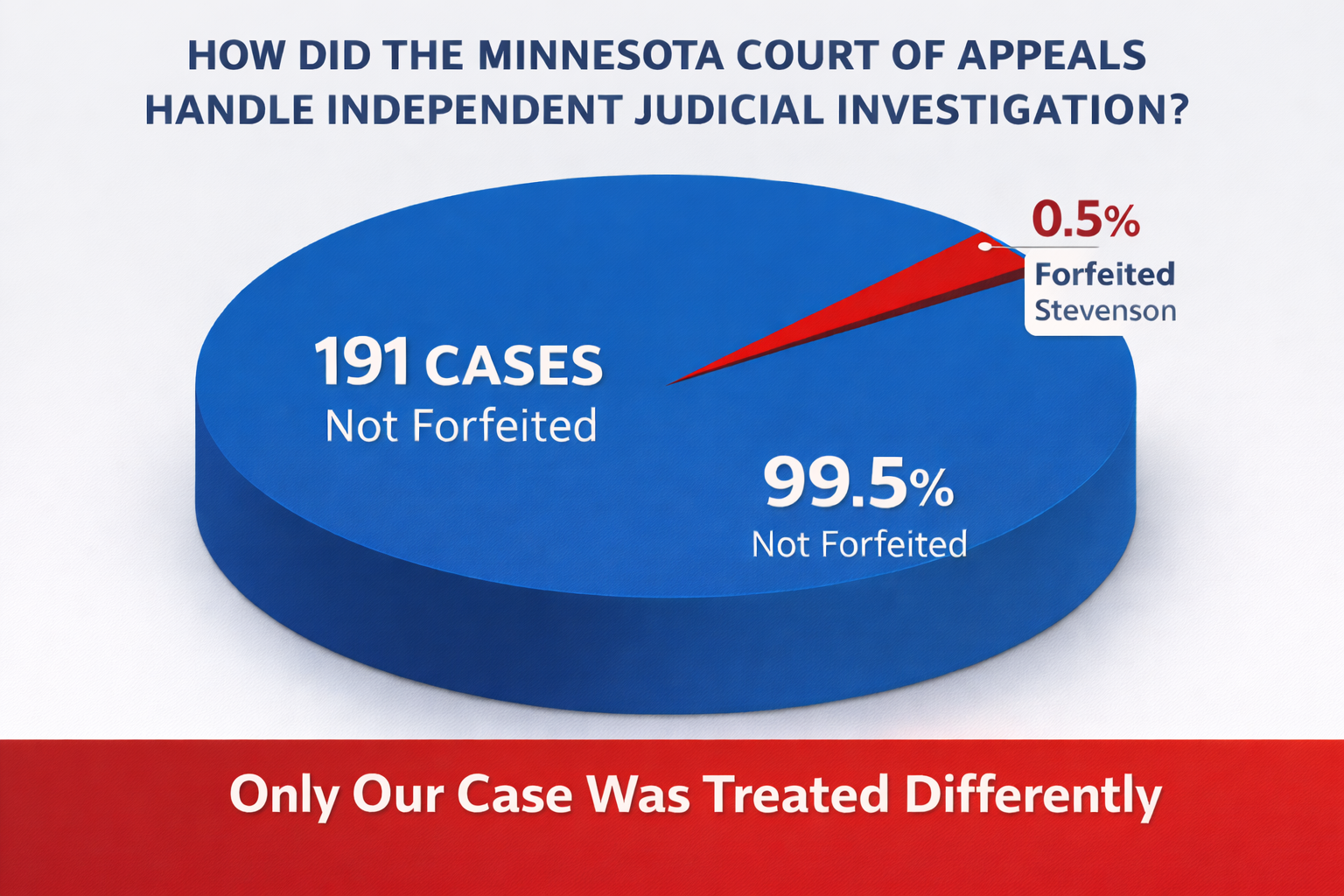
That “one-of-one” outcome is not a footnote. It’s a signal. If the governing rule is truly bright-line, it is hard to reconcile a procedural result where this issue—unlike virtually every comparable Minnesota decision invoking judicial impartiality principles—is shut down at the threshold through forfeiture rather than confronted on the merits.
The post-hearing declaration: what happens when the record grows after the hearing?
Eight days after the hearing in Stevenson v. Stevenson, I submitted a sworn supplemental declaration addressing the judge’s timeline narrative.
I explained that Judge Miller’s “clean break” framing did not seem logical and prompted me to review public MCRO records.
My declaration then identified records indicating that Judge Mark F. Hansen continued to rely on Clerk James Morrison after retirement, including:
- A January 20, 2017 letter where Morrison identified himself as “Law Clerk to the Honorable Mark F. Hansen”
- Follow-up emails the same day
- And an order signed by Judge Hansen that followed from those communications
My declaration also challenges the implied idea of “exclusive” clerking relationships by pointing to MCRO examples where Morrison assisted multiple Otter Tail County judges during overlapping timeframes.
This matters because the Stevenson opinion summarizes the district court’s in-hearing timeline framing and then treats the independent-investigation challenge as forfeited.
So, the “gap” becomes this:
- The judge introduces new facts after argument.
- A post-hearing sworn declaration supplies record-based context undermining the “clean break” narrative.
- The judge relies on his own extra-record facts in his ruling and ignores the sworn declaration.
- The Court of Appeals still resolves the independent-investigation issue largely through preservation doctrine, totally ignoring that a post-hearing declaration was filed that contradicted many of the facts introduced and relied upon by Judge Miller.
The preservation double standard: Leonida vs. Stevenson
Here is the comparison that, to me, best fits the title of this post:
In Leonida
- The state advanced an important factual framing at oral argument.
- The state conceded it was not briefed.
- The court relied on it anyway.
In Stevenson
- The appellants challenged extra-record fact-gathering by the judge.
- The court invoked Thiele and forfeiture because there was no contemporaneous objection.
If “the truth is in the gaps,” then the gap here is stark:
New, unbriefed pro-state context can be absorbed and credited (Leonida), while post-argument judicial fact narration is insulated by forfeiture doctrine (Stevenson).
One more “gap” worth naming: Judge Tracy M. Smith on both panels
Importantly, Judge Tracy M. Smith appears in both cases.
- Leonida oral argument panel includes Judge Smith.
- Stevenson oral argument panel includes Judge Smith.
That does not prove anything by itself. But when similar legal themes recur across cases, panel overlap can matter—not because of identity, but because it helps track patterns: what arguments get framed as dispositive, what gets called forfeited, and what gets treated as “unique.”
Why this matters
Courts often say the legitimacy of outcomes depends on:
- neutrality,
- transparency,
- and consistent rules.
But when outcomes turn on “gap facts” (late-raised context, ambiguous procedural framing, selective preservation doctrine), the public’s ability to trust the process erodes—because the rules start to look less like rules and more like tools.
And that brings us back to the lesson I taught my family:
The truth is often in the gaps.
Not because the courts always lie—
but because what gets left out, and how issues get framed, can be the difference between a bright-line rule and a contextual exception that negates it.
For readers who want to hear the oral-argument exchanges referenced above, here is the audio:
Audio link (Leonida oral argument)
Audio link (Stevenson oral argument)
For additional background and AI-assisted analysis of independent judicial investigations, visit our Independent Investigations page.
