

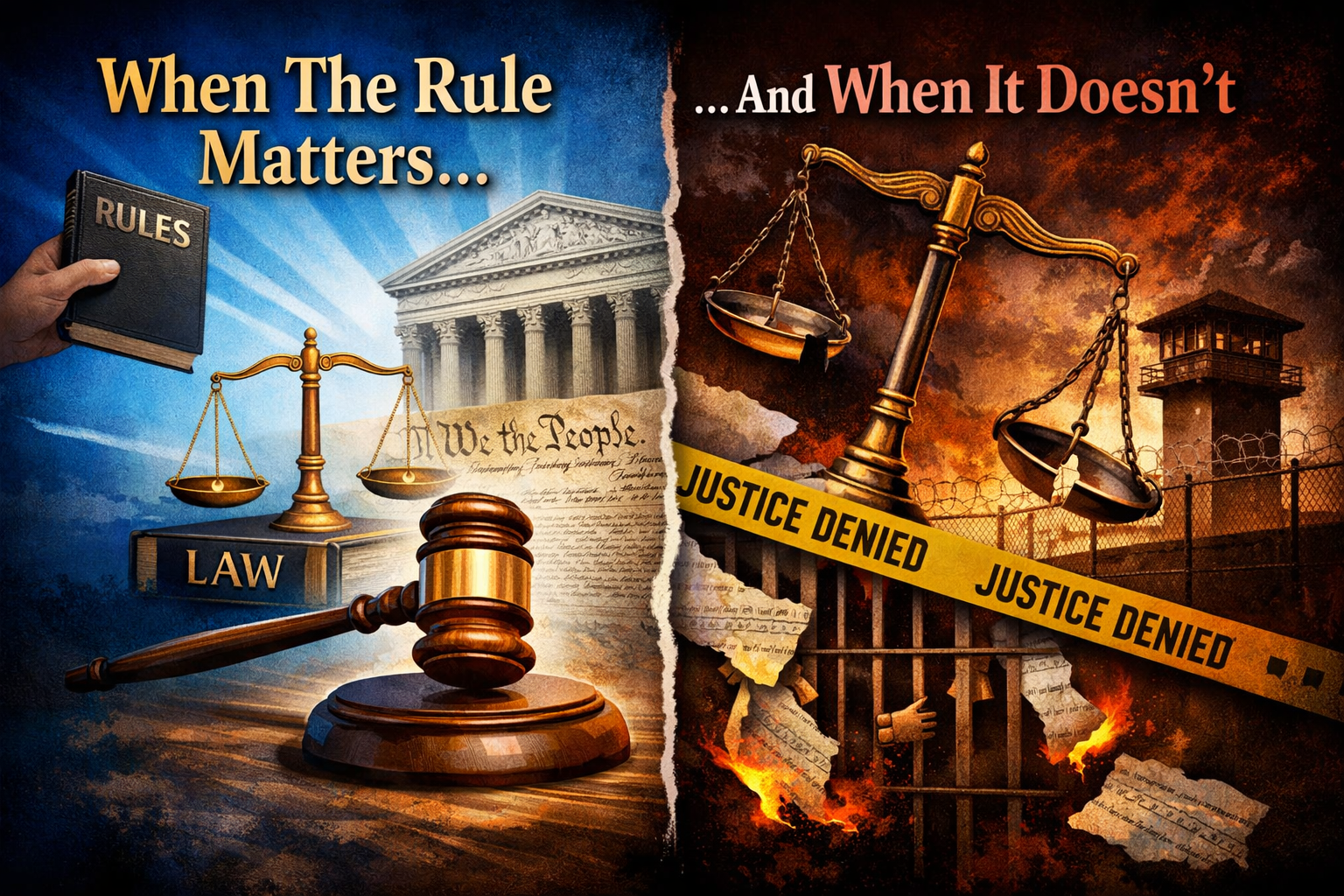
When the Rule Matters—and When It Doesn’t
Minnesota’s courts have long recognized one of the clearest principles in due-process jurisprudence: a judge may not independently investigate facts outside the record. When they do, it is structural error—automatically reversible, with no need to prove prejudice. That bright-line rule was established in State v. Dorsey (2005) and reaffirmed repeatedly, culminating in the Minnesota Supreme Court’s 2025 decision in State v. Duol.
But a comparison of State v. Boettcher (Dec. 1, 2025) and Stevenson v. Stevenson (July 28, 2025) reveals something striking: the Minnesota Court of Appeals has applied this rule with unwavering rigor in criminal cases—yet with complete avoidance in a civil case involving judicial conduct.
The contrast is stark.
And the implications reach far beyond the parties involved.
Boettcher: The Court of Appeals Applies Dorsey and Duol Exactly as Written
In State v. Boettcher, the district court judge:
- Independently researched the geographical location of two cell towers,
- Verified those locations during witness examination, and
- Admitted doing so on the record.
The judge even acknowledged relying on knowledge from unrelated cases to overrule objections that should have required proper evidentiary foundation.
The Court of Appeals, applying the structural-error doctrine, held:
The district court deprived Boettcher of his constitutional right to an impartial judge by seeking information outside the record and thereby eliminating any vestige of impartiality.
The panel—Larkin, Wheelock, and Florey—cited:
- State v. Dorsey (2005),
- State v. Lopez (2023), and
- State v. Duol (2025)
and held unequivocally that this was structural error requiring automatic reversal.
“We have never recognized an exception to this guardrail.” — Duol, quoted in Boettcher.
The result: conviction reversed, new trial ordered.
This is exactly how structural error doctrine is supposed to work.
Stevenson: The Same Extra-Record Judicial Fact-Finding—But the Court of Appeals Refuses to Apply Dorsey
Five months earlier in Stevenson v. Stevenson, the Court of Appeals reviewed a civil appeal involving a recusal motion. During the hearing, Judge Miller:
- Independently researched the employment history of his law clerk,
- Obtained dates not provided by either party, and
- Introduced his independently gathered facts into the proceeding.
Judge Miller stated:
“Mr. Morrison started with Judge Mark Hansen in November 2013 and became Judge Benson’s law clerk in September 2016.”
These dates were not in the record.
They were not offered by the parties.
They were obtained by the judge himself.
In other words: exactly the conduct condemned in Dorsey.
Yet the Court of Appeals—Frisch, Slieter, and Tracy M. Smith—held:
“We discern no appearance of impropriety.”
And crucially:
- The panel did not cite Dorsey.
- The panel did not acknowledge the extra-record fact-finding problem.
- The panel avoided structural-error doctrine entirely.
- The panel held the issue forfeited in a footnote, despite structural error being non-forfeitable as a matter of law.
This forfeiture ruling is unprecedented in Minnesota appellate history—no prior appellate court has ever deemed an independent-judicial-investigation argument forfeited.
The result: affirmed, with no meaningful review of the judge’s conduct.
The Boettcher–Stevenson Divide: Same Behavior, Different Law
The Conduct
| Judicial Behavior | Boettcher | Stevenson |
|---|---|---|
| Judge independently investigates facts? | Yes | Yes |
| Extra-record facts introduced into the proceeding? | Yes | Yes |
| Facts used to resolve a contested issue? | Yes | Yes |
The Court of Appeals’ Legal Treatment
| Doctrinal Application | Boettcher | Stevenson |
|---|---|---|
| Cites Dorsey? | Yes | No |
| Cites Lopez? | Yes | No |
| Cites Duol? | Yes | No (Duol not yet decided) |
| Applies structural-error doctrine? | Yes | No |
| Treats extra-record investigation as constitutional error? | Yes | No |
| Declares the issue forfeited? | No | Yes, in a footnote |
| Outcome | Reversed, remanded | Affirmed, motion denied |
One more notable detail
- Judge Tracy M. Smith sat on the panel in Stevenson,
- But not on the panel in Boettcher.
This is significant in light of her role in Jones as well—another case where extra-record judicial fact-gathering was softened or minimized.
Why the Different Outcomes?
A. Criminal versus Civil?
Boettcher was criminal; Stevenson was civil.
But Dorsey applies to all judicial fact-finding, not just criminal cases.
The Minnesota Supreme Court has emphasized:
The impartiality requirement applies to all proceedings in which a judge exercises judicial power.
The prohibition on independent judicial investigation is constitutional, not procedural.
B. The “Timing” of Duol
In Stevenson, Duol had not yet been decided (released Sept. 3, 2025).
But Dorsey—the original bright-line rule—had been the law for 20 years.
The Court of Appeals simply chose not to apply it.
C. The Forfeiture Problem
The Court of Appeals declared the structural-error argument forfeited—even though:
- Structural error cannot be forfeited;
- Appellants raised the issue repeatedly below;
- The judge’s independent investigation was recorded on the transcript.
In Boettcher, by contrast, the Court of Appeals scrutinized the judge’s independent investigation even though the State conceded the error and no party raised a forfeiture argument.
What Boettcher Shows About the Stevenson Decision
Boettcher demonstrates what happens when the Court of Appeals applies the law faithfully:
- Dorsey governs.
- Independent judicial investigation = structural error.
- Structural error = automatic reversal.
Stevenson demonstrates what happens when the same court:
- Avoids Dorsey,
- Avoids structural-error analysis,
- Avoids acknowledging the independent investigation,
- And then declares the issue forfeited.
The difference is not factual.
It is not procedural.
It is doctrinal.
And it raises a foundational concern:
Final Thoughts
State v. Boettcher proves that the Minnesota Court of Appeals knows how to apply the structural-error doctrine correctly, clearly, and forcefully. The opinion is a model of how judicial impartiality should be protected.
Stevenson v. Stevenson, by contrast, stands out as a case where the Court:
- Avoided binding precedent,
- Minimized plain extra-record judicial fact-finding,
- And declared a structural-error argument forfeited for the first time in Minnesota history.
The law was the same in both cases.
The judicial behavior was the same in both cases.
But the outcomes—and the analysis—could not have been more different.
And Minnesotans deserve answers about why.
For additional background and AI-assisted analysis of independent judicial investigations, visit our Independent Investigations page.
