

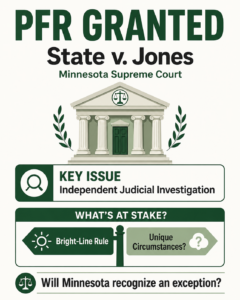
Petition for Review (PFR) Granted in State v. Jones (Independent Judicial Investigation)
Will Minnesota Recognize an Exception to the “Bright-Line” Rule?
On January 21, 2026, the Minnesota Supreme Court granted review of Issue 1 (independent investigation) in State v. Jones (A24-1451). The Court granted review only on that issue—an unmistakable signal that this case is about more than one defendant and one trial judge. It is about whether Minnesota’s impartial-judge guardrail is truly a bright-line rule, or whether it can be softened when a court believes the circumstances are “unique.”
Below are the Issue I paragraphs from the petition:
Issue I: A judge violates their duty of impartiality by independently investigating or relying on extra-record facts. This Court has never recognized an exception to this “bright-line rule.” Here, for the first time, the court of appeals recognized such an exception for a court’s determination on whether a defendant who does not appear in court has waived their right to be present.
As a matter of first impression, is there an exception to the rule that prohibits a judge from independently investigating facts when a court is required to determine whether a defendant has waived their right to be present after failing to appear? If there is no exception, must this Court reverse and remand for a new trial on the ground Jones was denied his right to an impartial judge?
Rulings below: Following an evidentiary hearing regarding Jones’s absence from court, the judge independently obtained and relied on extra-record information to find that Jones waived his right to be present. The court of appeals affirmed, reasoning the “specific, unique circumstances” of this case are excepted from the rule in Dorsey that prohibits a judge from independently investigating facts. Jones, slip op., at 11-13.
Why this Supreme Court review matters
“Bright-line” rules exist for a reason: they’re meant to be predictable, uniform, and resistant to case-by-case rationalizations. If Minnesota’s rule against independent judicial fact-gathering is truly bright-line, then it shouldn’t matter whether the situation is hard, unusual, or inconvenient. The rule should still apply.
But Jones puts pressure on that principle because the Court of Appeals didn’t merely distinguish prior cases—it treated the situation as functionally outside the bright-line rule’s reach due to the claimed necessity of determining whether the defendant’s absence was a voluntary waiver. That is exactly the kind of reasoning that—if accepted—invites a follow-on question in the next case: how “unique” is unique enough?
This is why the Supreme Court’s decision in Jones has the potential to become a major reference point going forward. The Court can:
- Reaffirm that the rule remains categorical (no exceptions), even when a trial judge believes it “has to” fill an informational gap; or
- Recognize a limited exception—and then define its boundaries and procedural safeguards so that the “exception” doesn’t quietly become an expandable loophole.
Either outcome will shape how Minnesota courts approach judicial impartiality claims in future cases.
The “unique circumstances” move—and what’s at stake
The Court of Appeals affirmed in Jones while expressly invoking “specific, unique circumstances” to justify why Dorsey and related precedent “do not control.” The opinion reasons that because counsel could provide no information about the defendant’s absence, the court was effectively “forced” to consult information outside the trial record—specifically, court records from other matters—to decide whether there was a waiver.
That framing is the doctrinal pivot: it converts what is supposed to be a strict boundary (“don’t independently investigate”) into a context-sensitive standard (“unless the situation is unique enough that the judge must”). And once that door opens, the next fight becomes inevitable: how far can a judge go, and what kind of extra-record material is permissible?
This Supreme Court review will likely turn on whether Minnesota’s “no independent investigation” principle is (1) categorical, or (2) conditional, allowing some form of judge-initiated information gathering in narrow contexts.
Why this echoes the “unique nature” language in Stevenson
This is not the first time Minnesota appellate decisions have used “unique” framing in the vicinity of judicial-impartiality guardrails.
In Stevenson v. Stevenson (A25-0186), the Court of Appeals held that the “independent investigation” issue was forfeited for lack of preservation. Yet in the same discussion, the court emphasized “the unique nature of a motion to disqualify,” noting that a judge must necessarily consider information about their own conflict or a conflict within their chambers.
Different posture. Different area of law. But a familiar rhetorical move: “unique” is used as a doctrinal pressure valve around otherwise strict impartiality principles.
Put side by side, Jones and Stevenson raise a larger rule-of-law concern: whether Minnesota is drifting from a rule that is supposed to be uniform into a rule that becomes context-dependent—and therefore easier to rationalize after the fact. Visit our Independent Investigations page for more information.
The Tracy M. Smith throughline
There is also a fact worth noting—carefully, and without overclaiming it:
Judge Tracy M. Smith served on the Court of Appeals panel in Jones, and she also served on the panel in Stevenson.
That does not prove intent, and it should not be framed as such. But it does make the comparison more than abstract. When the same judge is repeatedly present in a small set of cases dealing with the judiciary’s own impartiality guardrails—and those decisions lean on “unique” framing—it becomes reasonable to ask whether “unique” is becoming a patterned rationale for when bright-line rules don’t bite as hard.
The Supreme Court’s decision in Jones can either validate that approach or shut it down.
Where Knopik fits
State v. Knopick (A22-0766) also involves a judicial-impartiality/independent-investigation allegation, and it too uses “unique” language (in the drug-court context) to explain why a different case’s rule does not carry over.
That’s relevant here only to underscore a simple point: “unique” language matters in appellate reasoning, because it often becomes the hinge on whether a strict rule is applied uniformly—or treated as flexible when circumstances are framed as exceptional.
What to watch next
As this case moves forward, the key questions are straightforward—and high-stakes:
- Will the Supreme Court treat the “bright-line” rule as categorical, or recognize a limited exception?
- If it recognizes an exception, will it require safeguards that preserve the adversarial process—disclosure, an opportunity to respond, and a record made in open court?
- If there is no exception, will the Court treat the violation as requiring automatic reversal (structural-error style), or adopt some other remedy framework?
However the Court answers, Jones is positioned to clarify whether “bright-line” in Minnesota means what it says—or whether “unique circumstances” can redraw the line.
