

The Privilege Log Problem:
2 Sentences vs. 111 Pages
What a privilege log is supposed to prevent
“Privilege” is not supposed to be a trapdoor in civil discovery.
But that is exactly what the privilege log problem creates: one side can withhold documents, invoke privilege, and leave everyone else guessing what was hidden.
Note: This post is based on Minnesota civil discovery rules and the publicly filed court record; it is not legal advice.
When a party withholds documents as attorney-client privileged or work product, Minnesota’s rules require the party to identify the claim and describe what is being withheld well enough for the opposing party to assess the claim—without revealing privileged substance. That is the point of a privilege log. (Minn. R. Civ. P. 26.) NoteMinn. R. Civ. P. 26 (Privilege log language / numbering note): Minnesota’s privilege-log requirement appears in current Rule 26; older filings/orders may cite prior numbering (e.g., 26.01(f)) for the same requirement. Read Rule 26 on RevisorTap outside to close.
A privilege log is not busywork. It is the accountability mechanism that keeps “privilege” from turning into a blank check.
What we asked for: a log that can be audited
In our case, Plaintiffs filed three separate motions to compel—one against each Defendant. In each motion, Plaintiffs asked the Court to require the Defendant to amend the privilege log to comply with Rule 26’s privilege-log requirement. (Doc. 154, at 3–5.)
That request wasn’t a “technicality.” It was a demand for sunlight: if a party is going to withhold documents, the log has to contain enough identifying information to test whether privilege is real—or merely asserted.
Withholding by label: “Journal Archive” and “Notes to Counsel”
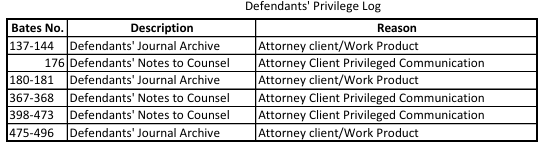
Here’s the core problem: Defendants withheld 111 pages as attorney-client privileged while using vague, category-style descriptions such as “Defendants’ Journal Archive” and “Defendants’ Notes to Counsel.”
That is not a privilege log that enables review. It is a label that disables it.
“Journal Archive” does not tell the opposing party what the document is (email, memo, compilation, timeline), who created it, who received it, when it was created, or why privilege applies. It’s a title masquerading as a description. And once a court accepts that, “privilege” becomes effectively immune from scrutiny—because no one can challenge what no one is allowed to evaluate.
What the two privilege logs reveal
If anyone still thinks this is “nitpicking,” the logs themselves end the debate.
Defendants’ privilege log (dated 5/12/2021) is six lines total—a short list of Bates ranges with generic labels (“Journal Archive,” “Notes to Counsel”) and generic privilege assertions (“Attorney client/Work Product,” “Attorney Client Privileged Communication”). It provides no dates, no times, no sender/recipient fields, and no subject-matter description that would let anyone evaluate the claim. That isn’t a log built for review; it’s a log built to shut review down.
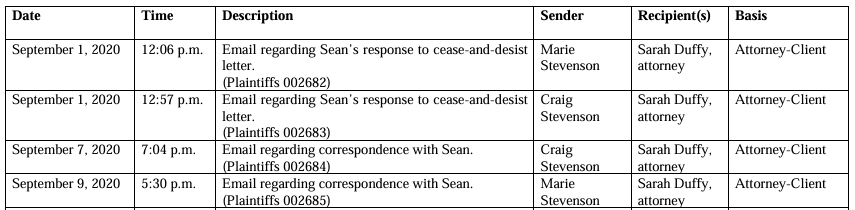
Plaintiffs’ amended privilege log, by contrast, is seven pages and is structured so privilege can be asserted without becoming unchallengeable: it identifies the communication with date/time, identifies who was involved, gives a meaningful description, and states the basis for withholding. That’s what an auditable log looks like.
This is the privilege-log problem in miniature: one side submitted a log designed to be evaluated; the other submitted a log that functioned as a blindfold.
Minnesota appellate courts have warned against “category-only” privilege claims
This isn’t a novel objection. Minnesota appellate courts have recognized that privilege claims cannot be accepted on bare labels or generalized categories when the description is too vague to test whether the privilege actually applies.
In Energy Policy Advocates v. Ellison (Minn. Ct. App. June 1, 2021), the Court of Appeals rejected privilege/work-product determinations that rested on generalized descriptions rather than proof that the withheld materials actually satisfied the elements of the privilege. The case was remanded with direction to use the normal tools that make privilege claims testable—specifically, to require “a privilege log itemizing each document and stating the legal basis” and to conduct in camera review of the withheld materials. (Energy Policy Advocates v. Ellison (COA).)
The point is simple: when privilege is asserted, courts have ways to verify it—a log that actually describes what is being withheld, and, where needed, in camera review. Accepting vague category labels instead of requiring those tools isn’t “efficiency.” It’s how privilege becomes unreviewable.
In other words, the remedy for vague privilege labels is not trust—it’s an itemized log with real identifying fields (date, author, recipients, description) and, where necessary, in camera review.
And timing matters. The Ellison (COA) opinion was already in effect months before Judge Miller’s December 21, 2021 order on the motions to compel. Yet in our case, the court accepted a privilege log that was not auditable and simultaneously held that a “common interest doctrine” applied to co-parties—resulting in no meaningful discovery into post-litigation inter-defendant communications and allowing Defendants to keep 111 pages hidden behind labels instead of testable descriptions. (Doc. 154.)
The imbalance: near-zero co-defendant communications produced, but 111 pages withheld
By the time of the motions to compel—almost a year into the case—the record reflects that Defendants had produced essentially no meaningful communications between themselves. Lisa Stevenson-Allen had produced no documents at all, relying instead on the document production of Sean and Renee Stevenson.
This prevented discovery of basic context such as date and time stamps on emails and any of Lisa’s responses or commentary surrounding key events. At that time, the only communication produced between co-Defendants was a single email exchange consisting of two sentences, while Defendants refused to provide substantive information about any other inter-defendant communications.
At the same time, the record reflects the opposite in what was withheld: 111 pages claimed as privileged—behind vague labels.
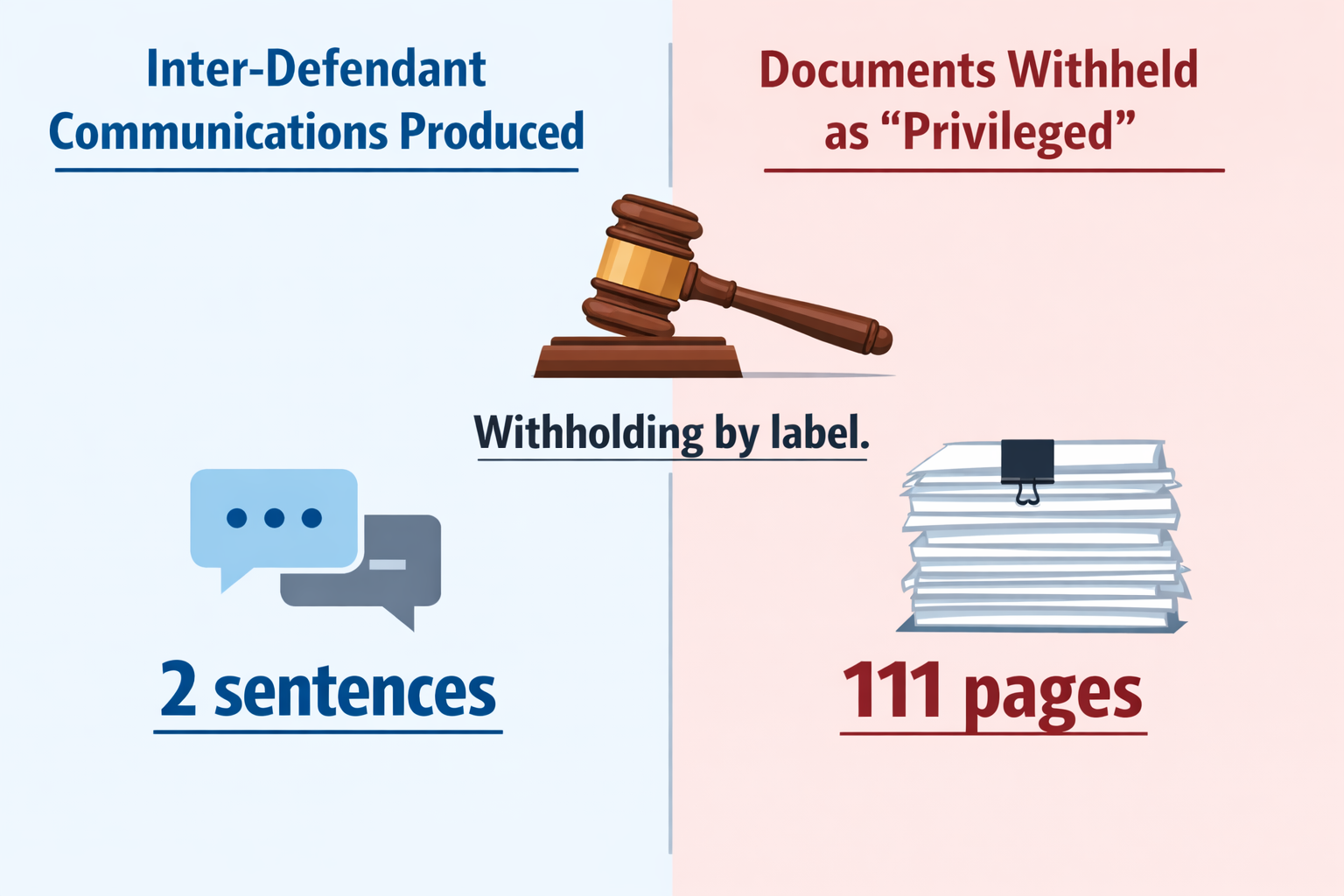
That disparity is where privilege stops being a protection and starts functioning like a weapon. When a party produces almost nothing in one category, then blocks a large set of documents from review with vague labels, the obvious question is not “why are Plaintiffs suspicious?” The question is:
“Do you want us to write down every single page?” — the dodge that collapses the rule
The privilege-log issue doesn’t fail because the rule is unclear. It fails because the demand for an auditable log gets reframed as an absurdity.
During the motion-to-compel hearing, defense attorney Kirsten Hansen defended the “Journal Archive” entry by saying: “Do you want us to write down every single page?” (Doc. 231, Tr. 15:14–25.)
Context: Defense counsel Kirsten Hansen has publicly identified retired Otter Tail County District Court Judge Mark F. Hansen as her father. (See disclosure/background: Judicial Officer Relationships.)
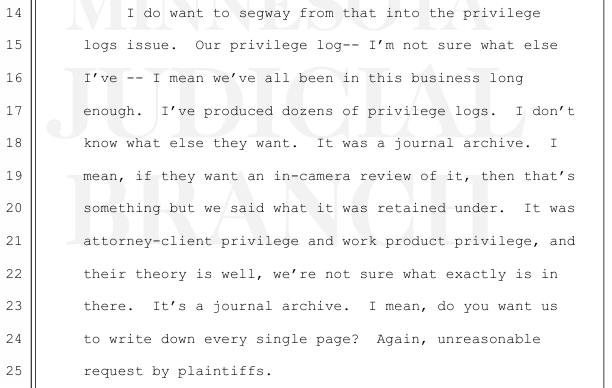
That question is a dodge. The rule is not “describe every word.” The rule is: provide enough identifying information so the claim can be tested. A party can comply without revealing privileged substance—by giving basic metadata and a meaningful description that allows the other side (and the court) to assess whether privilege is actually being applied correctly.
The Judge said it out loud: “I can limit discovery.”
Months before the later discovery and privilege-log ruling, Judge Kevin M. Miller stated on the record:
“I’m going to disagree on certain things regarding, I can limit discovery.” (Doc. 228, Tr. 13:17)
Read that sentence next to what happened later:
When a judge announces the power to “limit discovery,” and then later accepts no production by one Defendant and withholding by label for all Defendants, it’s hard for the public to avoid the conclusion that discovery wasn’t merely “managed.” It was cut down—and cut down in a way that protected one side’s communications from view or audit.
Discretion is real—but it isn’t supposed to erase accountability
In his Order Denying Plaintiffs’ Motions to Compel Discovery From Defendants (Doc. 154), Judge Miller emphasizes that Minnesota discovery rules are broad and “liberally construed,” citing Larson, and that district courts have broad discretion over discovery (citing In re Milk). (Doc. 154.)
But discretion is supposed to manage discovery fairly—not turn “privilege” into a black box.
“Technicalities and form” — and the sentence the order left out
The order frames our request as if it were a “technicality,” but Larson uses that language to justify broader disclosure—not less accountability.
Doc. 154 quotes Larson for the proposition that the rules should be “liberally construed … to discourage reliance on technicalities and form.” (Doc. 154.)
But Larson immediately follows that sentence with the point that actually applies to discovery disputes: “More to the point, we have consistently construed the discovery rules in favor of broad discovery.” Larson v. Indep. Sch. Dist. No. 314, 305 Minn. 358, 362–63, 233 N.W.2d 744, 747 (1975).
In other words: “don’t rely on technicalities” is not a license to let privilege logs become meaningless. It’s a reason to ensure discovery functions as discovery—especially when one side is withholding a large volume of material behind labels that cannot be evaluated.
And this privilege-log issue fits a broader pattern we’ve documented elsewhere: discovery and privilege rules can sound neutral in theory, but become lopsided in practice when one side is compelled to open wide access while the other side is permitted to withhold key categories behind unrecognized doctrines and untestable labels. For context, see I Can Limit Discovery, Distorting the Law – Spousal Privilege, Piercing Spousal Privilege, and Spousal Privilege.
A telling contrast: “liberal exchange of information” in Hammes
In another Otter Tail County case, Judge Miller addressed a motion-to-compel dispute very differently.
In Gregory P. Hammes and Stephanie C. Hammes v. Terry Magnuson, et al. (56-CV-20-794), Defendant Terry Magnuson objected that Plaintiffs had served 314 interrogatories—grossly exceeding the 50-interrogatory limit in Rule 33.01(a). (Hammes, Defendant’s Memorandum in Opposition to Motion to Compel, filed 7/13/2020.)
Judge Miller nevertheless granted the motion to compel and wrote:
“The Court will not engage in the tedious task of explaining whether each interrogatory is appropriate on a line-by-line, question-by-question basis.”
“Even if the subparts … were not factually related … the Court finds that the discovery process is best accomplished by the liberal exchange of information … [and] assuming arguendo that Plaintiffs did exceed the 50 interrogatory limit, there was good cause to do so.”
In Stevenson: 111 pages withheld behind six lines: “sufficient amount of detail.”
The same judge presided over both cases. If 314 interrogatories can be justified in the name of “liberal exchange of information,” why can’t a privilege log be required to contain the basic information needed to test 111 withheld pages? And that leads to the question this record forces:
Or put even more plainly: after stating “I can limit discovery,” did the court follow through by limiting it in a way that protected one side’s hidden documents from scrutiny? And if so, why?
What the Court ultimately did—and what that decision communicates
The Court denied all three motions to compel in their entirety. (Doc. 154.)
At the time of Doc. 154, the Minnesota Court of Appeals had already stated in Energy Policy Advocates v. Ellison that the common-interest doctrine is not recognized in Minnesota, yet Judge Miller’s order held that the common interest doctrine does apply to this matter. (Doc. 154.)
Readers can draw their own conclusions. The point here is narrower—and concrete: Minnesota’s appellate guidance already existed, and the practical effect of departing from it was to leave privilege claims effectively untestable and post-litigation co-defendant communications undiscovered.
The message to the public is unavoidable:
That is the privilege log problem: it turns discovery into a one-way mirror.
The takeaway
A privilege log is not a magic word. It’s the accountability mechanism that allows privilege to be asserted and tested. When a court condones withholding by label, it doesn’t just “manage discovery”—it quietly changes the rules in practice so that one side gets transparency and the other side gets darkness.
If you’re not a lawyer, here’s the quick plain-English version:
