

The Fairness Files:
Independent Judicial Investigation on Appeal
What Minnesota Cases Reveal About Independent Judicial Investigations
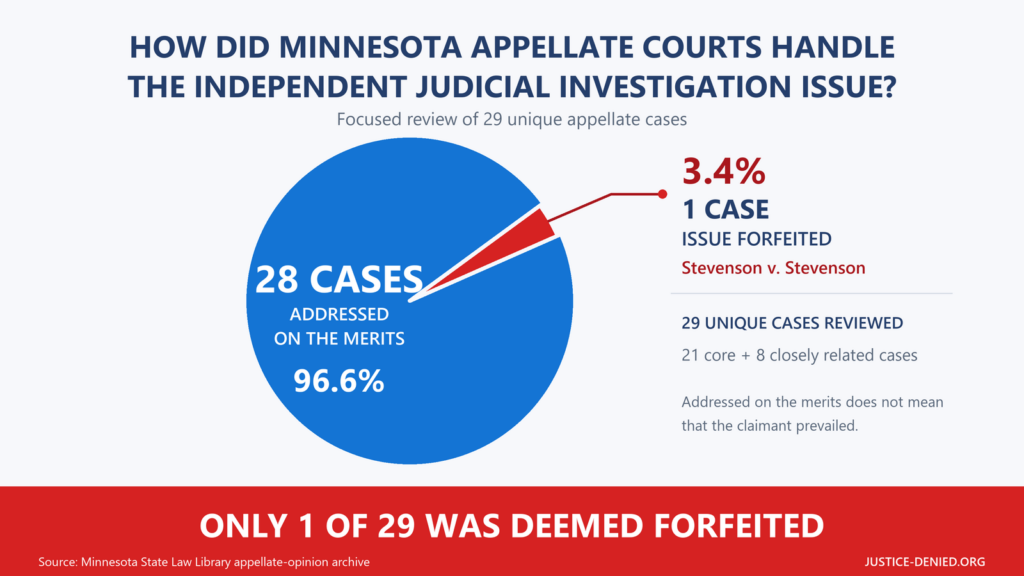
A review of Minnesota appellate decisions found 29 cases addressing whether a judge’s independent fact-gathering violated due process or the right to an impartial decision-maker. Only one disposed of the independent-investigation issue as forfeited.
When judges decide cases, they are ordinarily limited to the evidence presented by the parties and facts that may properly be judicially noticed. A judge who independently gathers facts risks leaving the neutral role of decision-maker and becoming an investigator.
To determine how Minnesota appellate courts have handled this problem, we searched the Minnesota State Law Library’s appellate-opinion archive for cases alleging either:
- A due-process violation caused by a judge’s independent investigation; or
- A denial of an impartial judge or fact-finder because the judge obtained, supplied, or relied upon information outside the evidentiary record.
The Findings at a Glance
- 29 cases addressed independent judicial investigation or a closely related due-process or impartiality claim.
- 12 cases found an investigation or extra-record reliance serious enough to require reversal or remand.
- 16 cases reached the merits but found no disqualifying investigation or loss of impartiality.
- 1 case expressly deemed the independent-investigation issue forfeited.
- The forfeiture rate was 3.4%.
Why This Count Differs From the Earlier 1-in-192 Graphic
An earlier Justice-Denied article, Independent Investigations – By The Numbers, used the Minnesota State Law Library’s raw phrase-search totals to show how rarely forfeiture appeared among opinions mentioning “independent investigation” or “own investigation.” Based on that broad tally, its accompanying graphic framed the comparison as one forfeiture out of 192.
That earlier figure was a useful first-pass indicator, but it was not a count of unique cases in which an appellate court actually decided the independent-investigation issue. Raw search results can overlap, can include more than one appellate opinion from the same case, and can capture decisions that use the search terms only in a citation, quotation, or unrelated context.
For this post, each opinion was individually reviewed. Multiple opinions from the same case were consolidated, and a case was counted only if the appellate court actually addressed judicial fact-gathering, extra-record reliance, due process, or impartiality. That narrower method produced 21 core cases and eight closely related cases—29 unique cases in all.
The two analyses therefore answer different questions. The earlier post measured how rarely forfeiture appeared across broad keyword results; this post measures how Minnesota appellate courts handled the issue in a screened set of relevant cases. The denominator changed from broad search hits to unique, substantively relevant cases. The central finding did not: Stevenson remains the only identified case in which the independent-investigation issue itself was expressly deemed forfeited.
Methodological update:
How the Cases Were Selected
Twenty-one cases treated independent judicial investigation, extra-record fact-finding, or reliance on facts outside the record as a principal issue.
Eight additional cases were included because the litigant alleged a due-process or impartiality violation based on comparable conduct, and the appellate court expressly considered whether that conduct amounted to an improper investigation or extra-record fact-finding.
Multiple appellate opinions in the same matter were counted as one case. For example, the Court of Appeals and Supreme Court decisions in State v. Dorsey were not counted separately.
The search excluded investigations conducted by police, prosecutors, agencies, attorneys, or jurors; opinions that merely cited an independent-investigation case without deciding such a claim; ordinary judicial legal research; and general bias allegations that did not involve independent fact-gathering or extra-record information.
The Minnesota State Law Library archive does not contain every Minnesota appellate opinion ever issued. Its stated coverage generally begins in May 1996. These findings therefore describe the cases available in the searchable archive through July 2026—not every decision in Minnesota history.
The 21 Core Independent-Investigation Cases
1.  State v. Dorsey — 2005
The trial judge openly questioned a defense witness’s testimony, directed a law clerk to investigate a disputed fact, disclosed the result, and relied on the discrepancy when evaluating credibility.
The Minnesota Supreme Court held that this conduct compromised Dorsey’s due-process right to an impartial judge and fact-finder. It established a “bright-line rule” against independent judicial investigations of facts in evidence.
Result: Reversed and remanded.
Forfeited: No. The claim was considered despite the absence of a contemporaneous objection.
2. State v. Blanshan — 2015
During a bench trial, the judge obtained an order from one of the defendant’s prior cases even though the order had not been admitted into evidence. The judge mistakenly treated it as trial evidence and cited it repeatedly when finding the defendant guilty.
Result: Reversed and remanded.
Forfeited: No.
3. State v. Weidenbach — 2017
The sentencing court relied on information obtained through an investigation outside the sentencing record. The Court of Appeals concluded that the defendant was deprived of his constitutional right to an impartial fact-finder.
Result: Reversed and remanded for resentencing.
Forfeited: No.
4. In re Welfare of A.J.G. — 2019
The district court independently investigated a factual assertion made by the juvenile and disclosed the results to the parties. The Court of Appeals classified the conduct as structural error.
Result: Reversed and remanded for a new trial.
Forfeited: No.
5. State v. Foote — 2020
Foote alleged that the court independently investigated information during probation-revocation proceedings. The State argued that the claim was forfeited because Foote did not seek the judge’s recusal.
The Court of Appeals expressly rejected that argument, explaining that a constitutional impartial-fact-finder claim is distinct from an ordinary recusal claim. It nevertheless concluded that the challenged information did not establish an improper investigation.
Result: Affirmed.
Forfeited: No—the State’s forfeiture argument was rejected.
6. State v. Leckner — 2020
The sentencing judge investigated the availability of services at a prison and relied on the resulting extra-record information when denying a sentencing departure.
Result: Reversed and remanded for resentencing.
Forfeited: No.
7. State v. Malone — 2021
The judge investigated how domestic-abuse no-contact orders were served, disclosed the investigation’s results, relied on those results in deciding a motion, and suggested a witness the State might call.
The Minnesota Supreme Court held that the investigation reasonably called the judge’s impartiality into question.
Result: Reversed and remanded.
Forfeited: No.
8. State v. Leonida — 2021
Leonida alleged that the sentencing judge independently investigated and relied on information about another felony order-for-protection violation.
The Court of Appeals concluded that, under what it described as the case’s unique circumstances, the judge did not violate Leonida’s constitutional right to an impartial fact-finder or the Code of Judicial Conduct.
Result: Affirmed.
Forfeited: No.
9. State v. McCorquodale — 2021
The judge relied on facts that were known to the judge but had not been introduced into evidence at trial. The Court of Appeals concluded that this deprived McCorquodale of an impartial fact-finder.
Result: Reversed and remanded for a new trial.
Forfeited: No.
10. State v. Scudder — 2022
At a restitution hearing, the judge independently investigated how a store priced its merchandise and revealed the results in open court.
Scudder did not object or respond when the judge disclosed the investigation. Nevertheless, the Court of Appeals reached the merits and held that the investigation was structural error.
Result: Reversed and remanded for a new restitution hearing.
Forfeited: No.
11. State v. Knopik — 2023
The sentencing judge received an unsolicited communication and sought clarification from a corrections agent. The parties were informed and allowed to respond.
The Court of Appeals held that the judge did not independently verify and rely on the communication’s truth. The opinion described the asserted error as unpreserved but did not deem the claim forfeited.
Result: Affirmed.
Forfeited: No.
12. State v. Bowlby — 2025
The district court relied on geographic, proximity, and route-related facts that were not presented by the parties. The State argued that this conduct demonstrated a lack of impartiality.
Result: Reversed and remanded.
Forfeited: No.
13. State v. Oxendine — 2025
The judge relied on personal knowledge from an earlier bail proceeding when making findings about whether Oxendine knew the terms of a domestic-abuse no-contact order. That information was not part of the trial record.
The Court of Appeals concluded that the judge exhibited emergent bias by relying on prejudicial extra-record information.
Result: Conviction reversed and remanded for a new trial on the affected charge.
Forfeited: No.
14. Stevenson v. Stevenson — 2025
The district court assembled information concerning a possible conflict involving a law clerk and used its resulting factual findings when deciding a disqualification motion.
The Court of Appeals stated that the parties did not object or argue in district court that the investigation was improper. It therefore held:
“This issue was not preserved for appeal and is forfeited.”
The court added that disqualification motions are unique because a judge may need to consider information about a possible conflict within the judge’s chambers.
Result: Affirmed.
Forfeited: Yes.
15. State v. Duol — 2025
The postconviction judge deliberately investigated and considered extra-record facts when deciding Duol’s petition.
The Minnesota Supreme Court held that deliberate independent fact-gathering violates the constitutional right to an impartial judge and constitutes structural error under the Minnesota Constitution’s Due Process Clause.
Result: Reversed in part and remanded.
Forfeited: No.
16. State v. Jones — 2025
After Jones failed to appear for trial, the judge investigated the circumstances of his absence to determine whether he had forfeited his right to be present.
The Court of Appeals concluded that this inquiry did not violate Jones’s right to an impartial judge because the court was legally required to investigate whether the absence was voluntary.
Result: Affirmed. However, a Petition for Review (PFR) was granted by the Minnesota Supreme Court on the independent judicial investigation issue, and oral argument is scheduled for August 31, 2026.
Forfeited: No.
17. State v. Boettcher — 2025
Boettcher alleged that the judge independently investigated facts underlying an evidentiary ruling. The Court of Appeals agreed that the court improperly investigated facts outside the record.
Result: Reversed and remanded.
Forfeited: No.
18. State v. Fields — 2026
Fields alleged structural error based on an independent investigation. The record showed that the judge reviewed material from an earlier proceeding in Fields’s current case.
The Court of Appeals concluded that reviewing the existing record was not an independent investigation.
Result: Affirmed.
Forfeited: No.
19. State v. Hill — 2026
Hill alleged that the judge independently investigated facts outside the record while reconsidering a suppression ruling. The Court of Appeals concluded that Hill had not established that an independent investigation occurred.
Result: No relief on the investigation claim.
Forfeited: No.
20. Glover v. State — 2026
Glover alleged that the trial judge advocated for the State and independently researched disputed facts.
The Minnesota Supreme Court determined that the judge’s research was legal rather than factual and that the judge’s questions sought clarification of matters already raised by the parties.
Result: Affirmed.
Forfeited: No. Although the postconviction court identified a procedural bar, the Supreme Court addressed the impartiality allegations on their merits.
21. State v. Truelove — 2026
Truelove argued that independent research conducted while the court considered a sentencing departure deprived him of an impartial judge.
The Court of Appeals concluded that the conduct was not an independent investigation into facts in evidence.
Result: Affirmed.
Forfeited: No.
Eight Additional Due-Process and Impartiality Cases
These cases involved closely related allegations concerning judicial use of extra-record information, communications, questioning, or knowledge. In each, the appellate court considered whether the conduct amounted to an independent investigation or loss of impartiality.
22. State v. Ehrmantraut — 2010
The judge supplied facts learned in a related proceeding during a bench trial. The Court of Appeals determined that the facts were peripheral and nonprejudicial.
Result: Affirmed.
Forfeited: No.
23. In re Marriage of Knight — 2014
The judge communicated with another judge and obtained information about a related case. The Court of Appeals concluded that the communication concerned scheduling and overlapping proceedings, not an improper factual investigation.
Result: Affirmed.
Forfeited: No.
24. State v. Siltman — 2015
The judge questioned the State’s expert and allegedly investigated facts or acted as an advocate. The Court of Appeals concluded that the questions clarified evidence already presented.
Result: Affirmed.
Forfeited: No.
25. State v. Cardinale — 2020
The judge allegedly investigated a failed polygraph and treatment information outside the record. The Court of Appeals determined that the information was contained in admitted probation materials.
Result: Affirmed.
Forfeited: No.
26. State v. Richards — 2022
The sentencing judge allegedly relied on information outside the record. The Court of Appeals determined that the information appeared in the warrant of commitment and presentence report.
Result: Affirmed.
Forfeited: No.
27. In re Welfare of M.B.W. — 2023
The judge relied on a fact remembered from a related restraining-order proceeding and asked a witness to confirm it. The Court of Appeals characterized the exchange as confirmation, not an independent investigation.
Result: Affirmed.
Forfeited: No.
28. State v. Lopez — 2023
An unsupported factual finding suggested that the judge might have independently researched pandemic-related business closures. The Minnesota Supreme Court concluded that the record did not support an inference of active investigation and that the erroneous finding was harmless.
Result: Affirmed.
Forfeited: No.
29. State v. Kaneakua — 2023
The judge allegedly used extra-record information from the defendant’s other criminal cases. The Court of Appeals concluded that the information was in the current court file and concerned scheduling.
Result: Affirmed.
Forfeited: No.
Why Stevenson Stands Apart
The cases do not establish a general rule that an objection is unnecessary in every circumstance. They do, however, show that Minnesota appellate courts have repeatedly reached investigation-based impartiality claims despite the absence of a contemporaneous objection.
Among the clearest examples:
- In Dorsey, defense counsel neither objected nor sought the judge’s removal. The claim was nevertheless reviewed, and the Supreme Court reversed.
- In Foote, the State expressly argued forfeiture. The Court of Appeals rejected that argument and reached the merits.
- In Scudder, the defendant did not object or respond when the judge revealed the investigation. The Court of Appeals still found structural error and reversed.
- In Knopik, the court described the asserted error as unpreserved but decided whether an improper investigation occurred.
- In Jones, the court reached the investigation and impartiality questions rather than disposing of them through forfeiture.
Against that background, Stevenson is not merely one more affirmance. Within the 29-case population, it is the only decision that expressly ended the independent-investigation claim by declaring it forfeited.
What the Numbers Do—and Do Not—Show
The numbers establish three points.
First, independent judicial investigation is usually treated as an impartiality question with constitutional significance, not simply an ordinary evidentiary mistake.
Second, Minnesota appellate courts frequently review these claims even when the party did not make a contemporaneous objection. That is especially true when the challenged conduct allegedly created structural error or compromised the neutrality of the decision-maker.
Third, Stevenson represents an unusual procedural outcome. Only one of the 29 identified cases—3.4%—expressly deemed the independent-investigation issue forfeited.
The research does not, by itself, establish why Stevenson was treated differently or whether its forfeiture ruling was legally correct. It does establish that the ruling is an outlier within the searchable Minnesota appellate record.
Sources and Research Note
Every case cited above links directly to the official opinion maintained by the Minnesota State Law Library.
The research included precedential, nonprecedential, published, and unpublished appellate opinions. Search terms included combinations and variants of “independent investigation,” “own investigation,” “independent research,” “extra-record facts,” “outside the record,” “due process,” “impartial judge,” “impartial fact-finder,” “forfeited,” “waived,” and “not preserved.”
AI Disclosure:
