

When Lawyers Mislead Minnesota Courts
Candor Is Not Optional
In Minnesota, a lawyer’s duty of advocacy has a hard boundary: the lawyer may argue forcefully, interpret the record favorably, and press every good-faith legal position available to the client. But a lawyer may not knowingly misstate the facts, misstate the law, submit false evidence, or allow a court to be misled by a statement the lawyer knows is false.
That principle is not a courtesy rule. It is a professional obligation enforced through Minnesota’s lawyer-discipline system.
The Rule: Candor Toward the Tribunal
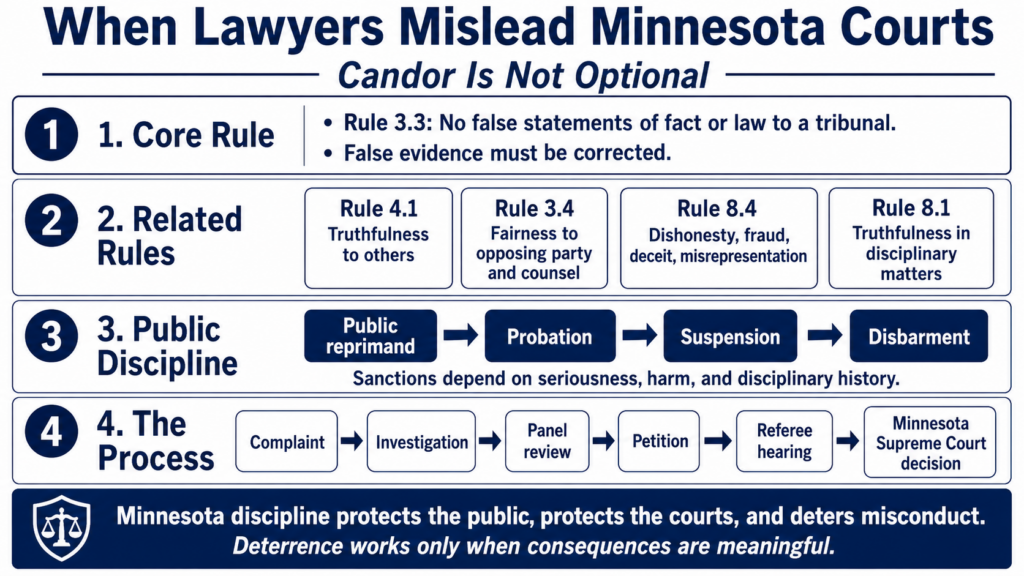
The central rule is Minnesota Rule of Professional Conduct 3.3, titled “Candor Toward the Tribunal.”
Rule 3.3(a)(1) provides that a lawyer shall not knowingly “make a false statement of fact or law to a tribunal, or fail to correct a false statement of material fact or law previously made to the tribunal by the lawyer.” Minn. R. Prof. Conduct 3.3(a)(1).
That matters because courts decide cases based on the record, the parties’ filings, oral argument, affidavits, exhibits, and the law presented to them. If a lawyer knowingly gives the court a false factual or legal premise, the problem is not merely that the opposing party may be disadvantaged. The problem is that the judicial process itself has been compromised.
Rule 3.3 also reaches false evidence. A lawyer may not offer evidence the lawyer knows to be false. If a lawyer, the lawyer’s client, or a witness called by the lawyer has offered material evidence and the lawyer later comes to know of its falsity, the lawyer must take reasonable remedial measures. In some circumstances, those remedial measures may include disclosure to the tribunal. Minn. R. Prof. Conduct 3.3(a)(3).
The rule’s comments explain the reason. A lawyer is an advocate, but also an officer of the court. The adversary system permits persuasion; it does not permit knowingly misleading the judge.
False Statements Are Not Limited to Courtroom Testimony
The duty of candor is not limited to sworn testimony. It can apply to written filings, affidavits, oral argument, statements in open court, representations in motion practice, and legal arguments that depend on knowingly false statements of law.
Rule 3.3’s comment recognizes that lawyers often file pleadings and papers based on information supplied by clients or others. But when a lawyer makes an assertion as the lawyer’s own statement—such as in an affidavit, certification, memorandum, or statement in court—the lawyer may do so only when the lawyer knows it is true or believes it is true after a reasonably diligent inquiry. Minn. R. Prof. Conduct 3.3 cmt. 3.
Legal argument is also covered. A lawyer is not required to present the law neutrally, but legal argument based on a knowingly false representation of law is treated as dishonesty toward the tribunal. Minn. R. Prof. Conduct 3.3 cmt. 4.
Related Rules: Truthfulness, Evidence, and Dishonesty
Rule 3.3 is not the only Minnesota ethics rule that addresses truthfulness.
Rule 4.1, titled “Truthfulness in Statements to Others,” states that, in representing a client, a lawyer shall not knowingly “make a false statement of fact or law.” Minn. R. Prof. Conduct 4.1.
Rule 3.4, titled “Fairness to Opposing Party and Counsel,” prohibits a lawyer from falsifying evidence, assisting a witness to testify falsely, or knowingly disobeying an obligation under the rules of a tribunal, unless the lawyer openly refuses based on a claim that no valid obligation exists. Minn. R. Prof. Conduct 3.4(b), (c).
Rule 8.4, titled “Misconduct,” makes it professional misconduct for a lawyer to engage in “dishonesty, fraud, deceit, or misrepresentation,” or conduct prejudicial to the administration of justice. Minn. R. Prof. Conduct 8.4(c), (d).
And if a lawyer is responding to a disciplinary matter, Rule 8.1 separately prohibits a lawyer from knowingly making a false statement of material fact or failing to correct a known misapprehension in the disciplinary process. Minn. R. Prof. Conduct 8.1(a), (b).
Together, these rules reflect a basic principle:
Why the Minnesota Supreme Court Treats This Conduct Seriously
Minnesota attorney discipline is often described as not being imposed solely to punish the attorney. The Minnesota Supreme Court has repeatedly stated that the purpose of attorney discipline is to protect the public, protect the judicial system, and deter future misconduct by the disciplined attorney and by other lawyers. See, e.g., In re Klotz, 909 N.W.2d 327, 335 (Minn. 2018); In re Pitera, 827 N.W.2d 207, 210 (Minn. 2013).
That principle is important. Discipline should not be arbitrary, retaliatory, or driven by anger. But the idea that discipline is “not punishment” should not be misunderstood as a reason to minimize serious misconduct. Protection of the public, protection of the courts, and deterrence all require consequences that are meaningful enough to matter.
If discipline becomes too mild in the face of serious or knowing misconduct, it risks sending the wrong message. A lawyer weighing whether to shade the truth, omit a material fact, misstate the record, or mislead the court may conclude that the professional cost is simply not high enough to change the behavior. In that sense, inadequate discipline can undermine the very purposes the Minnesota Supreme Court identifies: public protection, protection of the judicial system, and deterrence.
False statements to courts strike directly at those interests. A court cannot administer justice if lawyers knowingly distort the facts, misstate the law, or allow false evidence to stand uncorrected. The court system depends on adversarial testing, but adversarial testing assumes that officers of the court will not knowingly feed the tribunal false information.
This is why discipline for false statements can range from a public reprimand to suspension and, in severe cases involving cumulative misconduct and aggravating factors, disbarment.
Meaningful Deterrence Is Part of Public Protection
The Minnesota Supreme Court’s statement that discipline is not imposed merely to punish should not be read as a license for weak consequences. Deterrence is one of the stated purposes of discipline. And deterrence requires that misconduct carry a cost that lawyers actually recognize as serious.
That is especially true when the misconduct involves dishonesty toward a court. A lawyer who knowingly misleads a judge is not simply violating a private duty to a client or opposing counsel. The lawyer is interfering with the court’s ability to decide the matter fairly. If the consequence is too small, the system risks creating a dangerous incentive: mislead first, correct only if caught, and treat discipline as a manageable professional expense.
That is not public protection. It is not protection of the judicial system. And it is not meaningful deterrence.
Examples From Minnesota Attorney-Discipline Cases
Minnesota Supreme Court disciplinary decisions show that false statements to courts are not treated as minor technical violations.
In In re Michael, the Minnesota Supreme Court imposed a 30-day suspension where the attorney made a false statement to a court, disobeyed a court order, made a frivolous argument, and improperly accused a judge of bias. In re Michael, 836 N.W.2d 753, 758–59, 767 (Minn. 2013).
In In re Van Liew, the court imposed a 90-day suspension for making a false statement to a tribunal and failing to file opposition to a motion. In re Van Liew, 712 N.W.2d 758, 758 (Minn. 2006) (order). Although a direct Minnesota Law Library archive copy of this older order may not be readily available online, the Minnesota Supreme Court has cited and described the sanction in later public disciplinary decisions. See, e.g., In re Petition for Disciplinary Action Against Dinneen, No. A14-0537 (Minn. July 9, 2014).
In In re Scott, the court imposed a 30-day suspension for false statements to a court in the attorney’s own divorce and custody proceeding. In re Scott, 657 N.W.2d 567, 568 (Minn. 2003) (order). As with some older disciplinary orders, direct archive access may be limited, but the Minnesota Supreme Court has repeatedly cited the case as an example of discipline for false statements to a court. See, e.g., In re Petition for Disciplinary Action Against Dinneen, No. A14-0537 (Minn. July 9, 2014).
In In re Winter, the court imposed a suspension with no right to petition for reinstatement for 120 days where the attorney knowingly made a false statement to a tribunal and to another attorney and failed to correct the false statement. In re Winter, 770 N.W.2d 463, 465, 470 (Minn. 2009).
In In re Dinneen, the lawyer admitted allegations that included filing an unsigned affidavit without having communicated with the affiant about the affidavit and making a knowingly false statement to a court. The court publicly reprimanded the lawyer and imposed two years of supervised probation. The order is notable because the court expressly observed that Minnesota has suspended attorneys for misrepresentations made to judicial officers, and the court required additional briefing on whether a more severe sanction was warranted. In re Petition for Disciplinary Action Against Dinneen, No. A14-0537 (Minn. July 9, 2014).
More recently, in In re McCloud, the Minnesota Supreme Court disbarred an attorney whose misconduct included repeatedly neglecting a client matter, failing to communicate plea offers, making a knowingly false statement to a court, and keeping an unearned portion of a flat fee. The court emphasized several aggravating factors, including the attorney’s extensive disciplinary history, lack of remorse, significant legal experience, and the intentional nature of the misconduct. In re Petition for Disciplinary Action Against McCloud, No. A24-0509 (Minn. Oct. 15, 2025).
These cases do not mean that every false-statement allegation produces the same sanction. Discipline depends on the nature of the misconduct, the cumulative weight of the violations, harm to the public, harm to the legal profession, aggravating factors, mitigating factors, and the lawyer’s disciplinary history. But the pattern is clear: false statements to a court are serious professional misconduct.
Real-World Consequences: Discipline, Sanctions, and Fraud on the Court
False statements to a tribunal are not merely “bad advocacy.” They can have real-world consequences for the opposing party, the court, the public, and the lawyer who makes or fails to correct them.
At the case level, a false statement can distort the court’s understanding of the record, affect motion practice, increase litigation costs, force the opposing party to spend time and money correcting the record, and delay or deny a fair decision. At the system level, false statements undermine confidence that courts are deciding cases based on facts, law, and evidence rather than gamesmanship.
Minnesota’s civil rules recognize some of those consequences. Under Minnesota Rule of Civil Procedure 11, an attorney who presents a pleading, written motion, or other document to the court certifies that the factual contentions have evidentiary support and that legal contentions are warranted by existing law or by a nonfrivolous argument for changing the law. Minn. R. Civ. P. 11.02(b), (c). If Rule 11.02 is violated, the court may impose an “appropriate sanction,” including nonmonetary directives, penalties, or attorney-fee awards when warranted for effective deterrence. Minn. R. Civ. P. 11.03.
Minnesota Rule of Civil Procedure 60.02 also recognizes that fraud, misrepresentation, or other misconduct by an adverse party may justify relief from a final judgment, order, or proceeding. Minn. R. Civ. P. 60.02(c). The rule further states that it does not limit a court’s power to set aside a judgment for fraud upon the court. Minn. R. Civ. P. 60.02.
That does not mean every false statement automatically constitutes fraud on the court. Courts generally treat fraud on the court as a more serious, more exceptional doctrine. In Maranda v. Maranda, the Minnesota Supreme Court explained that ordinary fraud and fraud on the court must be distinguished because fraud on the court can eliminate the normal time restriction for seeking relief from judgment. Maranda v. Maranda, 449 N.W.2d 158, 165 (Minn. 1989).
The court also discussed federal formulations of the doctrine, including descriptions of fraud on the court as a “scheme to interfere with the judicial machinery” and as an “unconscionable plan or scheme” designed to improperly influence the court’s decision. Maranda, 449 N.W.2d at 165. In ordinary civil litigation, courts often apply the doctrine narrowly, reserving it for the most serious misconduct directed at the judicial process itself, such as fabricated evidence, bribery, or conduct by officers of the court that corrupts the court’s ability to perform its adjudicative function.
The United States Supreme Court’s decision in Hazel-Atlas Glass Co. v. Hartford-Empire Co. illustrates the point. There, the Court set aside a judgment after a fraud was carried through the Patent Office and into the courts, including through use of an article falsely presented as the work of a disinterested author. Hazel-Atlas Glass Co. v. Hartford-Empire Co., 322 U.S. 238, 246–51 (1944). The Court treated the misconduct not merely as a private wrong between litigants, but as an attack on the integrity of the judicial process.
That distinction should not minimize the seriousness of false statements. Even when misconduct does not meet the high threshold for fraud on the court, it can still violate the Rules of Professional Conduct, mislead the tribunal, increase litigation costs, damage the opposing party, and erode public confidence in the courts.
In short, the question is not simply whether a lawyer’s false statement “worked.” The deeper question is whether the lawyer’s conduct interfered with the court’s ability to decide the case honestly, fairly, and on the record before it.
How the Minnesota Lawyer-Discipline Process Works
Minnesota’s attorney-discipline system is overseen by the Minnesota Supreme Court. The Office of Lawyers Professional Responsibility investigates and prosecutes lawyer-misconduct matters. The Lawyers Professional Responsibility Board and its panels play a role in reviewing serious matters before public discipline is pursued.
In simplified form, the process generally works this way:
- A complaint is submitted or information is received.
- The matter may be dismissed, investigated, or referred for further review.
- Less serious isolated misconduct may result in private discipline or other nonpublic resolution.
- Serious misconduct may be presented to a Lawyers Professional Responsibility Board panel for review.
- If public discipline is authorized, the Director files a Petition for Disciplinary Action with the Minnesota Supreme Court.
- The Supreme Court may appoint a referee to conduct an evidentiary hearing and make findings of fact, conclusions of law, and a recommended discipline.
- The Minnesota Supreme Court makes the final decision on public discipline.
Public discipline may include a public reprimand, probation, suspension, or disbarment. Private discipline and dismissed matters are generally confidential. Public discipline, by contrast, is issued by the Minnesota Supreme Court and becomes part of the public record.
That distinction is important. Allegations alone are not discipline. A private complaint is not proof. A public disciplinary petition is not a final finding. But when the Minnesota Supreme Court issues a public disciplinary order, that order becomes an official statement by the state’s highest court about the lawyer’s professional conduct.
Why This Matters to Judicial Transparency
Judicial fairness depends on truthful advocacy. Judges rely on lawyers to identify the record accurately, cite the law honestly, and correct material misstatements when they occur. When lawyers fail in that duty, the harm extends beyond one motion, one hearing, or one case. It affects public confidence in the courts.
That is why the duty of candor is not a side issue. It is one of the structural supports of the adversary system.
A lawyer may be zealous. A lawyer may be creative. A lawyer may argue every reasonable inference in the client’s favor. But a lawyer may not knowingly mislead the tribunal.
When future public disciplinary decisions involve false statements to a court, the question should not be whether the lawyer was a vigorous advocate. The question should be whether advocacy crossed the line into dishonesty—and whether Minnesota’s disciplinary system responded in a way that protects the public, protects the courts, deters future misconduct, and preserves confidence in the rule of law.
