


Key Takeaways
- The eggshell plaintiff rule generally holds wrongdoers responsible for harm even when a victim is unusually vulnerable.
- Under Minnesota IIED law, a defendant’s knowledge of a person’s peculiar susceptibility can affect whether conduct is considered extreme and outrageous.
- Cafferty makes that knowledge legally relevant but does not eliminate IIED’s demanding requirements.
What the Eggshell Plaintiff Rule Means in Minnesota
The first time I heard the term “eggshell plaintiff,” I misunderstood it completely.
It was near the beginning of our lawsuit, and to me, the words sounded insulting. I pictured someone fragile, weak or sickly — someone the Defense could point to and say, essentially, There was already something wrong with her.
I assumed being labeled an “eggshell plaintiff” would be a bad thing.
I eventually learned that I had it almost exactly backwards.
The eggshell plaintiff rule—also called the eggshell skull rule—is not supposed to punish a person for being vulnerable. It exists because the law recognizes that human beings do not all react to the same injury in the same way. Some people have physical vulnerabilities. Others have emotional or psychological vulnerabilities. A wrongdoer does not ordinarily get to escape responsibility simply because the person he injured happened to be more susceptible to harm than someone else might have been.
The traditional formulation is simple: You take your victim as you find them. The Cornell Legal Information Institute describes the eggshell-skull rule as holding a defendant responsible for the full extent of harm caused by a wrongful act, even when the victim’s reaction is unusually severe or unforeseeable. Read Cornell’s explanation of the eggshell-skull rule.
The Literal “Eggshell” Example
There is actually a medical condition that provides an almost perfect illustration. Osteogenesis imperfecta, sometimes called brittle bone disease, is a genetic disorder in which a person’s bones can fracture very easily — sometimes from minimal injury. The National Institutes of Health explains osteogenesis imperfecta here.
Imagine two people sitting in identical cars at a stoplight. The driver behind them negligently crashes into each car at the same speed.
One victim walks away with a sore neck.
The other has osteogenesis imperfecta and suffers multiple serious fractures.
The driver who caused the collision cannot ordinarily say:
“That isn’t my responsibility. A normal person’s bones would not have broken.”
That is the essence of the eggshell plaintiff rule. The wrongdoer takes the injured person as he finds that person. An unusual vulnerability does not reduce the consequences for which the wrongdoer may be responsible.
And importantly, under the traditional eggshell plaintiff rule, the wrongdoer does not even need to know about the vulnerability beforehand.
But now change the hypothetical.
Suppose the driver behind the person with osteogenesis imperfecta knows about the condition. He knows that even a relatively minor impact could cause serious injury. And instead of accidentally failing to stop, he deliberately steps on the accelerator and drives into the person’s car.
That additional fact — knowledge — takes us beyond the simplest eggshell-plaintiff concept and into something especially important in a claim for intentional infliction of emotional distress.
When the Defendant Knows Where the Vulnerability Is
Minnesota recognizes the tort of Intentional Infliction of Emotional Distress, commonly abbreviated IIED.
In Hubbard v. United Press International, Inc., the Minnesota Supreme Court recognized IIED as an independent tort and set out its demanding requirements. Read Hubbard v. United Press International, Inc.
Generally speaking, an IIED plaintiff must establish four things:
- The defendant’s conduct was extreme and outrageous;
- the conduct was intentional or reckless;
- the conduct caused emotional distress; and
- the emotional distress was severe.
Minnesota courts have deliberately set a high bar for this tort. Ordinary insults, disagreements, unpleasant behavior and hurt feelings are not enough.
But there is another principle that becomes enormously important when the defendant already knows that the person being targeted has a particular vulnerability.
In Cafferty v. Garcia’s of Scottsdale, Inc., the Minnesota Court of Appeals discussed what the Restatement of Torts calls a person’s “peculiar susceptibility” to emotional distress. Read Cafferty v. Garcia’s of Scottsdale, Inc.
The principle is that conduct may become extreme and outrageous because the actor knows that another person is especially susceptible to emotional distress because of a physical or mental condition. Conduct that might not otherwise cross the legal line can become much more serious when someone knowingly proceeds in the face of that vulnerability.
The Minnesota Court of Appeals stated that a defendant’s knowledge of a plaintiff’s peculiar susceptibility “may lower the burden of production of evidence of outrageous conduct.” That does not mean vulnerability automatically proves IIED; it means the defendant’s knowledge can matter when the conduct itself is evaluated. See the full Cafferty decision.
That is a very different concept from the one I originally imagined when I heard the words “eggshell plaintiff.”
The law was not saying:
This person is weak.
It was saying:
You knew this particular person was especially vulnerable to this particular harm. What did you do with that knowledge?
Why That Mattered in Our Case
That distinction became particularly significant to me because of the facts underlying our own lawsuit.
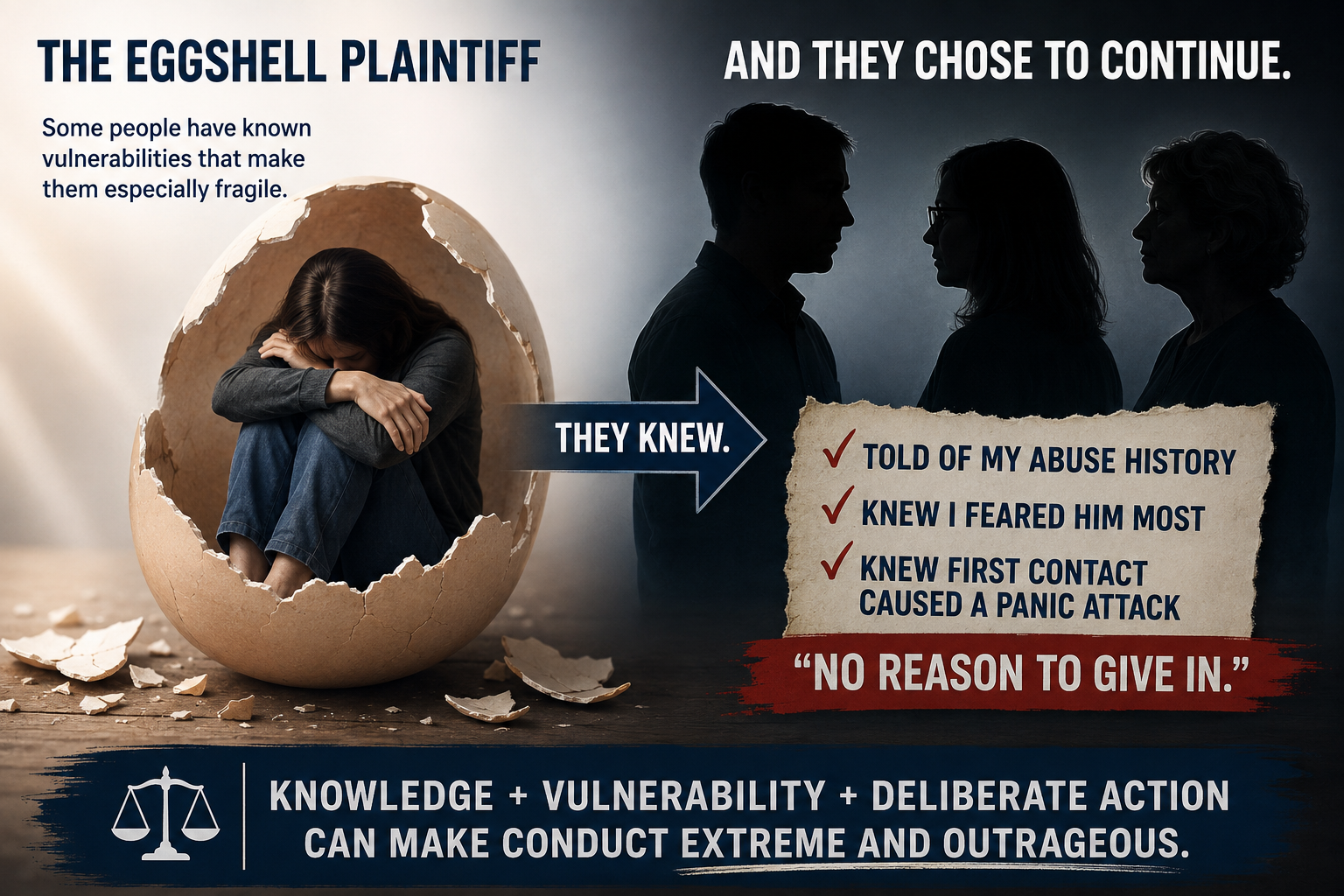
Our case involved conduct by Craig’s family members who were not strangers to my history.
They had been told that I had been abused by my father.
They had been told that I had left home at age 16 to escape.
They had been told that I feared him more than anyone else in the United States.
They had been told that we had a security plan in place, and considered him a threat to our family.
My fear of my father was not something invented for a lawsuit decades later. It was longstanding.
As a child and minor, I had experienced numerous panic attacks related to my father. At one point, I had feared for my safety.
And most importantly, when Defendants – Craig’s sister (Lisa Stevenson-Allen, an LPCC) and his estranged son (Sean Stevenson of Rosemount, MN) – made their first contact with him, they were told that the contact had caused me to have a panic attack.
They therefore had information about both the history and the present-day effect.
Yet the contacts continued.
At one point, Sean sent a text to Lisa (a licensed counselor) indicating that he and his mother, Renee C. Stevenson (Rosemount, MN), saw “no reason to give in.”
To me, that evidence was important for a reason I did not fully understand when our lawsuit began.
This was not simply a question of whether another hypothetical person would have been terribly distressed by the same conduct.
It was a question of what these Defendants knew about this particular person before they continued doing it.
That is the principle I wish I had understood when I first heard the term “eggshell plaintiff.”
The Case Law We Put Before the Court
There is another aspect of our case that makes Cafferty v. Garcia’s of Scottsdale, Inc. particularly difficult for me to overlook.
In our memorandum opposing summary judgment, we cited Cafferty four separate times. We were not asking the court to invent a new theory of emotional-distress liability. We were pointing to a Minnesota Court of Appeals decision discussing precisely the circumstance that mattered to us: a defendant’s knowledge that a particular plaintiff is unusually susceptible to emotional distress.
Cafferty explains that the extreme and outrageous character of conduct may arise from the actor’s knowledge that another person is peculiarly susceptible to emotional distress. Quoting the Restatement, the Minnesota Court of Appeals explained that conduct can become “heartless, flagrant, and outrageous” when an actor proceeds in the face of such knowledge, even though the same conduct might not be outrageous if the actor did not know of the vulnerability.
The court also recognized another important consequence of that knowledge. Emotional distress that might otherwise appear exaggerated when compared with the reaction of an ordinary reasonable person may still be actionable when the heightened reaction results from a peculiar susceptibility of which the defendant had knowledge.
Yet in his June 16, 2023 summary-judgment order, Document 429, Judge Kevin Miller wrote:
“Plaintiffs cite no case, in this or any other jurisdiction, where an emotional distress claim was sustained based on such a theory, and the Court discovers none.”
That statement is especially difficult to understand because Judge Miller was already familiar with Cafferty.
Only six months earlier, in his December 6, 2022 order addressing six pretrial motions, Document 366, Judge Miller himself cited the case while discussing my IIED claim:
“Marie’s IIED claim against Sean requires proving that she ‘suffered severe emotional distress’ that was the ‘result of the extreme and outrageous conduct.’ Langeslag, 664 N.W.2d at 869. She must show ‘a causal connection between the conduct and the emotional distress.’ Id. at 869. Her distress is not actionable if it was caused by ‘preexisting conditions’ that were not ‘specifically aggravated by [Sean’s] conduct.’ Id. Moreover, if some preexisting condition gave her ‘a peculiar susceptibility to such distress,’ then she cannot recover for distress caused by that condition, in excess of what a reasonable person would experience, unless Sean ‘had knowledge’ of the condition. Cafferty v. Garcia’s of Scottsdale, Inc., 375 N.W.2d 850, 853 (Minn. App. 1985).”
That earlier description captures exactly why Cafferty mattered to our case.
Our theory was not merely that I had a preexisting vulnerability and therefore suffered more than an average person might have suffered. We contended that Defendants knew about the vulnerability, knew what had caused it, and received direct evidence of its continuing effect when their first contact with my father resulted in a panic attack. We alleged that they nevertheless continued the conduct.
Cafferty does not dictate the result of every IIED case involving a vulnerable plaintiff. The Minnesota Court of Appeals repeatedly emphasized that IIED still requires genuinely extreme and outrageous conduct and severe emotional distress. But Cafferty does establish that knowledge of a plaintiff’s peculiar susceptibility is legally relevant to both the evaluation of the defendant’s conduct and the plaintiff’s unusually severe reaction.
That distinction could have been important under Minnesota’s summary-judgment standard.
If the evidence is evaluated as though the relevant question were simply, Would an ordinary person have experienced this degree of emotional distress?, a plaintiff with an unusual vulnerability begins at an obvious disadvantage. But Cafferty instructs courts not to end the analysis there when the defendant knew of the vulnerability. The defendant’s knowledge becomes part of the legal context in which both the conduct and the resulting distress are evaluated.
Consequently, failing to address Cafferty could have affected the outcome in at least two interconnected ways.
First, it could have caused the alleged conduct to be evaluated without giving appropriate weight to Defendants’ prior knowledge. Conduct that might appear insufficiently outrageous when viewed in isolation can take on a different character when the actor knows that it is directed at a particular vulnerability.
Second, it could have caused the severity of my reaction to be measured too heavily against that of a hypothetical ordinary person, without adequately accounting for Cafferty‘s recognition that an unusually severe reaction may matter differently when the defendant knew of the plaintiff’s peculiar susceptibility.
That does not establish that citation to Cafferty required Judge Miller to deny summary judgment. Courts can distinguish precedent, find factual differences, or conclude that other elements of a claim remain unsupported. But if a court rejects a theory on the stated ground that no supporting case exists, the existence of a Minnesota appellate decision addressing that very legal principle is significant.
And here, Cafferty was not an obscure decision that had never been brought to the court’s attention.
We cited it four times.
Judge Miller had cited it himself six months earlier.
For me, that makes what happened at summary judgment an important part of the story of the eggshell plaintiff in our case. The very authority explaining why a defendant’s knowledge of vulnerability matters was before the court, yet the summary-judgment order stated that no case supporting such a theory had been cited or discovered.
The “Reasonable Person” Problem
IIED law frequently uses language about what a “reasonable person” could be expected to endure.
At first glance, that can seem devastating to someone whose reaction is unusually severe precisely because of previous trauma.
Suppose 100 people would be mildly upset by a particular act, but one person would experience profound emotional distress because that act deliberately recreates something associated with severe childhood trauma.
Does the law simply disregard that person’s reaction because the other 99 people would have handled it better?
Not necessarily.
Minnesota’s own case law recognizes the importance of this distinction.
In Cafferty, the Court of Appeals explained that there is generally no liability for exaggerated and unreasonable emotional distress, unless it results from a peculiar susceptibility to such distress of which the actor has knowledge. Read the court’s discussion in Cafferty.
That “unless” matters.
It recognizes something fundamental about intentional harm: context matters, and knowledge matters.
There is a world of difference between accidentally saying something that unknowingly touches an emotional nerve and repeatedly pressing that same nerve after being specifically told what it does to the other person.
Vulnerability Is Not the Same as Weakness
This is the part of the eggshell concept I misunderstood most profoundly.
A preexisting vulnerability does not mean the victim is defective.
Consider the person with osteogenesis imperfecta. We would never logically say that because her bones fracture more easily, someone should therefore have greater freedom to injure her.
The vulnerability is a fact about the victim.
What the defendant does in light of that vulnerability is a fact about the defendant.
The same principle can apply to emotional injury.
A person may have an old wound. Another person may know exactly where that wound is.
The existence of the wound does not give someone permission to strike it.
And when someone knows about a particular vulnerability and deliberately proceeds with conduct calculated — or at least known — to exploit it, that knowledge can become highly relevant to whether the conduct is intentional, reckless, extreme or outrageous.
Eggshell Damages and IIED Susceptibility Are Related — But Not Identical
There is an important legal distinction here. The traditional eggshell plaintiff rule is principally a rule about causation and damages. Once someone commits a wrongful act that legally causes an injury, that person generally cannot reduce responsibility merely because an unsuspected preexisting condition caused the injury to be much worse than anticipated. Cornell provides a concise overview of this rule.
The IIED principle involving known peculiar susceptibility does something somewhat different.
There, the defendant’s knowledge itself may help explain why the conduct was so objectionable. An action that might be merely insensitive under one set of circumstances can look very different when the actor knows that the conduct poses a particular risk of severe emotional harm to the specific person being targeted.
So the two doctrines overlap, but they should not be confused.
One says: You take your victim as you find them.
The other asks: If you knew exactly how vulnerable this person was, why did you proceed anyway?
What I Wish I Had Known
When I first heard that I could be considered an eggshell plaintiff, I heard an accusation.
I thought it meant that the Defense would portray me as unstable, unhealthy or somehow less resilient than an ordinary member of society.
Years later, I understand the principle very differently.
Being an eggshell plaintiff does not mean that someone’s suffering counts for less because he or she came into an encounter carrying injuries from the past.
It can mean precisely the opposite.
The law does not normally permit a wrongdoer to injure a vulnerable person and then point to that vulnerability as an excuse for the extent of the damage.
And in an intentional-infliction-of-emotional-distress case, there is an additional question that may be critical:
Did the defendant know?
Did the defendant know that this person had a particular susceptibility?
Did the defendant understand what was likely to cause serious distress?
Was the defendant actually shown the consequences once the conduct began?
And after receiving that knowledge, what did the defendant choose to do next?
Those are very different questions from asking whether the plaintiff was “strong enough.”
They focus attention where it belongs — not merely on the vulnerability of the person who was harmed, but on the knowledge and conduct of the person who caused the harm.
That is what I wish I had understood the first time someone used the words “eggshell plaintiff.”
Sources and Further Reading
- Cornell Legal Information Institute — Eggshell Skull Rule
- National Institutes of Health (NIAMS) — Osteogenesis Imperfecta
- Cafferty v. Garcia’s of Scottsdale, Inc., 375 N.W.2d 850 (Minn. Ct. App. 1985)
- Hubbard v. United Press International, Inc., 330 N.W.2d 428 (Minn. 1983)
- Justice-Denied — Dismissing an IIED Claim at Summary Judgment