


Introduction
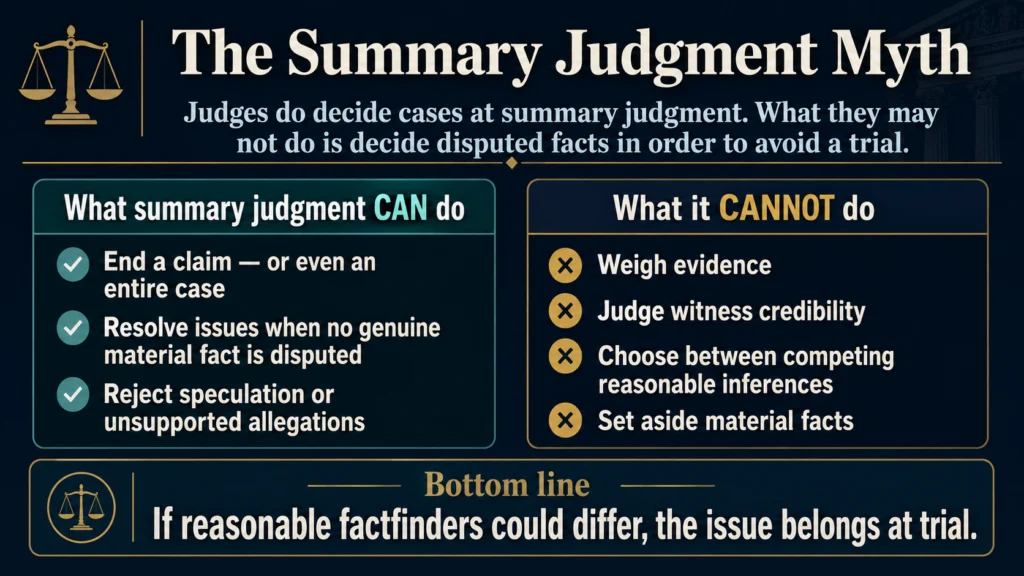
In a recent University of Washington School of Law explainer, Sanne H. Knudsen, the Stimson Bullitt Endowed Professor of Environmental Law, identifies as a common myth the idea that summary judgment means “the judge simply decides a case rather than letting it go to trial.”
The doctrinal point behind that statement is sound. A judge ruling on summary judgment is not supposed to act as the factfinder. The judge is not supposed to weigh competing testimony, decide who is credible, or choose the factual inference the judge finds most persuasive.
But taken literally, the statement risks creating a myth of its own.
A judge absolutely can decide an issue, a claim, or an entire case at summary judgment. The University of Washington article itself explains that a granted motion resolves an issue and may eliminate some claims while leaving others for trial. Minnesota Rule of Civil Procedure 56.01 is equally direct: a party may seek summary judgment on a claim, a defense, or part of either, and the court must grant it when no genuine issue of material fact exists and the movant is entitled to judgment as a matter of law.
When summary judgment disposes of every claim, the judge has decided the case. There will be no trial, no live testimony, no cross-examination, no jury deliberation, and no verdict. The judgment is real, final, and often devastating.
Summary judgment is not a trial. But it is a judgment.
The crucial distinction is not whether the judge decides. The distinction is what the judge is permitted to decide—and whether the court stays within that boundary.
This is also where the language becomes important. To say that a judge may not weigh evidence states a legal prohibition. To say that a judge cannot weigh evidence may sound like a factual guarantee that it never happens.
Rule 56 creates the prohibition. It does not make a violation impossible.
Every myth heading below therefore states a proposition this article rejects. The first two myths misunderstand what summary judgment does and what is required to defeat it. The remaining myths mistake legal safeguards for automatic guarantees of judicial behavior.
Myth No. 1: Summary Judgment Does Not Decide the Case
It can—and often does.
A judge deciding a summary-judgment motion determines whether the law permits a claim, defense, issue, or entire case to proceed to trial. If every claim is dismissed, the judge has ended the case just as certainly as a jury verdict would have ended it.
What the judge may not do is decide a genuinely disputed issue of material fact in order to make the trial unnecessary.
The Minnesota Supreme Court drew that line clearly in DLH, Inc. v. Russ, 566 N.W.2d 60, 69–71 (Minn. 1997). The district court’s function is not to decide factual issues, but to determine whether genuine factual issues exist. The court may examine whether the evidence is legally sufficient. It may not weigh the evidence or choose between reasonable versions of what happened.
Put differently:
The judge decides whether a trial is legally necessary. The judge may not decide the factual contest in order to declare that a trial is unnecessary.
Rule 56 limits the method by which the judge may reach judgment. It does not mean the judge has not decided the case.
Myth No. 2: Any Factual Dispute Defeats Summary Judgment
It does not.
Not every disagreement requires a trial. The dispute must be both genuine and material. A factual disagreement is material only if it could affect the result under the governing law. A party opposing summary judgment must also identify actual record evidence—not allegations, speculation, or a merely theoretical possibility.
The University of Washington article identifies several situations in which summary judgment may properly serve its intended purpose: when the evidence permits only one reasonable factual conclusion, when a party lacks evidence on an essential element, or when the material facts are agreed upon and only a legal question remains.
Minnesota law says the same thing. DLH requires evidence sufficiently probative to permit reasonable people to draw different conclusions. A complete lack of proof on an essential element may justify judgment without trial.
That limitation matters. Criticism of summary judgment should not become a claim that every weak, unsupported, or immaterial disagreement belongs before a jury. It does not.
But the reverse is equally important. Once the record contains evidence supporting competing reasonable conclusions on a material issue, summary judgment is no longer a device for deciding which conclusion is more convincing.
The proper question is not merely whether some disagreement exists. It is whether a reasonable factfinder could resolve a material disagreement in favor of the nonmoving party.
Myth No. 3: The Rule Prevents Judges from Choosing Between Competing Facts
It does not. The rule forbids the choice; it does not place a physical barrier between the judge and the evidence.
That distinction is not cynical. It is demonstrated by the appellate decisions that reverse summary judgment because a court weighed evidence, assessed credibility, or resolved competing inferences. Those decisions would have nothing to correct if the rule made such conduct impossible.
Factfinding also does not always announce itself with an express declaration that one witness is credible and another is not. It can occur when a court omits contrary evidence, discounts testimony, characterizes one inference as the only reasonable inference, or presents the moving party’s version as established even though the record supports another version.
In Staub v. Myrtle Lake Resort, LLC, 964 N.W.2d 613, 620 (Minn. 2021), the Minnesota Supreme Court reversed summary judgment even though the defendants might ultimately persuade a jury that their explanation was correct. Whether they might win at trial was not the inquiry at that procedural stage. The facts and reasonable inferences had to be resolved in favor of the nonmoving party. Summary judgment, the Court repeated, is a “blunt instrument” that should not be used when reasonable people could draw different conclusions from the evidence.
Likewise, in Hoyt Properties, Inc. v. Production Resource Group, LLC, 736 N.W.2d 313, 320 (Minn. 2007), the Minnesota Supreme Court concluded that the district court could reach its result only by weighing evidence and assessing credibility. That was error. Credibility and the inferences fairly drawn from disputed evidence belong to the factfinder.
The United States Supreme Court delivered the same warning in Tolan v. Cotton, 572 U.S. 650, 656–60 (2014). It vacated summary judgment because the lower court failed to credit contradictory evidence and resolved disputed issues in favor of the moving party.
These cases do not establish that judges are legally authorized to select the most persuasive factual version. They establish that judges sometimes do so despite the rule—and that an appellate court may then be required to correct the error.
The question at summary judgment is not:
“What probably happened?”
It is:
“Could a reasonable factfinder accept the nonmoving party’s supported version of what happened?”
The law forbids the judge from choosing between two reasonable versions. It does not make that choice impossible, invisible, or automatically self-correcting.
Myth No. 4: Material Facts Cannot Disappear from the Analysis
They can.
A material fact may disappear through omission, minimization, selective quotation, recharacterization, or an unexplained decision to “set it aside.” The fact does not cease to exist in the record. It ceases to play its required role in the court’s analysis.
There are, of course, legitimate reasons for declining to rely on a particular assertion. A court may disregard an assertion that lacks evidentiary support. It may determine that a factual dispute is immaterial under the governing law. It may also assume that a fact is true and explain why the claim nevertheless fails.
Those are proper uses of summary judgment.
What a court may not properly do is manufacture an undisputed record by omitting evidence favorable to the nonmoving party, minimizing supported testimony, or removing a legally significant fact before applying the law.
A particularly direct Minnesota example is Progressive Insurance v. Abel, A21-1267 (Minn. App. June 13, 2022). The Minnesota Court of Appeals reversed after concluding that the district court ignored relevant evidence favorable to the nonmoving parties, understated deposition testimony, and drew inferences against them. Quoting an earlier decision, the court warned that “a court must not rely on selected facts in order to justify a conclusion.”
Progressive is nonprecedential, but its method tracks binding Minnesota Supreme Court law. In Kenneh v. Homeward Bound, Inc., 944 N.W.2d 222, 228, 231–32 (Minn. 2020), the Supreme Court said the plaintiff’s account had to be accepted at summary judgment and that a disputed statement presented a credibility question for the jury. The Court also found error where the analysis appeared to discount testimony because the plaintiff could not identify precise dates.
These cases matter not only because they state the proper rule. They show that courts can, in practice, narrow the record until a disputed case appears undisputed.
A court may conclude that a supported fact does not matter under the substantive law. But it must explain why the nonmoving party still loses with that fact and its reasonable inferences included. It cannot simply remove the fact from the analysis and then treat the remaining record as complete.
The myth is not that courts are legally permitted to set aside material facts. They are not. The myth is that the rule ensures material facts never disappear.
Myth No. 5: Calling an Adverse Inference “Reasonable” Makes It Proper
It does not.
A judge may believe the moving party’s inference is reasonable. The judge may even believe it is more persuasive. But the reasonableness of one inference does not eliminate a different reasonable inference supported by the record.
The relevant question is not whether the adverse inference is reasonable in isolation. The question is whether it is the only reasonable inference after the evidence is viewed in the manner Rule 56 requires.
If the record also supports a reasonable inference favoring the nonmoving party, the existence of the competing inference ordinarily demonstrates why a factfinder is needed.
Calling an adverse inference “reasonable” does not make it the only reasonable inference.
This principle becomes especially important when intent, motive, knowledge, or meaning is disputed. Those issues are often proved through circumstantial evidence rather than direct admissions.
In Elseth v. Hille, A12-1496 (Minn. App. May 13, 2013) (unpublished), the Minnesota Court of Appeals recognized that intent is generally a question of fact and that summary judgment is often inappropriate when motive and intent play leading roles. The court also supplied the necessary qualification: the nonmoving party must still produce evidence supporting the claimed intent.
That is the proper balance. Intent is not automatically immune from summary judgment. A party cannot survive merely by asserting an unsubstantiated state of mind.
But when record evidence supports competing reasonable inferences about intent, the judge may not properly select the adverse inference merely because it seems plausible, probable, or more convincing.
“Reasonable” is not a permission slip for the judge to choose. When both sides have reasonable evidentiary support, it is often the reason the choice belongs to the factfinder.
Myth No. 6: Reciting the Correct Standard Proves It Was Applied
It does not.
Most summary-judgment orders begin with the right words: no genuine issue of material fact; evidence viewed in the light most favorable to the nonmoving party; no credibility determinations; reasonable inferences drawn against the movant.
Those words matter. But they do not apply themselves.
Kenneh, Hoyt, Staub, Progressive, and Tolan all demonstrate that a court can state or recognize the governing standard and still mishandle the record. The real test is found in the analysis:
- Did the court include the evidence favorable to the nonmoving party?
- Did it describe disputed testimony in that party’s favor?
- Did it avoid deciding which witness was more credible?
- Did it preserve reasonable competing inferences for the factfinder?
- Did it distinguish an unsupported assertion from supported contrary evidence?
- Did it explain why the claim fails even when the nonmoving party’s supported version is accepted?
A correct legal preface cannot cure factual selection later in the order.
Nor does the presence of familiar Rule 56 language prove that the reasoning that follows complied with Rule 56. The standard must be tested against what the court actually did with the evidence.
How These Myths Converged in Stevenson v. Stevenson
Our experience shows why the distinction between legal prohibition and actual judicial conduct matters.
Myth No. 1 was plainly false in our case: Judge Kevin Miller decided every claim at summary judgment and ended the case without a trial.
That does not mean Myth No. 2 was true. The mere existence of some factual disagreement would not have required a trial. Any dispute still had to be genuine, material, and supported by record evidence.
The central concern instead involves Myths 3 through 6: whether Rule 56’s stated safeguards actually governed the court’s treatment of the record.
Judge Miller had authority to grant summary judgment if the legal standard was satisfied. The disputed question is whether the path to that judgment stayed within the limits imposed on summary-judgment factfinding.
In the June 16, 2023 summary-judgment order in Stevenson v. Stevenson (56-CV-20-2928), Judge Miller twice used the phrase “setting aside the fact” that Renee and I were married at the time of the alleged taking of property. The order itself treated the marriage as legally significant to whether the alleged conduct could constitute theft. See Doc. 429, pp. 23–25.
The order expressly acknowledged that I denied intending to permanently deprive Renee of the property. It then identified circumstances it said “could reasonably support the opposite inference,” described the indifference-to-rights theory as “more than arguable,” and concluded that theft was a reasonable interpretation of the admitted conduct. Justice-Denied has examined that sequence in detail.
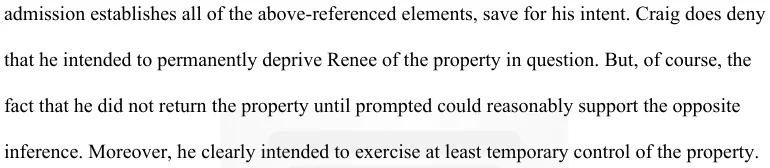
Stevenson v. Stevenson, No. 56-CV-20-2928, Doc. 429, Order Granting Defendants’ Motions for Summary Judgment (June 16, 2023), p. 24.
The next page supplied a distinct alternative rationale. The court wrote that “[e]ven if Craig had an innocent intent,” Sean’s statement was “merely a non-actionable gloss” on the admitted facts. Doc. 429, p. 25. That qualification matters: the order did not rest solely on a finding of criminal intent.
The narrower concern is how the order used the intent question before reaching that alternative ground:
- The court treated the marriage fact as legally significant.
- The court acknowledged a live dispute over intent.
- The court identified an inference supporting Craig’s position.
- The court used the opposite inference as affirmative support for its substantial-truth analysis before offering an alternative rationale that treated innocent intent as legally insufficient.
If the favorable inference made no legal difference, the alternative rationale on page 25 could carry that work. Using the contrary inference as additional support is different: choosing between supported competing inferences is ordinarily the work of a factfinder.
This is the distinction the original headings obscured. It is not accurate to say that a judge is incapable of choosing facts or setting them aside. A judge can do those things as a practical matter, and in our view that is what occurred. The legal question is whether the judge was authorized to do so under Rule 56.
The Minnesota Court of Appeals later affirmed in Stevenson v. Stevenson, No. A23-1209 (Minn. App. Apr. 8, 2024) (nonprecedential). It recited the familiar summary-judgment standard and concluded that the theft-related statement was not defamatory because I admitted removing property belonging to Renee and truth is a complete defense. The opinion did not discuss the district court’s repeated “setting aside” language or its express use of a competing inference about intent.
That affirmance resolved our appeal. It does not make the opinion precedential, and it does not eliminate the tension between the method used in our case and the methods Minnesota appellate courts have required elsewhere.
Primary case materials: March 15, 2023 summary-judgment hearing transcript (Doc. 421); June 16, 2023 Order Granting Defendants’ Motions for Summary Judgment (Doc. 429, pp. 23–25); and Stevenson v. Stevenson, No. A23-1209 (Minn. App. Apr. 8, 2024) (nonprecedential).
Justice-Denied has documented related concerns in Summary Judgment – Setting Aside Material Facts, Ignoring Evidence at Summary Judgment, and Distorting the Law – The Elements of a Crime. The last of those articles examines a related danger: converting the ordinary meaning and context of an alleged accusation into a technical checklist of criminal elements, thereby turning a potentially factual question about what a reasonable reader would understand into a judge-decided abstraction.
The Comparisons Are About Method, Not Identical Facts
No two cases are identical. Kenneh involved workplace harassment. Staub involved circumstantial evidence of causation after a fatal fall. Progressive involved insurance coverage and a young adult’s residence. Wakasugi v. 3M involved pregnancy discrimination.
That does not make the comparisons irrelevant. Summary-judgment law exists precisely to provide a consistent method across different substantive claims.
In Kenneh, the Supreme Court required the plaintiff’s account to be accepted and left disputed credibility to the jury. In Staub, the Supreme Court refused to choose among plausible competing explanations. In Progressive, the Court of Appeals reversed because favorable evidence was omitted and adverse inferences were drawn. And in Wakasugi v. 3M Co., A24-1647 (Minn. App. June 2, 2025), another nonprecedential opinion, the court reversed because the evidence and reasonable inferences could allow a juror to find that pregnancy and parental leave motivated the elimination of the plaintiff’s position.
The comparison is especially notable because Judge Randall Slieter served as presiding judge on the panels in Progressive, Stevenson, and Wakasugi, and authored the Stevenson opinion. Justice-Denied previously examined that contrast in Two Faces of Summary Judgment.
The point is not that the outcomes must always match. The point is that the method should.
The Myth Behind the Myths
The deepest myth is that the law of summary judgment and the practice of summary judgment are necessarily the same thing.
The law permits a court to decide a claim—or an entire case—without trial when no genuine dispute of material fact requires a factfinder. It forbids the court from reaching that result by weighing evidence, choosing credibility, omitting supported material facts, or selecting between competing reasonable inferences.
Those two propositions can both be true:
- Judges have the power to decide cases at summary judgment.
- Judges are not authorized to decide the disputed facts needed to make summary judgment possible.
But a rule against factfinding is not self-executing. Factfinding can appear as an omitted paragraph, a shortened quotation, a characterization of testimony, a declaration that one inference is “more reasonable,” or a decision to “set aside” a fact that complicates the result.
That is why the summary-judgment standard must be judged by what the court actually does with the record—not by how accurately the court recites the rule at the beginning of the order.
A court may decide that a dispute is immaterial. It may decide that the nonmoving party lacks evidence. It may decide that, even accepting that party’s supported version as true, the law allows only one result.
But when a court can reach judgment only by discounting testimony, selecting favorable facts, setting aside a legally significant fact, or choosing between reasonable competing inferences, the procedure has stopped functioning as summary judgment.
It has become a trial on paper—one in which the party entitled to a factfinder never received one.
This article is part of The Fairness Files, Justice-Denied.org’s examination of whether judicial decisions reflect a fair, evenhanded, and reviewable process.
🤖 This article was authored by Justice-Denied.org with the assistance of artificial intelligence.