

Introduction
A medical professional may describe an injury. A medical professional may explain symptoms, treatment, and possible causes. An expert may help jurors understand evidence beyond ordinary experience.
But there is a line.
In a criminal trial, a medical professional cannot take the jury’s place and decide the ultimate legal question: Did the charged sexual assault occur?
That question belongs to the jury.
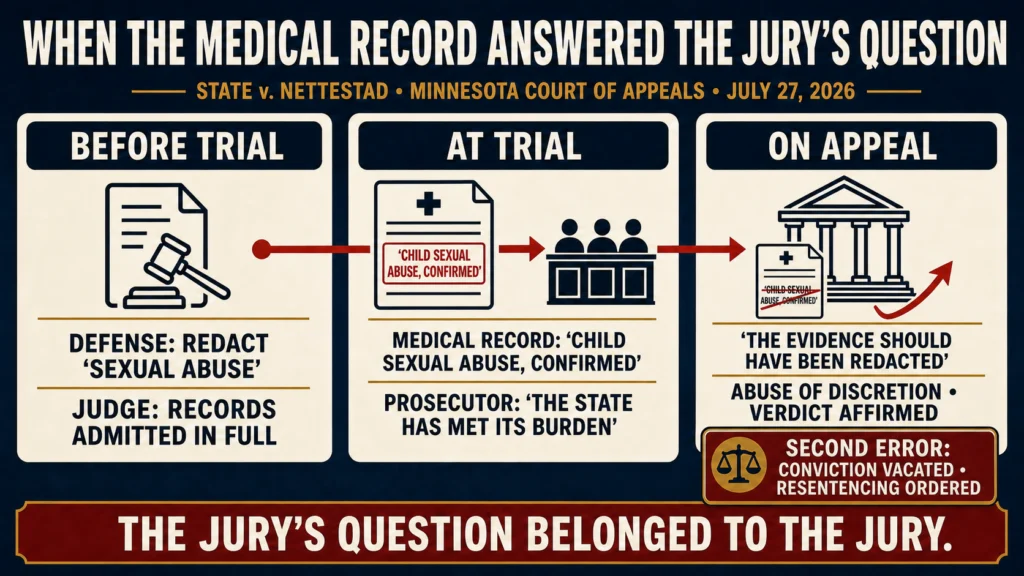
In State v. Nettestad, Otter Tail County District Court Judge Kevin M. Miller allowed medical records telling the jury that child sexual abuse had been “confirmed.” The prosecutor then invoked those conclusions as evidence that the State had proved an element of the crime.
On July 27, 2026, the Minnesota Court of Appeals held that Judge Miller abused his discretion.
“The evidence should have been redacted,” the appellate court wrote. It later stated: “The district court violated this holding.”
The Court of Appeals ultimately found the error harmless because of the other evidence against the defendant. It affirmed the verdicts. But that does not erase what happened in the courtroom—or how clearly the issue had been placed before Judge Miller.
This was not a hidden problem discovered only after trial. The defense raised it in writing. The parties argued it again before trial. Judge Miller reconsidered and clarified his ruling.
He still got it wrong.
And the medical record was allowed to answer the jury’s question.
Justice-Denied reviewed the publicly accessible MCRO filings, orders, jury instructions, transcripts, and appellate oral-argument recording in Otter Tail County District Court File No. 56-CR-23-558. We did not have access to sealed or confidential materials. Consistent with the appellate opinion, we refer to the minor complainant by the court-selected pseudonym “Lerna.”
The Difference Between Medical Evidence and a Legal Verdict
Nettestad was charged with three counts of first-degree criminal sexual conduct involving his younger half-sister. The State alleged that an initial assault occurred when Lerna was seven years old and that the abuse continued over an extended period.
After the initial allegations, Lerna underwent medical examinations. One report listed a final diagnosis of child sexual abuse that was “confirmed.” A physician wrote that he had reviewed the case and agreed with the nurse’s findings.
Those conclusions went beyond describing bruising, abrasions, bacterial vaginosis, or other medical observations. They told the jury what conclusion to draw from them.
Minnesota law has addressed this boundary for decades.
In State v. Saldana, the Minnesota Supreme Court held that an expert’s opinion that a rape occurred was an inadmissible legal conclusion. In State v. Obeta, the court reaffirmed the prohibition against expert testimony resolving whether a complainant was sexually assaulted.
The distinction matters. Experts may educate jurors. They may not decide guilt-producing questions for them.
The Defense Raised the Issue Before Trial
The defense did not remain silent and complain only after conviction.
In a September 11, 2024 motion, defense counsel asked Judge Miller to redact references to “sexual abuse,” “sexual assault,” and similar conclusions from the medical records. The defense also asked the court to prohibit medical witnesses from asserting or suggesting that Lerna had been sexually abused. [MCRO Docket 060]
The motion did not cite Saldana or Obeta by name. But it expressly raised the ultimate-opinion problem and relied on Minnesota Rule of Evidence 702 and other decisions governing expert testimony.
Judge Miller’s December 30, 2024 order did not clearly resolve that problem.
One portion directed the removal of certain references to sexual-abuse allegations. Another permitted medical opinion testimony under Rule 702. The order did not meaningfully analyze the difference between testimony about medical findings and an expert conclusion that the alleged crime had occurred. [MCRO Docket 082]
The conflict resurfaced less than three weeks before trial.
During a January 24, 2025 hearing, the prosecutor specifically asked to retain the diagnosis of sexual abuse of a child. The defense responded that its original motion sought removal of all such conclusions. Judge Miller said he would review and clarify the issue. [MCRO Docket 167, pp. 4–8]
He did.
On February 6, 2025, Judge Miller issued a clarifying order acknowledging that an earlier order had conflated separate issues. He then ordered the medical records admitted in their entirety and refused to redact the sexual-abuse conclusions. [MCRO Docket 115]
The defense had identified the danger. The prosecutor had identified the exact language it wanted to use. Judge Miller had another opportunity to examine the question.
The result was still legally incorrect.
What the State Conceded at Oral Argument
The April 28, 2026 appellate oral argument revealed an important distinction that is less apparent in the written opinion.
The State began its argument by defending admission of what it characterized as a brief reference to sexual abuse in medical records stipulated to by the defense. The State argued that defense counsel had made a strategic decision to introduce the records rather than permit the SANE nurse and physician to testify in person.
A member of the appellate panel interrupted to clarify the scope of that stipulation:
“There was a stipulation, but not for the specific finding that sexual abuse occurred.”
The State responded:
“I don’t disagree with that.”
[Minnesota Court of Appeals oral argument, approximately 15:07–15:18]
That concession matters.
The defense had accepted the medical records as the method by which medical evidence would be presented. It had not agreed that the conclusion “sexual abuse, confirmed” was legally admissible.
The difference is fundamental. A stipulation concerning foundation or method of delivery does not waive a preserved objection to the substance of particular evidence.
The panel’s questioning then exposed a deeper problem.
The State argued that the same conclusion could have been presented through live testimony from the nurse and physician. But a panel member focused on what the medical report itself contained:
“There was no analysis in the report. It was a conclusion.”
The judge noted that the report declared that sexual abuse had occurred, described it as confirmed, and referred to findings—but did not explain the expert reasoning that supposedly justified that conclusion. The judge then asked what the “expert” component of the entry actually was. [Minnesota Court of Appeals oral argument, approximately 18:15–18:38]
The State’s answer focused again on Rule 702 and on what live medical witnesses might have said. But that addressed the form in which evidence could have been presented—not whether a medical professional could resolve the ultimate question for the jury.
Another panel member rejected the suggestion that the improper conclusion was insignificant, remarking during the argument that it seemed like “a big deal under Saldana.”
The oral argument therefore confirms three important points:
- The defense did not stipulate to the conclusion that sexual abuse occurred.
- The report supplied a conclusion without setting out the expert analysis supporting it.
- The appellate panel recognized that the conclusion implicated the precise boundary established in Saldana.
The records did not merely present expert information from which jurors could draw their own conclusion. They supplied the conclusion itself.
That was not medical evidence helping the jury answer its question.
It was the medical record answering the question for the jury.
What the Jury Heard
Once Judge Miller admitted the conclusions, the State did not treat them as incidental language buried in medical files.
During opening statements, the prosecutor told jurors that a sexual-assault nurse had diagnosed sexual abuse and that a doctor agreed. The defense objected. Judge Miller overruled the objection. [MCRO Docket 169, p. 68]
During testimony, the State elicited that the final diagnosis was child sexual abuse—“confirmed.” [MCRO Docket 170, p. 157]
Then came closing argument.
The prosecutor told the jury that medical professionals had concluded Lerna was, in fact, sexually abused. The prosecutor pointed to the medical record and declared:
“The State has met its burden as it relates to element one.”
That statement reveals the importance the State assigned to the improperly admitted conclusion. The medical opinion was not used solely to explain treatment. It was expressly offered as proof that the prosecution had satisfied part of its burden. [MCRO Docket 171, pp. 117, 125]
The jury had heard the complainant’s account. It had seen photographs and medical findings. It heard competing explanations from witnesses and experts.
But it also received something it should not have received: the authority of medical professionals placed behind the conclusion that the alleged criminal act had been confirmed.
The Court of Appeals Found an Abuse of Discretion
The Minnesota Court of Appeals’ opinion was direct.
The court rejected the State’s attempt to narrow Saldana to testimony about rape-trauma syndrome. It explained that Saldana also prohibited an expert from resolving whether an assault occurred because that is a legal conclusion. Obeta reaffirmed the same limitation.
Judge Miller’s ruling violated that prohibition.
The appellate court also recognized why such opinions are dangerous. The professional stature of medical witnesses can give a legal conclusion an appearance of scientific legitimacy. Jurors may give special weight to a conclusion appearing in a clinical record or endorsed by a physician.
The oral argument showed that this distinction was not academic. A panel member questioned what expert analysis the bare conclusion contained and rejected the suggestion that the language was insignificant.
The State focused largely on how the evidence entered the record and what live medical witnesses might have said. But the governing question was what no medical witness—or medical record—was permitted to decide for the jury.
That is precisely why judges must enforce the boundary.
Why the Conviction Was Nevertheless Affirmed
Justice-Denied does not minimize the rest of the appellate decision.
The Court of Appeals found the evidentiary error harmless and declined to order a new trial. It concluded there was no reasonable probability that the improper opinions substantially affected the verdict.
The court relied on several considerations:
- The State referred to the conclusions only a limited number of times.
- The defense presented its own medical expert.
- Lerna testified at trial.
- The State introduced a forensic interview and corroborating messages.
- Other portions of the medical evidence were properly admitted.
- The prosecution presented substantial additional evidence of guilt.
The appellate court therefore affirmed the verdict.
That distinction is important. The decision does not declare Nettestad innocent. It does not hold that the entire trial was unfair. It does not conclude that the medical-record error changed the verdict.
But “harmless” does not mean “proper.”
Harmless-error review asks whether an established error probably changed the result. It does not retroactively transform an unlawful ruling into a lawful one.
The ruling was wrong. The question had been squarely presented. And the Court of Appeals held that Judge Miller abused his discretion.
A Second Error—This Time Affecting the Sentence
The medical-record ruling was not the only legal error identified on appeal.
Before sentencing, the defense argued that Judge Miller could not enter convictions and impose sentences for both Count 1 and Count 3 because one was included within the other.
Minnesota Statutes section 609.04 permits conviction of the charged offense or an included offense—but not both.
The defense’s April 10, 2025 motion quoted the statute, distinguished it from Minnesota’s separate “single behavioral incident” rule, and cited State v. Folley, a Minnesota Supreme Court decision addressing overlapping criminal-sexual-conduct convictions. [MCRO Docket 142]
At sentencing, defense counsel explained that:
- The charging periods overlapped.
- The probable-cause statement identified the Count 1 conduct as the first incident in the pattern alleged in Count 3.
- The Count 3 jury instructions permitted jurors to rely on the same initial conduct used to prove Count 1.
- Even if later conduct was needed to establish an extended pattern, the initial offense remained incorporated into the larger offense.
Judge Miller stated that he had reviewed the parties’ submissions and had “the ability to do my research.”
He nevertheless entered convictions and imposed sentences on both counts. [MCRO Docket 172, pp. 4–15]
On appeal, the State conceded that this was wrong.
The Court of Appeals ordered the district court to vacate “the improper conviction” and resentence Nettestad. Read together with the defense motion and the court’s count-overlap analysis, the public record indicates that the improper conviction was Count 1.
Not Merely a Paperwork Correction
The sentencing error appears to have had a concrete consequence.
Judge Miller first sentenced Nettestad to 172 months on Count 1. He then imposed 180 months on Count 3, with the prosecutor explaining that criminal-history points had been applied to the later count. The sentences were concurrent. [MCRO Dockets 146 and 172]
Under the applicable 2014 Minnesota Sentencing Guidelines, convictions sentenced sequentially at the same hearing can increase the criminal-history score used for a later count. A severity-level-A sex offense contributes three felony points.
For the remaining first-degree criminal-sexual-conduct offense:
- A criminal-history score of zero carried a fixed presumptive duration of 144 months and a nondeparture range of 144 to 172 months.
- A score of three carried a fixed duration of 180 months and a range of 153 to 216 months.
The public record therefore strongly indicates that the improper first conviction generated the three points used to calculate the 180-month sentence on Count 3.
Because the presentence investigation and any confidential sentencing worksheet were not publicly available, this conclusion should be understood as a calculation from the public transcript and sentencing guidelines. But the practical issue is difficult to miss: the sentence imposed on Count 3 was eight months above the top of the score-zero nondeparture range.
The appellate court’s decision was not simply an instruction to remove a redundant entry from the court record. It required resentencing after an improper conviction appears to have materially increased the calculation for the remaining offense.
What Nettestad Adds to the Public Record
Until now, Justice-Denied’s documented appellate reversal involving Judge Miller centered on spousal privilege in our own civil case.
Nettestad matters because it is independent of us.
It involved different parties, different attorneys, a criminal prosecution, a jury trial, medical evidence, and a person’s liberty. Yet it presents a troublingly familiar process:
- A governing legal limitation was presented to Judge Miller.
- The issue was sufficiently clear to require a direct answer.
- Judge Miller’s reasoning did not adequately apply that limitation.
- The Court of Appeals later held that the ruling was legally wrong.
In the medical-record dispute, the defense raised the precise danger of medical professionals declaring that sexual abuse occurred. Judge Miller revisited the issue and still admitted the conclusions.
At sentencing, the defense quoted the governing statute, cited a closely analogous Supreme Court decision, and explained the overlap. Judge Miller stated that he had researched the question and still entered both convictions.
These are no longer allegations arising only from our case. They are appellate-confirmed errors in an unrelated criminal proceeding.
What This Evidence Proves—and What It Does Not
The public record proves that Judge Miller made two significant legal errors in Nettestad:
- He admitted expert medical conclusions that the Court of Appeals held should have been redacted.
- He entered and sentenced Nettestad on an included offense that the Court of Appeals ordered vacated.
The record also proves that both issues were brought to his attention before he ruled.
That is powerful evidence of failures to apply controlling law after notice.
But the record does not reveal Judge Miller’s state of mind. It cannot establish whether he misunderstood the law, overlooked part of the argument, accepted the prosecution’s reasoning too readily, conducted insufficient research, or knowingly disregarded controlling authority.
Justice-Denied will not claim to know what the evidence cannot establish.
Intent, however, is not the only question that matters.
Judicial accountability also concerns performance. When a judge has the authority to decide what evidence a jury may hear and how many years a person may spend in prison, the public is entitled to ask whether controlling law is being carefully identified, understood, and applied.
The Question Belonged to the Jury
The central lesson of Nettestad is not complicated.
Medical professionals could describe what they observed. They could explain the injuries, testing, diagnoses relevant to treatment, and medically possible causes. They could respond to competing medical theories.
But they could not decide the ultimate legal question for the jury.
The defense raised that boundary. Judge Miller declined to enforce it. The prosecution then used the medical conclusion as proof that it had satisfied an element of the crime.
The Court of Appeals found an abuse of discretion.
Then, at sentencing, another legal boundary was presented: Minnesota law did not permit convictions for both the charged offense and an included offense. Judge Miller crossed that boundary too. This time, the Court of Appeals reversed and ordered resentencing.
One error allowed medical authority to speak with the force of a verdict. The other appears to have added three points to a sentencing calculation.
The jury’s question belonged to the jury.
The sentencing calculation belonged to the law.
Judge Miller was responsible for protecting both boundaries.
He did not.