


Introduction
A decision that ends a case can also end the effort to obtain evidence. Summary judgment lets a court decide a claim without a trial when no genuine dispute over facts that could affect the outcome remains and one side is entitled to judgment under the law. In these cases, unresolved discovery requests ended as moot—meaning the courts treated them as no longer requiring a ruling because the claims had ended.[9]
In R&P Industries, LLC v. First Western Bank & Trust, the Minnesota Court of Appeals reversed summary judgment because an affidavit and parking-revenue records created a factual dispute about whether the property was occupied. That reversal also reopened a dependent claim and a discovery request. In Stevenson v. Stevenson, the dismissal was affirmed, leaving discovery issues moot.[1][8]
The cases were heard by different judges. Judge Laurie J. Miller presided over the Hennepin County foreclosure case, 27-CV-25-548. Judge Kevin M. Miller presided over the Otter Tail County Stevenson case, 56-CV-20-2928. Their records share a procedural sequence worth examining: a court assesses the viability of the claims, then uses that assessment to determine whether further discovery still matters.[2][6]
The parking lots that kept operating
R&P bought nine Minneapolis parcels in 2022. The property included commercial buildings and three parking lots. After the mortgage fell into default, First Western began foreclosure proceedings. A process server reported the property vacant and unoccupied, posted notices in May 2024, and personally served none of the plaintiffs. The bank purchased the parcels together at the July foreclosure sale.[1]
The buildings had been condemned, but the parking lots supplied a separate occupancy theory. Under Minnesota Statutes section 580.03, actual occupancy can trigger personal service of a foreclosure-sale notice. R&P maintained that its parking operations continued despite the buildings’ closure. The dispute concerned who was actually using the property when service was attempted.[1]
The district court initially allowed that theory to proceed. In its June 3, 2025 order denying the bank’s motion to dismiss (Doc. 29), it explained that automated payment stations were no less open and visible than a human attendant. That ruling tested the allegations. Summary judgment later required evidence supporting them.[4]
Surinder Singh supplied that evidence in his September 25, 2025 affidavit supporting the plaintiffs’ summary-judgment motion (Doc. 48). He described helping manage the plaintiffs’ businesses, visiting the property almost every day, overseeing the parking lots, and continued use by daily customers and commercial parking lessees. Paragraph 18 incorporated parking-revenue statements; paragraph 19 described his regular visits. The May 2024 statement recorded $1,816.13 in meter revenue.[3]
The affidavit and the revenue records
In its January 9, 2026 Order on Cross-Motions for Summary Judgment (Doc. 66), the district court rejected the plaintiffs’ occupancy evidence. While discussing the condemned buildings, it called Singh’s affidavit self-serving and contradicted by the process server’s affidavits, then stated:
“Mr. Singh’s self-serving statements cannot create a genuine issue of material fact.”
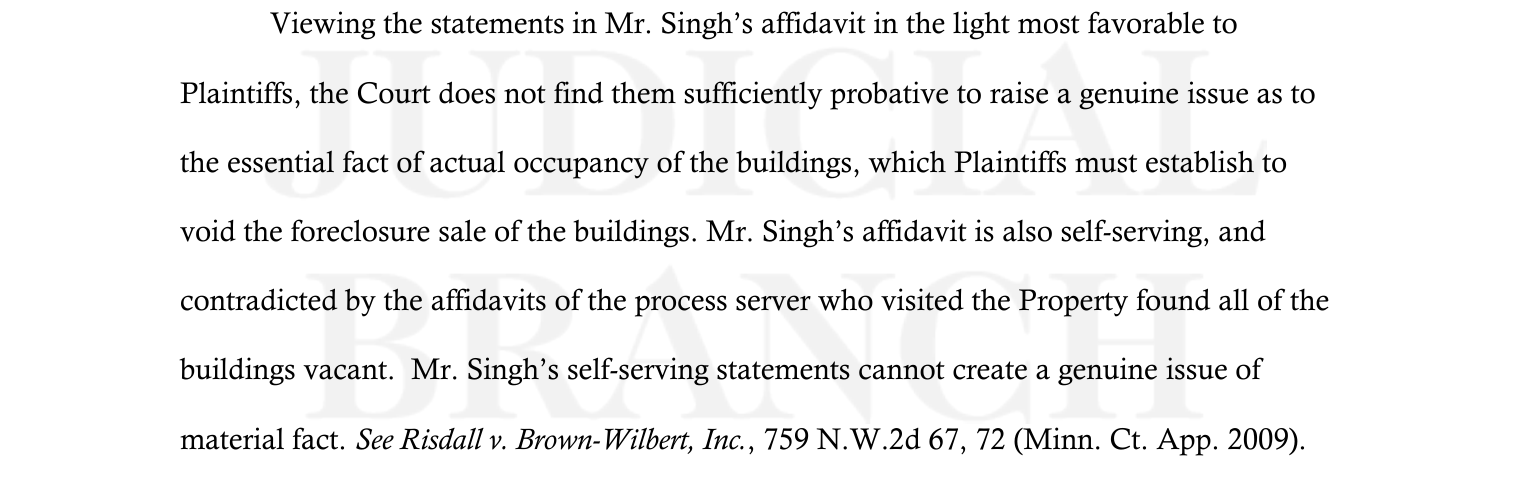
R&P, Order on Cross-Motions for Summary Judgment, Doc. 66, January 9, 2026, p. 20.
Enlarge image.
In the separate parking-lot analysis, the court acknowledged evidence of an operating business and the May meter revenue. It nevertheless concluded that the records did not prove an open and visible operation by the plaintiffs. It also noted that the statements named Impark and the former owner, RJS Investments, rather than a plaintiff.[2]
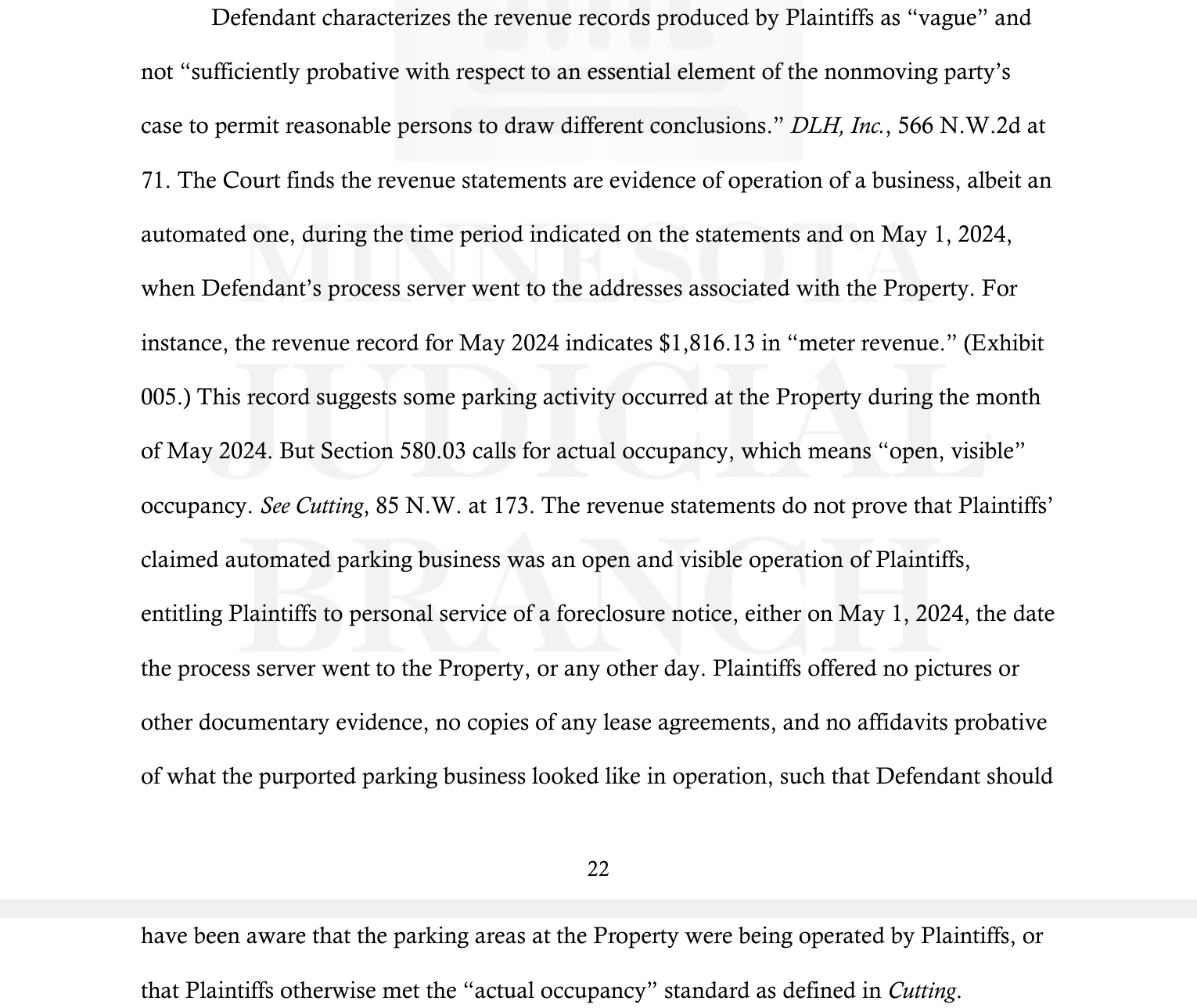
R&P, Order on Cross-Motions for Summary Judgment, Doc. 66, January 9, 2026, pp. 22–23. The excerpts continue across the original page break.
Enlarge image.
The Court of Appeals considered Singh’s affidavit because it did not contradict his prior testimony or affidavit. It then evaluated his description of the parking operations together with the revenue records. Those records corroborated active operations at the time of attempted service. The combined evidence created a genuine issue about actual occupancy, and the court reversed summary judgment.[1]
That is the distinction at the heart of the reversal. An interested witness’s concrete account can supply evidence. When contemporaneous records support that account, a court must assess whether a reasonable factfinder could draw a different conclusion. Here, the evidence was sufficient to keep the occupancy claim alive; whether the plaintiffs ultimately establish it remains for further proceedings.[1][9]
In Stevenson, the plaintiffs’ June 2, 2023 letter (Doc. 424) identified contradictions between defendant Lisa Stevenson-Allen’s 2022 deposition testimony and her testimony in a 2001 criminal trial. Judge Kevin M. Miller’s June 16, 2023 summary-judgment order did not mention the letter or address those identified contradictions.[8] Justice-Denied’s Contradictory Statements Under Oath examines the conflicting accounts and the order’s omission.
A photograph in the bank’s own filing
The district record contains another revealing detail. A photograph attached to bank attorney Francis J. Rondoni’s January 24, 2025 declaration opposing the plaintiffs’ motion for a temporary restraining order (Doc. 11) shows a parking-rate sign bearing the words “Owner R&P Industries LLC,” the Impark name, and a lot number. The image appears in Exhibit H, on PDF page 16, following the vacancy affidavit for that location.[5]
The Court of Appeals expressly declined to consider the parking-sign theory because the plaintiffs had not presented it to the district court. Its reversal rested on the affidavit and revenue evidence. The photograph illustrates a practical feature of summary judgment: a document’s presence in the file and a party’s presentation of the argument it supports are separate steps.[1]
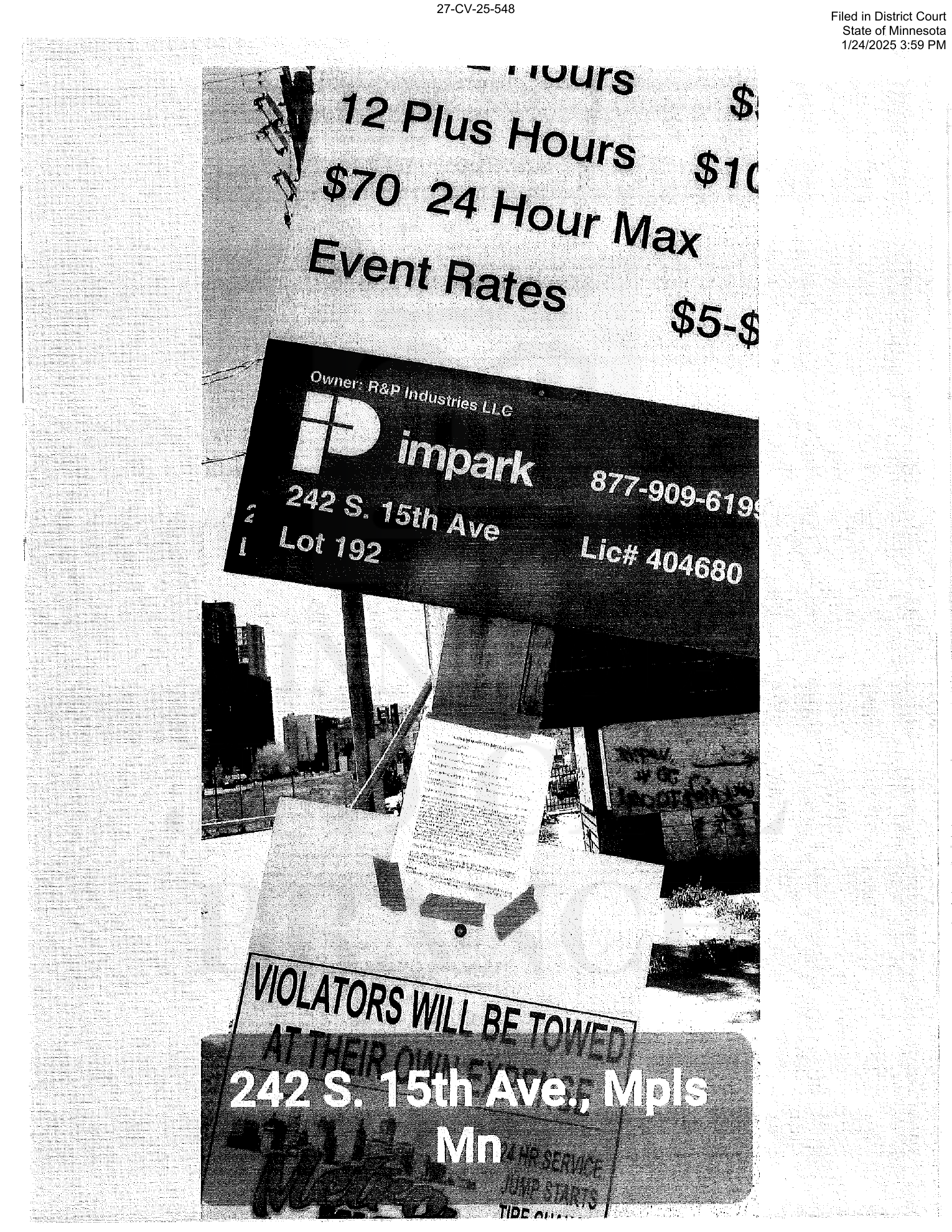 Enlarged owner line from the same photograph.
One dismissal ended the remaining questions
The parking-occupancy ruling became the foundation for two more decisions. Having rejected the challenge to the foreclosure, the district court dismissed a related claim for unlawful self-help removal. It also denied the plaintiffs’ remaining motions as moot.[2]
The plaintiffs asked the court to accept late responses to requests to admit facts and move the discovery deadline from August 4 to December 15, 2025. They pointed to changes in counsel and the bank’s first formal answer, filed after the discovery deadline. The bank argued that the plaintiffs had not pursued discovery diligently or identified material facts more time would uncover. The parties also disputed subpoenas to Imperial Parking and Cedar Towing for parking and towing records and the deadline for obtaining them.[7]
The district court expressly said it did not rely on deemed admissions. It granted judgment on its assessment of the evidence, then concluded that it need not address the discovery dispute. On appeal, reversing the occupancy ruling also removed the sole basis for dismissing the self-help claim and denying the discovery motion. Both returned for consideration. The appellate court left their merits to the district court.[2][1]
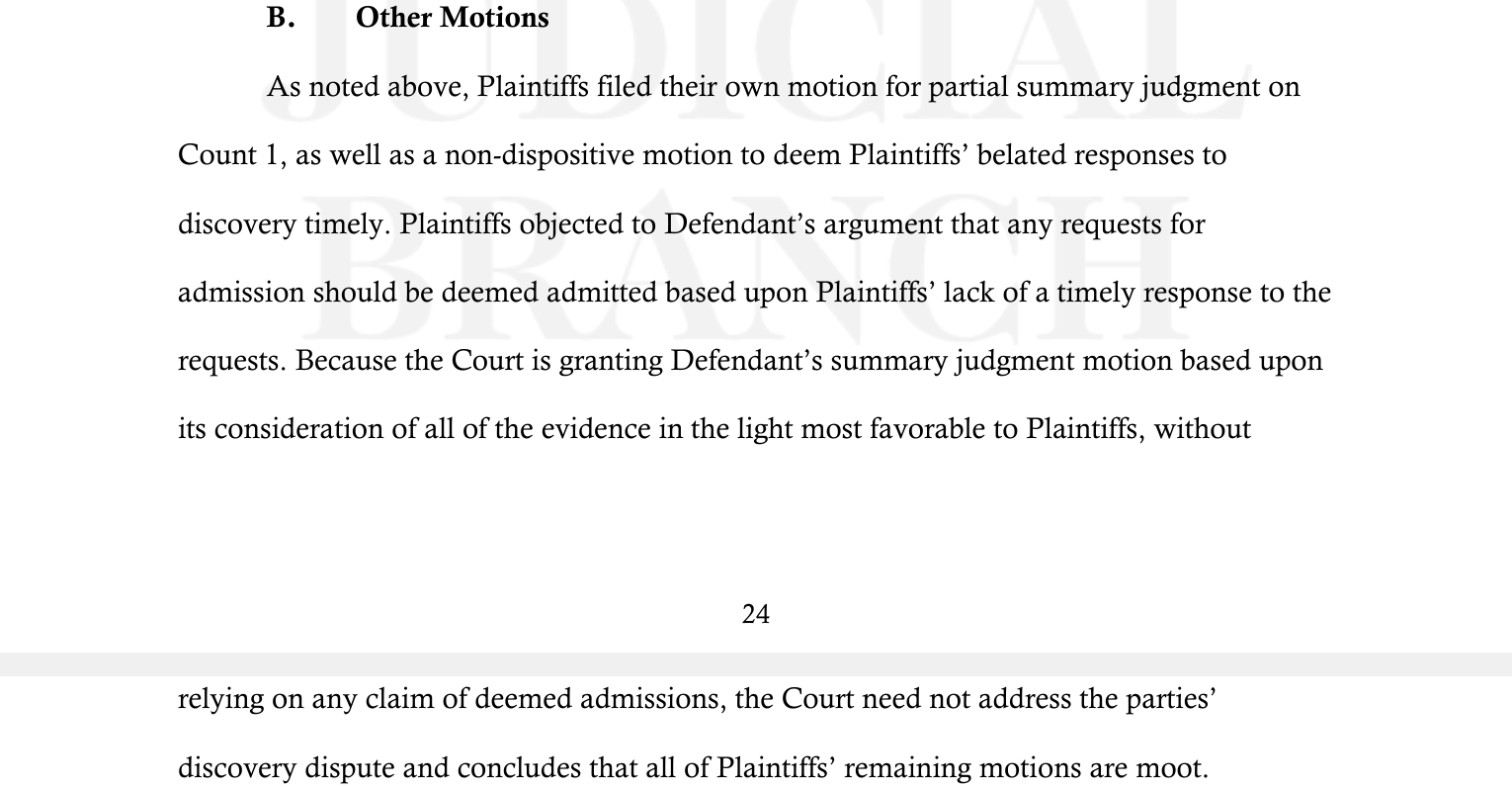
R&P, Order on Cross-Motions for Summary Judgment, Doc. 66, January 9, 2026, pp. 24–25. The excerpts continue across the original page break.
Enlarge image.
In Stevenson, dismissal ended pending discovery
In Stevenson, discovery concerned alleged coordination among defendants and deleted communications. The December 6, 2022 order on six pretrial motions, including sanctions and discovery (Doc. 366), found that Sean Stevenson had lied under oath about deleting text messages and required him to reimburse the costs of examining Renee’s and Lisa’s phones. It also declined to delay summary judgment and reserved whether to reopen discovery until the claims’ viability was assessed.[6]
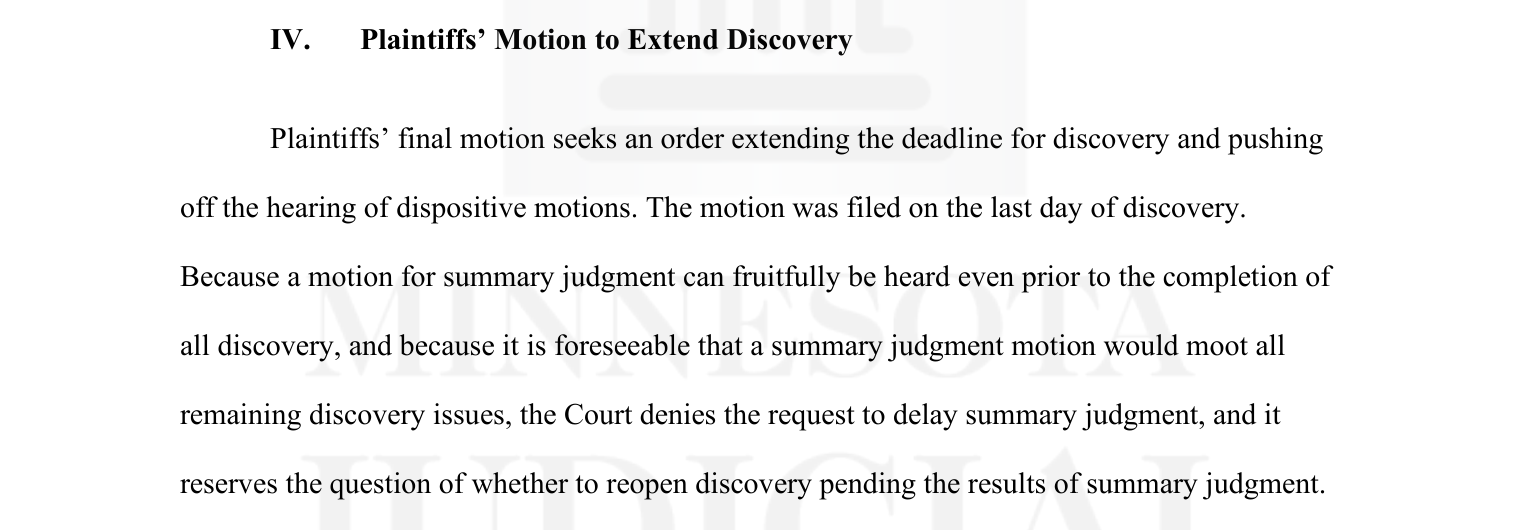
Stevenson, order on pretrial motions, Doc. 366, December 6, 2022, p. 49.
Enlarge image.
The order’s reasoning was explicit: further discovery into a conspiracy would not sustain the claim if another essential element failed. On page 54, the court identified Rule 56.04 as a way for the plaintiffs to explain unavailable evidence and said it would determine how to address further discovery if they could otherwise meet the claim’s elements.[6]
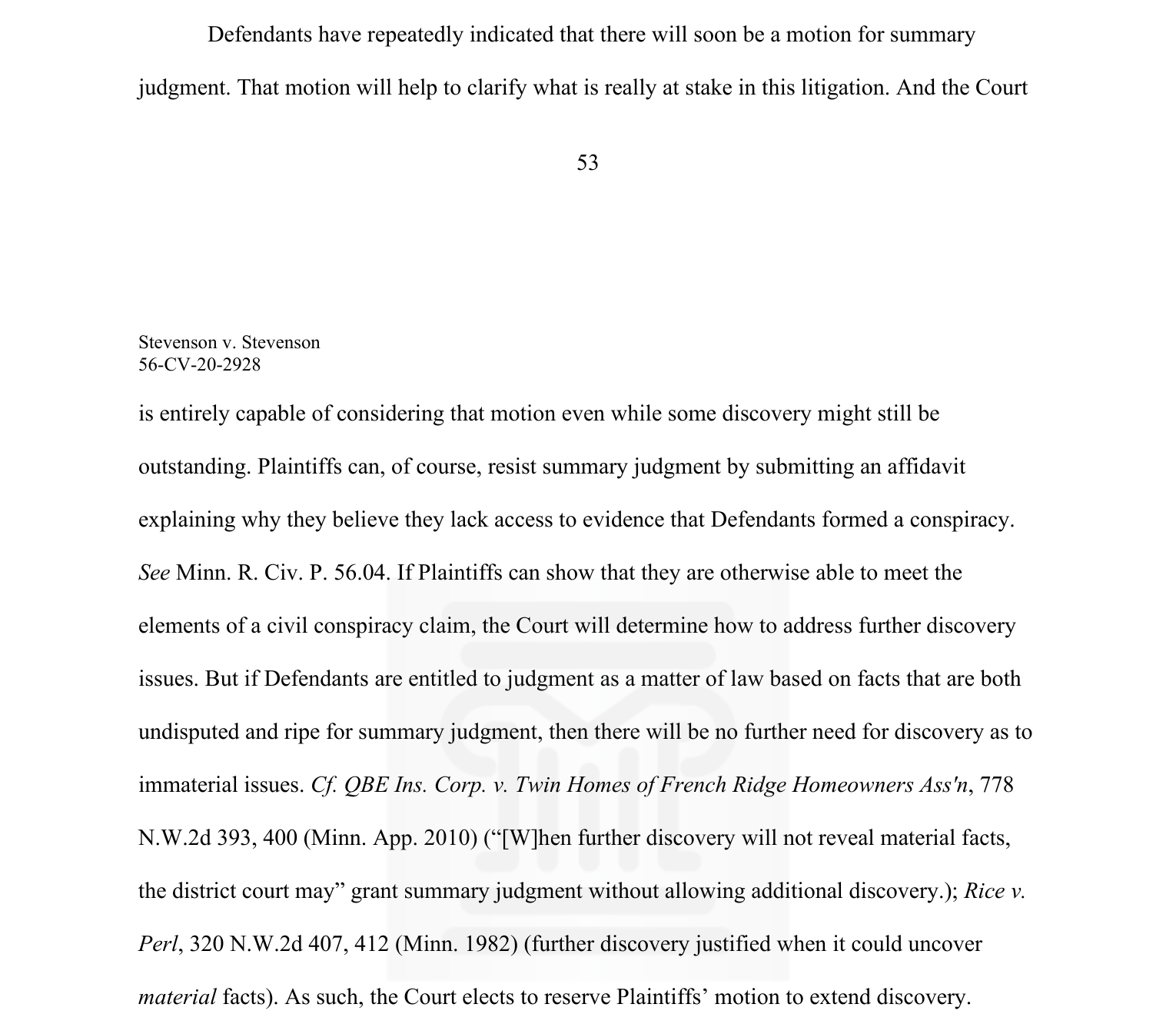
Stevenson, order on pretrial motions, Doc. 366, December 6, 2022, pp. 53–54. The excerpts preserve the original page break.
Enlarge image.
At the March 15, 2023 summary-judgment hearing, the Stevenson plaintiffs’ attorney expressly asked the court to apply Rule 56.04 and not grant summary judgment at that stage on the existing record.[6]
The June 16, 2023 summary-judgment dismissal order (Doc. 429) dismissed the complaint; all other pending motions and requests were dismissed as moot. The April 8, 2024 appellate opinion affirmed dismissal of the defamation, intentional-infliction-of-emotional-distress, and conspiracy claims. It treated the missing substantive elements as decisive, left discovery motions moot, and upheld the denial of additional monetary sanctions.[8]
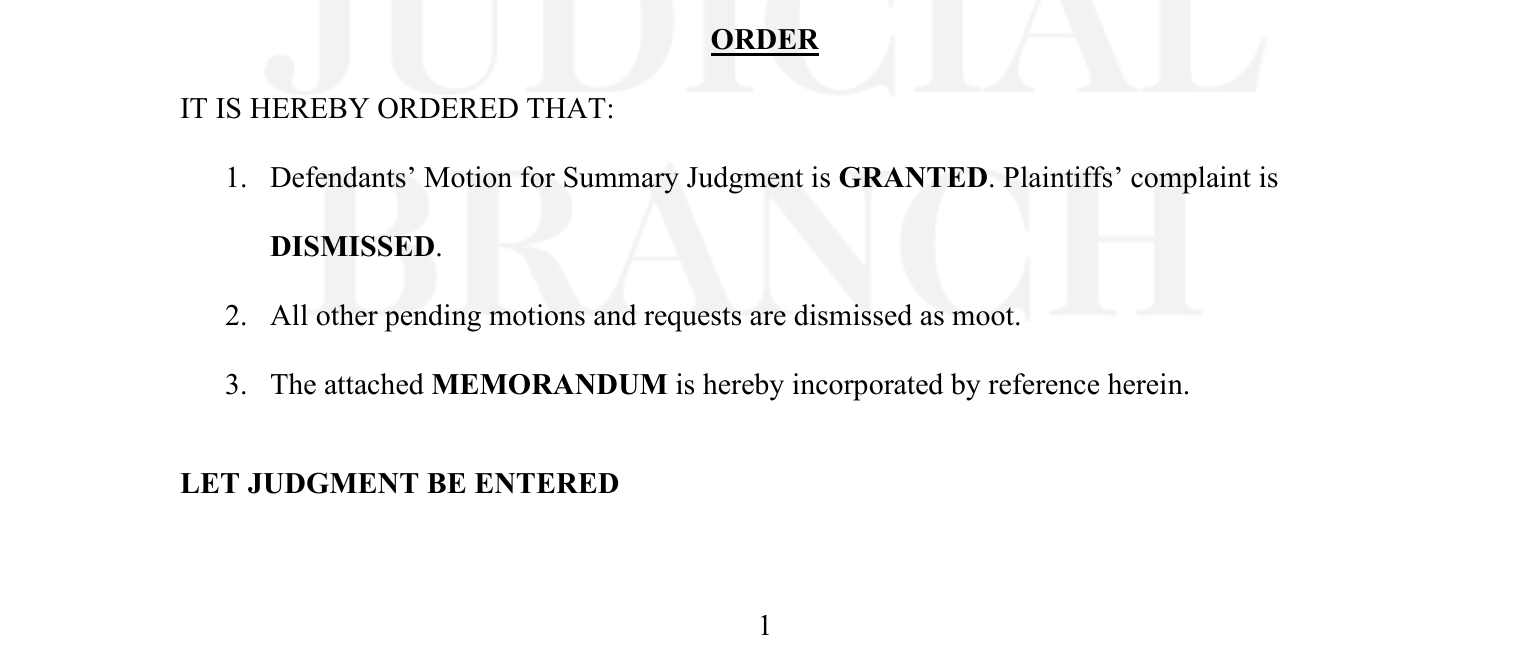
Stevenson, summary-judgment dismissal order, Doc. 429, June 16, 2023, p. 1.
Enlarge image.
| Decision | R&P | Stevenson |
|---|---|---|
| District court’s premise | The occupancy evidence did not create a material factual dispute. | The claims could not survive on their substantive elements. |
| Effect on outstanding matters | The self-help claim failed; remaining motions, including discovery relief, became moot. | Pending motions and requests became moot when the complaint was dismissed. |
| Appellate result | Affidavit and revenue evidence required reversal; the dependent matters returned for consideration. | Dismissal was affirmed; discovery remained moot. |
Summary judgment and discovery: the decisive threshold
The comparison turns on access to evidence. In R&P, reversal returned the self-help claim and discovery motion for consideration along with the foreclosure challenge. In Stevenson, dismissal was affirmed and discovery remained moot. A ruling that ends a case can also end the opportunity to obtain the evidence a party says is missing.
Sources and record locators
Document numbers refer to the Minnesota Court Records Online (MCRO) court-file indexes: Hennepin County file 27-CV-25-548 for R&P and Otter Tail County file 56-CV-20-2928 for Stevenson. Page numbers refer to the PDF unless a paragraph or printed transcript page is specified. The district documents can be located through Minnesota Court Records Online.
- R&P Industries, LLC, et al. v. First Western Bank & Trust, A26-0442, September 21, 2026, Minnesota Court of Appeals nonprecedential opinion: pp. 2–5 (background and evidence); pp. 6–10 (summary-judgment analysis); p. 9 n.2 (unpreserved photograph theory); p. 11 (dependent rulings and remand).
- R&P Doc. 66, January 9, 2026, Order on Cross-Motions for Summary Judgment: p. 2 (disposition and judge); p. 20 (affidavit discussion under building occupancy); pp. 21–23 (parking evidence); pp. 24–25 (self-help and moot motions). Doc. 69, the same summary-judgment order filed January 13, 2026, contains the same substantive text.
- R&P Doc. 48, September 25, 2025, Surinder Singh Affidavit in Support of Plaintiff’s Motion for Summary Judgment: p. 4, ¶¶ 18–19 and 24; Exhibit 005, PDF p. 90 (May 2024 parking statement).
- R&P Doc. 29, June 3, 2025, order denying dismissal: p. 15 (automated payment stations and adequately pleaded occupancy theory).
- R&P Doc. 11, January 24, 2025, Declaration of Francis J. Rondoni in Opposition to Plaintiffs’ Motion for Temporary Restraining Order: Exhibit H, PDF pp. 15–16 (vacancy affidavit and attached parking-sign photograph).
- Stevenson v. Stevenson, Doc. 366, December 6, 2022, Order and Memorandum Granting in Part, Denying in Part, and Reserving in Part Six Pre-Trial Motions: pp. 16–17 (false testimony and forensic costs); pp. 49–54 (discovery extension and summary judgment). Doc. 421, March 15, 2023 summary-judgment hearing transcript, printed p. 61, lines 1–13 (plaintiffs’ Rule 56.04 request).
- R&P Doc. 25, April 4, 2025, scheduling order, p. 1; Doc. 37, the bank’s August 27, 2025 letter, and Doc. 38, the plaintiffs’ responsive letter the same day, pp. 2–3 (subpoenas and parties’ positions); Doc. 50, October 3, 2025, plaintiffs’ notice of motion and motion to deem admissions responses timely and amend the scheduling order; Doc. 51, October 3, 2025, plaintiffs’ supporting memorandum, pp. 2–3 and 10–12; Doc. 53, October 3, 2025, plaintiffs’ proposed order granting that relief, p. 1 (proposed deadline); Doc. 55, October 9, 2025, bank’s memorandum opposing those motions, pp. 11–13. The bank’s first Answer to the plaintiffs’ Amended Complaint is Doc. 40, filed September 5, 2025.
- Stevenson v. Stevenson, Doc. 424, June 2, 2023, plaintiffs’ letter identifying conflicting sworn testimony (filed confidentially); Doc. 429, June 16, 2023, Order and Memorandum Granting Summary Judgment and Dismissing, pp. 1 and 33; A23-1209, April 8, 2024, Minnesota Court of Appeals nonprecedential opinion, pp. 5–11 (substantive claims) and pp. 12–13 (moot discovery and denial of additional monetary sanctions).
- Minnesota Rule of Civil Procedure 56, particularly 56.01, 56.03(d), and 56.04.