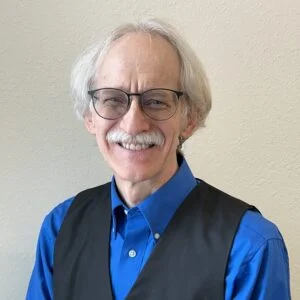

Introduction
Judge Kevin M. Miller has explained why disputed facts should reach a jury. In Christiansen Keefe v. Kronemann Construction, Inc., he allowed an injured worker to seek punitive damages because jurors could reasonably draw inferences in the worker’s favor. He also allowed the worker to record a defense psychological examination over the defendant’s objection.
The case later settled before trial, after these rulings preserved disputed questions for a jury’s consideration.[1]
Those rulings belong in Justice-Denied’s coverage. They also sharpen the comparison with Stevenson v. Stevenson, where Miller prohibited recording Marie Stevenson’s psychological examination and rejected proposed defamation allegations as substantially true despite Craig Stevenson’s sworn account disputing the underlying accusation.
Recording allowed in Keefe, prohibited in Stevenson
Keefe survived a fall down a grain-elevator handlift shaft in January 2021. His physical and psychological injuries became issues in his personal-injury lawsuit. Kronemann sought defense examinations, including a psychological examination by Dr. Jennifer Service. Keefe agreed to examinations but sought conditions, including audio recording.
By the July 2024 hearing, the parties had agreed to record three examinations. The remaining recording dispute concerned Dr. Service’s psychological examination. Miller resolved it in Keefe’s favor. His October 18, 2024 order permitted recording that examination, required advance disclosure of questionnaires, consent forms, and waivers to Keefe’s attorney, and incorporated the parties’ agreements about expenses and expert reports. Keefe Doc. 43, pp. 3–6.
Miller relied on Minnesota’s one-party recording statute and his power to set examination conditions under Rule 35.01. He also explained that defense examiners are not treating physicians and that recording therefore posed no doctor-patient confidentiality problem. Doc. 43, p. 5.
In Stevenson, Miller had reached the opposite recording result. His April 15, 2022 order (listed in MCRO under April 18) required Marie to attend an independent medical examination (IME) in St. Cloud and directed: “There shall be no recording of Marie’s IME.” The order summarized competing arguments about recording, then announced the prohibition without explaining why recording itself was unsuitable in her case. Stevenson Doc. 205, pp. 4–7.
The Keefe ruling makes the need for an explanation concrete. Miller recognized recording as a permissible safeguard in one psychological examination after prohibiting it in another. The orders leave readers to examine what justified the different treatment.
The same examiner had objected to recording before
Keefe’s attorney supplied a particularly useful comparison: a 2019 order in Gutwasser v. Lakeville Real Estate Management, LLC involving Dr. Service herself. That order records her refusal to conduct a neuropsychological examination if it was recorded. Judge Arlene M. Asencio Perkkio nevertheless allowed recording, finding no demonstrated prejudice and concluding that recording would promote transparency. Keefe Doc. 37, Exhibit H, Bates 0062–0065; original PDF pp. 322–325.
Gutwasser concerned neuropsychological testing; Keefe’s disputed examination was psychological. The comparison establishes that the same examiner’s objection had already been considered and rejected by another Minnesota judge. Miller’s Keefe order likewise allowed recording. A defense examiner’s preference did not determine the outcome.
When competing inferences belonged to jurors
Keefe also sought permission to add punitive damages—additional damages intended to punish particularly serious misconduct. Under Minnesota Statutes section 549.191, that request required a factual showing before punitive damages could be pleaded. Miller granted it on March 28, 2025.
The central questions concerned whether employee Adam Fry deliberately disregarded a known danger when he helped send Keefe up the unsafe handlift, and whether foreman Levi Lewis implicitly approved Fry’s actions.
Miller explained that courts must credit the plaintiff’s evidence and draw reasonable inferences in the plaintiff’s favor when deciding whether a jury question exists. He expressly rejected weighing conflicting evidence for credibility. Keefe Doc. 61, pp. 12–14.
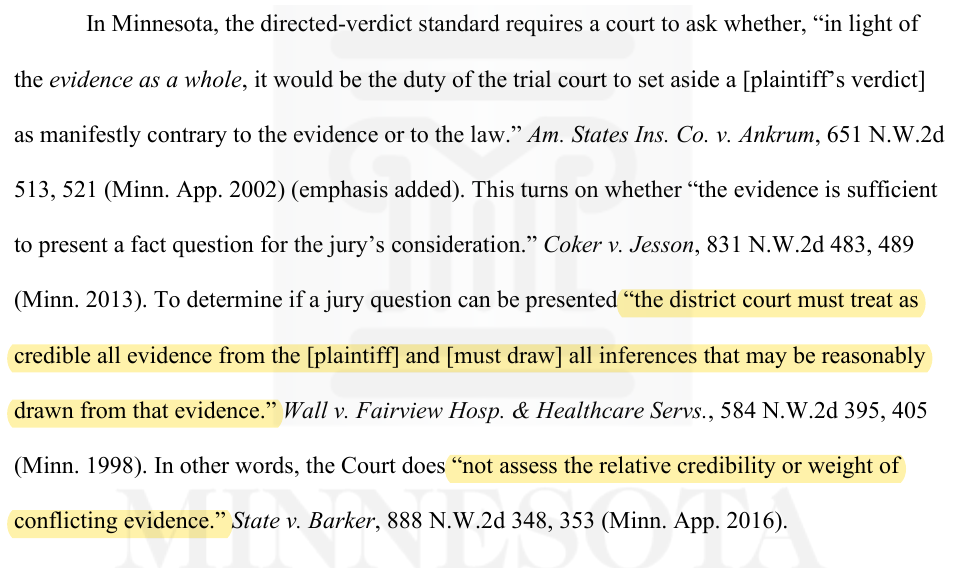
Christiansen Keefe v. Kronemann Construction, Inc., No. 56-CV-23-1802, Doc. 61 (March 28, 2025), p. 12. Highlighting added.
Enlarge image. Read or download pages 12–14 (PDF).
That principle affected the result. Lewis had not verbally directed Fry to assist Keefe. Miller nevertheless found that Lewis’s presence, knowledge, and failure to intervene could support an inference of approval. Although the inference was contestable, Miller concluded it could reasonably be drawn by a jury. Doc. 61, pp. 19–20.
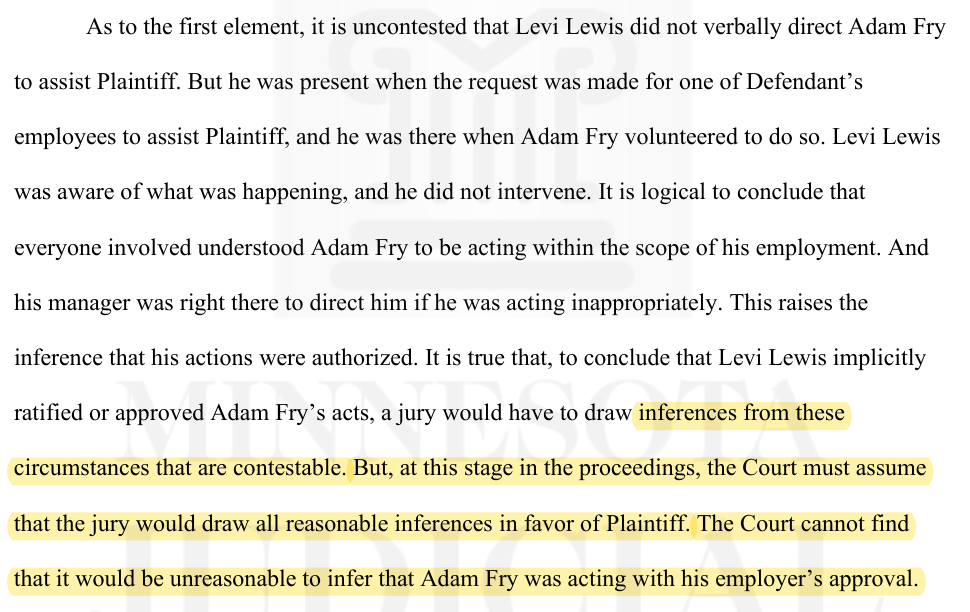
Christiansen Keefe v. Kronemann Construction, Inc., No. 56-CV-23-1802, Doc. 61 (March 28, 2025), p. 19. Highlighting added.
Enlarge image.
Miller also considered opposing evidence for context and rejected several of Keefe’s proposed punitive-damages theories. He still preserved the claim supported by reasonable inferences. Keefe won permission to pursue punitive damages; the order did not award them.
The sworn account missing from Stevenson’s explanation
In Stevenson, the December 15, 2021 amendment order allowed a civil-conspiracy claim and Ashley Anderson’s addition as a defendant. Both amendments were unopposed. Stevenson Doc. 152, pp. 5–7 and 10–11.
The order struck three proposed allegations as substantially true and another as privileged. Regarding truth, Miller wrote that Plaintiff had supplied no evidence supporting a reasonable interpretation that the statements were false. Stevenson Doc. 152, pp. 9–10.
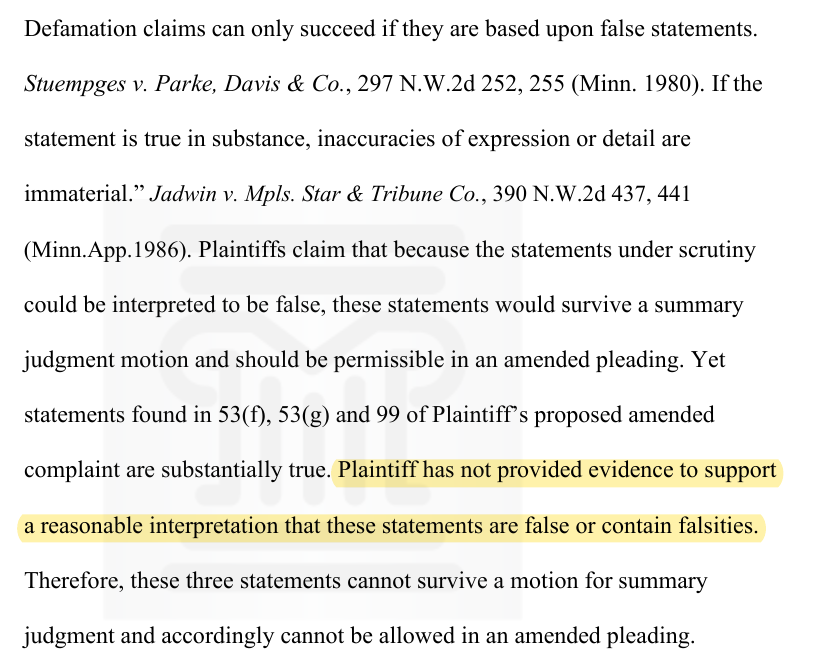
Stevenson v. Stevenson, No. 56-CV-20-2928, Doc. 152 (December 15, 2021), p. 9. Highlighting added.
Enlarge image. Read or download pages 9–10 (PDF).
However, Craig had submitted a four-page sworn declaration disputing the accusation that he had added his name to Renee’s insurance without her permission. He described his father seeking Renee’s authorization by telephone and a separate call in which Renee herself arranged for Craig’s name to be added to another policy. He expressly denied adding his name without her knowledge or consent. Stevenson Doc. 136, pp. 2–4, paragraphs 11–43.
The order did not identify that declaration or explain why its account failed to create a factual dispute. That omission is the comparison’s central concern: Keefe’s order explained why a contestable inference remained for jurors; Stevenson’s order announced substantial truth without addressing this contrary sworn account.
The motions involved different claims: statutory permission to seek punitive damages in Keefe and proposed defamation allegations under Rule 15 in Stevenson. Both orders considered whether the proposed claims could survive summary judgment. Minnesota permits courts to deny amendments on that basis, as the Supreme Court explained in Johnson v. Paynesville Farmers Union Cooperative Oil Co., PDF pp. 37–38. The question is how each treated evidence favoring the plaintiffs when deciding which claims could proceed.
Keefe’s case ended in settlement
On July 23, 2025, counsel notified Miller that all claims had settled at mediation the previous day and requested cancellation of the pending motion hearing, pretrial conference, and scheduled jury trial. Keefe Doc. 74, p. 1.
In Keefe, Miller allowed the plaintiff to record a defense examination and explained why disputed inferences could support a punitive-damages claim. In Stevenson, he prohibited Marie’s recording and rejected proposed defamation allegations as substantially true without addressing Craig’s four-page sworn declaration.
Those decisions shape the evidence litigants can preserve and the questions a jury may ever hear. Miller’s own Keefe rulings explain why recording and disputed inferences deserved protection. His Stevenson orders leave the different treatment unexplained.
Primary court records
The linked PDF excerpts can be read or downloaded directly. To locate other court filings, search Minnesota Court Records Online by case number, then find the filing by date and Index number.
- Christiansen Keefe v. Kronemann Construction, Inc., No. 56-CV-23-1802: Index #43, October 18, 2024, IME order, pp. 2–6 (original-page PDF excerpt, pp. 3–6); Index #61, March 28, 2025, punitive-damages amendment order, pp. 12–14 and 19–20 (PDF excerpt, pages 12–14; original pages 19–20); Index #37, July 15, 2024, declaration and exhibits, Exhibit H, PDF pp. 322–325, Bates 0062–0065 (Gutwasser order, June 28, 2019); Index #74, July 23, 2025, settlement letter, p. 1.
- Stevenson v. Stevenson, No. 56-CV-20-2928: Doc. 205, signed and court-file-stamped April 15, 2022, listed in MCRO under April 18, IME order, pp. 4–7; Doc. 152, December 15, 2021, amendment order, pp. 5–11 (PDF excerpt, pages 9–10); Doc. 136, October 1, 2021, declaration, pp. 2–4, ¶¶11–43.
- Johnson v. Paynesville Farmers Union Cooperative Oil Co., Minnesota Supreme Court, August 1, 2012, Nos. A10-1596 and A10-2135, PDF pp. 37–38: review of proposed amendments under the summary-judgment standard.