


Introduction
The Minnesota Court of Appeals has now begun addressing a problem courts across the country are facing: legal briefs that appear to rely on artificial-intelligence “hallucinations.”
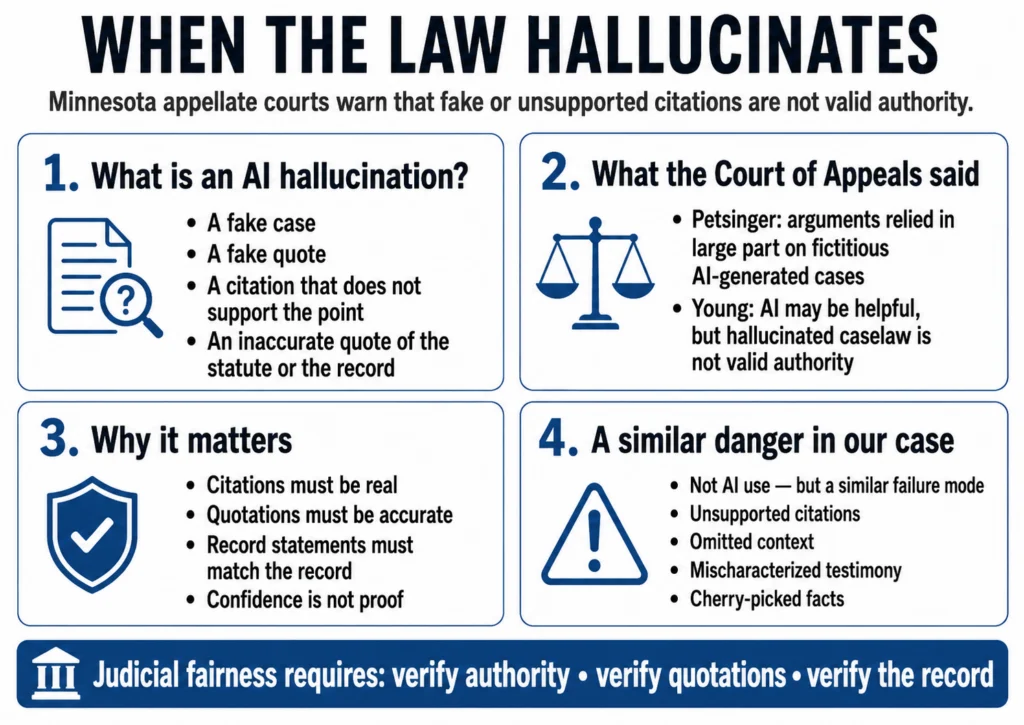
In plain English, an AI hallucination occurs when a generative AI system produces something that sounds authoritative but is not true. In the legal setting, that can mean fake cases, fake quotations, inaccurate statutory language, or citations that exist but do not support the proposition for which they are offered.
That is not a harmless technology glitch. In court, a citation is supposed to be a bridge between argument and authority. If the citation is fake, misleading, or unsupported, the bridge collapses.
Two recent nonprecedential Minnesota Court of Appeals opinions illustrate the problem. In Petsinger v. Steele County Recorder’s Office, the court described the appellant’s arguments as being supported by what appeared to be:
“fictitious cases generated from the hallucinations of artificial intelligence.”
In Young v. Young, the court was even more explicit. It warned that many citations in the brief either did not exist or did not support the legal argument, and that the brief also inaccurately quoted statutes and the record. The court then stated the principle directly:
“we emphasize that hallucinated caselaw is not valid authority and that all parties should
be mindful of the importance of accuracy in their submissions”
That short sentence captures the core problem. The Court of Appeals did not say artificial intelligence is forbidden. In Young, the court acknowledged that AI can be a helpful tool. But the court drew the line where the legal system must draw it: unverified legal authority, inaccurate quotations, and unsupported record statements cannot become valid support simply because they appear in a legal brief.
The problem is not AI by itself.
The problem is unverified authority—legal writing that looks precise, sounds confident, and collapses when compared to the actual law or the actual record.
Why Hallucinated Legal Authority Is So Dangerous
Legal hallucinations are dangerous because they exploit the trust built into legal writing.
Courts, lawyers, litigants, and the public rely on citations because citations are supposed to be checkable. A case citation should lead to a real case. A quoted passage should match the source. A factual statement should trace back to the record. A legal rule should be supported by the authority cited for it.
When that chain breaks, the reader may not immediately know it. A fabricated case can look real. A misleading quotation can sound official. A distorted factual summary can appear neutral. A confident but unsupported legal proposition can seem inevitable.
That is why the AI-hallucination issue matters beyond technology. It is not merely about ChatGPT, legal research tools, or self-represented litigants. It is about whether the legal system insists that legal authority remain tethered to reality.
The Court of Appeals’ Message: Verify Before You File
The lesson from Petsinger and Young is simple: if a litigant uses AI, the litigant remains responsible for the filing.
That is true for lawyers. It is also true for self-represented litigants. Courts may give pro se parties some leeway in navigating procedure, but that leeway does not transform fake law into real law. A party cannot cite a case that does not exist and then blame the machine.
That is a fair rule. But it should not stop with litigants.
If the rule is that parties must verify citations, quotations, statutes, and record references before asking a court to rely on them, then the same principle should apply with even greater force to judicial orders. A court order is not merely advocacy. It is the government’s official explanation for why one side wins and the other loses.
That is where the AI-hallucination discussion begins to overlap with deeper concerns this site has raised about our own case.
When Hallucinated Authority Becomes a Discipline Case
On August 21, 2026, the Minnesota Office of Lawyers Professional Responsibility filed a disciplinary petition against Rochester attorney Faisal S. Ahmed. Ahmed has unconditionally admitted that a memorandum he filed after using generative AI contained two nonexistent cases and two real cases accompanied by materially false citations.
The disciplinary record identifies an important second failure. After opposing counsel told the district court that one of the cases could not be found, Ahmed asked to respond in writing, received a deadline, and filed nothing. The petition alleges—and Ahmed has admitted—that he later failed to withdraw the misrepresentations after additional citation errors were identified. A district court sanctioned him $5,000 and referred the matter to the disciplinary authorities.
The parties have jointly recommended a 30-day suspension, but the Minnesota Supreme Court has not entered a final disciplinary order. The recommendation should not be reported as imposed discipline.
The disciplinary proceeding does not answer that question, and the professional-conduct rules governing lawyers are not a substitute for the standards governing judges. But the verification principle should be symmetrical: legal authority does not become accurate because the person using it holds greater institutional power.
Not AI—But a Similar Failure Mode
To be clear: this post does not claim that Judge Kevin Miller used artificial intelligence in our case. That is not the point.
The point is that the danger identified in AI-hallucination cases has a human counterpart. The same kind of harm occurs when a judicial order presents something as law, fact, or neutral analysis even though the cited authority, quotation, or record does not fairly support it.
AI hallucination is one way that unsupported authority enters the courtroom. But it is not the only way.
A brief can hallucinate. A lawyer can overstate. A party can misquote. And a court can reshape the record by adopting one side’s framing, omitting key words, misstating testimony, or treating unsupported propositions as settled law.
The shared danger is false confidence. Whether generated by software or written by a human, the result is the same when unsupported claims are dressed in the language of legal authority.
Example One: When Advocacy Becomes “Authority”
In our post on the common-interest doctrine, we discussed one of the clearest examples.
Judge Miller’s December 21, 2021 discovery order used the common-interest doctrine as a broad shield against discovery into communications among defendants. The order attributed a sweeping proposition to In re Lawrence: that conversations among joint defendants are privileged and therefore need not be disclosed.
But our analysis showed that the sentence was not present in In re Lawrence at all, but originated from Defendants’ answers to interrogatories. The actual rule in Lawrence concerned joint attorney-client privilege where one attorney represents multiple clients. That is a very different concept from a blanket rule that co-defendants may withhold communications simply because they are co-defendants.
That is not an AI hallucination. But it resembles the core problem: a proposition was presented as though it came from legal authority when, according to our analysis, the cited case did not say it.
That matters because courts do not merely describe the law. Courts use legal authority to allocate power. A mistaken or unsupported citation can block discovery, end a claim, or make an outcome appear legally unavoidable.
Example Two: When Omitted Words Change What a Citation Communicates
AI hallucinations often involve fake quotations. But misleading quotation practices can arise without AI.
In our post on ellipses and omitted text, we discussed how selective quotation can change what a legal authority appears to say. One example involved a defamation discussion where the court quoted the “substance, gist, sting” language while omitting surrounding context, including language emphasizing that truth or falsity is generally a jury question.
Omitting words is not automatically improper. Courts and lawyers use ellipses all the time. But omissions become a fairness problem when they remove the very context that would make the legal standard less favorable to the outcome being reached.
That is the connection to hallucinations. A fake quote invents authority. A misleadingly clipped quote can distort authority. Both can cause the reader to trust a legal proposition that the source, fairly read, does not support.
Example Three: When the Record Is Rewritten After the Fact
In Young, the Court of Appeals criticized not only questionable caselaw citations but also inaccurate quotations of statutes and the record. That is important because record accuracy matters just as much as legal accuracy.
Our post on “revisionist history during discovery” raised a related concern. We argued that Judge Miller later described our original discovery motions as being made at a high level of generality, with little analysis of particular discovery responses. But our analysis of the record showed that the motions identified specific interrogatories, document requests, evasive answers, privilege-log defects, and known missing communications.
That kind of dispute is not about technology. It is about whether the court’s description of the record matches the record itself.
When a court says a party offered only generalities, but the record contains detailed, request-by-request analysis, the court’s framing does real work. It tells later readers—appellate judges, oversight bodies, lawyers, journalists, and the public—that the losing party failed to do something the record may show it actually did.
That is why accuracy is not a technicality. It is the foundation of meaningful review.
Example Four: When One Side’s Facts Become the Story
AI systems can hallucinate by producing a polished answer that leaves out inconvenient facts. Judicial orders can create a similar effect when they summarize one side’s evidence in detail while minimizing or omitting contrary evidence.
Our post on cherry-picking facts at summary judgment addressed that problem. We argued that Judge Miller’s summary-judgment order quoted a June 2020 letter from Sean C. Stevenson (Rosemount, MN) in a way that framed his conduct as polite and rational, while excluding emotionally significant emails from Craig and Marie that described fear, distress, panic, and requests that the conduct stop.
At summary judgment, that matters. The court is not supposed to weigh the evidence or choose the most favorable narrative for the moving party. The nonmoving party is entitled to have the evidence viewed in the light most favorable to them.
A one-sided factual narrative can function like a record hallucination. It may not invent a document. But it can invent inevitability by selecting only the facts that make one side’s position appear obvious.
Example Five: When Testimony About Deletion Is Reframed
Our post on mischaracterized testimony and ignored deletion raised another parallel.
We argued that the court failed to accurately address deposition testimony in which Sean admitted deleting messages he believed could be used as evidence in the litigation. According to our analysis, the court instead framed the deletion issue as involving personal conflict rather than litigation-related evidence concerns.
That distinction matters. If a party deletes messages because of personal embarrassment, that is one issue. If a party deletes messages because they may be used as evidence, that raises a very different concern.
Again, this is not an AI hallucination. But it implicates the same core value: legal decisions must be anchored to what the record actually says, not to a softened or more convenient version of it.
Example Six: When One Privilege Doctrine Is Treated Like Another
Our spousal-privilege post raised similar concerns about legal transposition—taking principles from attorney-client privilege cases and applying them to spousal privilege without adequate explanation.
The post argued that the court relied on attorney-client privilege cases to support a broad waiver theory, even though spousal privilege serves different interests and is governed by different concerns. It also identified altered or generalized quotation language that, in our view, made attorney-client authorities appear more transferable than they actually were.
This resembles one of the most common forms of legal hallucination: a real case is cited, but for a proposition it does not actually support.
That kind of error can be harder to detect than a fake case. A fake case may not appear in Westlaw or Google Scholar. But a real case misused for the wrong doctrine may look legitimate unless someone reads the source closely.
The Difference: AI Error Versus Judicial Authority
There is also an important difference.
When AI hallucinates, the immediate problem is usually verification failure. The tool generated output. The human failed to check it. Responsibility remains with the person who submitted the filing.
When a judicial order misstates a case, omits material quotation context, or mischaracterizes the record, the problem is more serious because the statement comes from the institution charged with deciding the dispute. The court’s words carry authority that a litigant’s brief does not.
That is why the Court of Appeals’ AI warning should not be treated as a narrow technology story. It should be treated as a rule-of-law story.
If Minnesota courts are going to insist that litigants verify every AI-assisted citation before filing a brief, courts should also insist that judicial orders verify every cited case, every quotation, every factual characterization, and every record-based statement before issuing an order.
The duty of accuracy should be symmetrical, but the burden should be greatest where the power is greatest.
Verification Is a Judicial Duty
The AI-hallucination problem gives Minnesota courts an opportunity to say something broader and more important:
- A citation should mean the cited source actually supports the proposition.
- A quotation should preserve the meaning of the quoted passage.
- An ellipsis should shorten text, not alter the legal standard.
- A factual summary should fairly account for material contrary evidence.
- A court should distinguish between a party’s argument and binding authority.
- A summary-judgment order should not make disputed facts disappear by omission.
The question is not only whether AI can hallucinate law. The deeper question is whether the legal system will tolerate any form of unsupported authority when it appears in polished, official, or confident legal writing.
The Real Lesson From the AI Cases
The Minnesota Court of Appeals is right to warn litigants about hallucinated cases and unsupported citations.
But the real lesson should be larger than “be careful with AI.” The lesson should be: verify authority. Verify quotations. Verify the record. Do not let confidence substitute for accuracy.
AI makes the problem easier to see because the errors can be dramatic: fake cases, fake holdings, fake quotations. But the legal system’s credibility is also damaged by quieter distortions—selective quotations, omitted facts, recharacterized testimony, and legal propositions that become “law” only because they appear in an order.
In that sense, AI hallucinations are not an entirely new problem. They are a new version of an old danger: legal writing that looks authoritative without being properly grounded.
That danger is especially serious when it affects people who lack institutional power, cannot afford endless litigation, or are forced to rely on appellate review that may defer to a distorted account of what happened below.
Technology did not create that problem. It merely gave the courts a new reason to confront it.
Conclusion
The Court of Appeals has now made clear that hallucinated caselaw is not valid authority. That is a necessary rule.
But public trust requires more. It requires courts to apply the same verification principle to every part of the legal process. Fake cases should not decide appeals. Misquoted cases should not decide discovery. Omitted context should not decide summary judgment. Reframed testimony should not decide sanctions, spoliation, or credibility-related issues.
The rule should be simple:
That is not an AI principle. It is a judicial fairness principle.