

Distorting the Law:
Intentional Infliction of Emotional Distress
Minnesota’s tort of intentional infliction of emotional distress (IIED) is narrow by design. It is not an easy claim. The plaintiff must show extreme and outrageous conduct, intent or recklessness, causation, and severe emotional distress, and Minnesota courts have repeatedly emphasized that the tort is sharply limited to especially egregious facts. But narrow is not nonexistent. Difficult is not impossible. And most importantly, IIED is still its own tort. It is not merely a label to be discarded whenever a court would rather talk about some other claim instead.
That is why Judge Kevin M. Miller’s summary-judgment dismissal of Marie’s IIED claim deserves close attention. The problem is not simply that he rejected a difficult claim. The problem is how he got there: by collapsing Marie’s separate IIED theory into defamation rhetoric, by selectively quoting authority, by omitting key language from the Restatement, by claiming no supporting case law could be found after citing Cafferty himself six months earlier, and by treating missing evidence as though it eliminated disputed intent altogether.
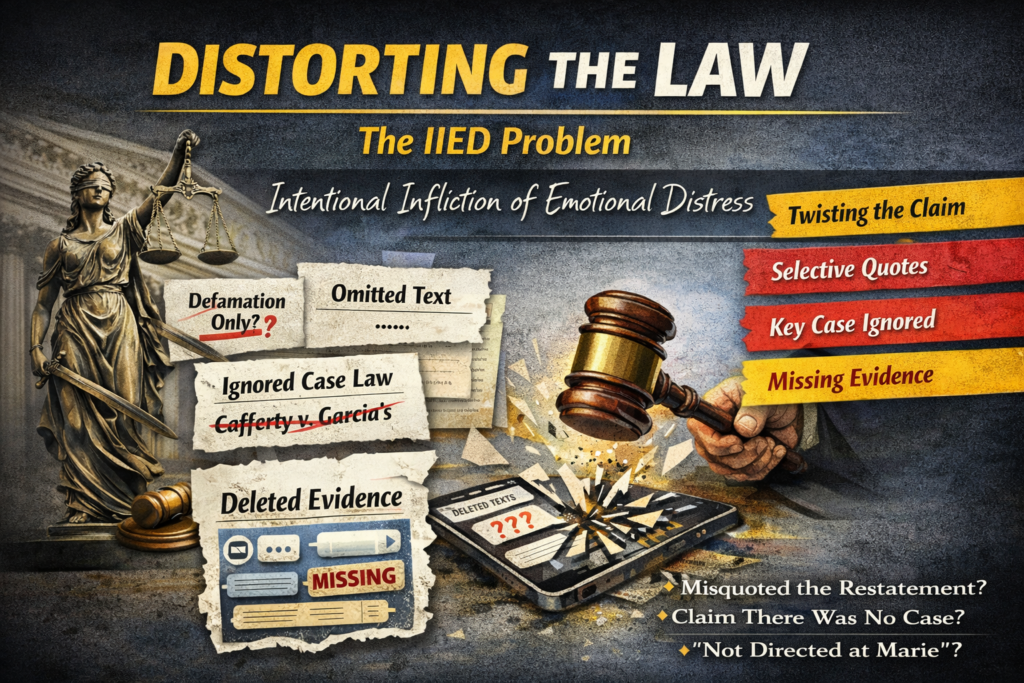
The infographic below highlights the core themes of this article: a separate tort reframed, key authority narrowed, relevant examples omitted, and missing evidence treated as though it resolved disputed intent.
That last point deserves special attention. Sean’s contacts with Marie’s father did not occur in a vacuum. The record reflected a pattern of calls and deleted texts between Sean and Lisa surrounding those contacts and the escalating warnings that followed. On May 25, 2020, there was a 43-minute call between Sean and Lisa, outreach to Marie’s father, and five unrecoverable texts. On June 5, after Craig and Marie warned Defendants that Marie had suffered a panic attack and feared her father, there were ten more deleted texts. On June 6, another deleted text followed. On June 7, while Craig pleaded for the harassment to stop, Sean and Lisa exchanged twenty-nine more texts—all missing.
Those missing communications matter because they go directly to motive, coordination, purpose, and intent. They could have shed light on why the contacts were made, whether Marie’s distress was discussed, whether further contact was planned after Defendants were told of her reaction, and whether upsetting or frightening Marie had become part of the point. Once those messages were deleted from both phones and could not be recovered, the surrounding record was no longer complete.
And that raises a serious question:
That question is not rhetorical flourish. It goes to the heart of summary judgment. This is not the stage at which a court is supposed to resolve evidentiary uncertainty against the nonmoving party. Yet that is effectively what happened here. When the most probative contemporaneous communications are gone, certainty about intent becomes much harder to justify—not easier.
A Separate Tort Was Collapsed into the Wrong Claim
Judge Miller’s order initially recognized the claims as pleaded. I brought the defamation claims. Marie brought the IIED claim. But when the order turned to Marie’s emotional-distress theory, that distinction began to blur. The order treated her claim as though it were really just a failed defamation claim under another name, then announced that Plaintiffs could not “circumvent” defamation law by “merely recasting” the claim as IIED.
That framing changed the claim before the law was ever applied to it. Marie’s theory was not simply that false words injured her reputation. Her theory was that Sean repeatedly contacted her estranged and abusive father, that the first contact caused immediate severe emotional distress, and that Sean continued after being informed of her reaction and her history. That is not merely defamation with a new label. It is a distinct theory built around knowledge, recklessness, repeated conduct, and severe emotional harm.
When a Source Is Quoted Against Itself
One of the clearest examples of distortion appears in Judge Miller’s use of Michael Steenson’s The Anatomy of Emotional Distress Claims in Minnesota.
The order cited Steenson for the proposition that Plaintiffs could not evade defamation limits by relabeling a failed defamation theory as IIED. But page 87 of Steenson does not begin there. It begins by saying that intentional infliction of emotional distress “stands alone.” It says the plaintiff’s right to recover for IIED does not depend on establishing defamation. It says the failure of a defamation claim should not automatically preclude IIED. It even gives the example of defamation being only one part of a broader pattern of harassment.
Only then does the article add the narrower “Conversely” sentence about relabeling the same conduct. And immediately after that, Steenson says an IIED claim may justify recovery “irrespective of the disposition of the defamation claim.”
A visual representation of the Court’s treatment of Steenson is illuminating:
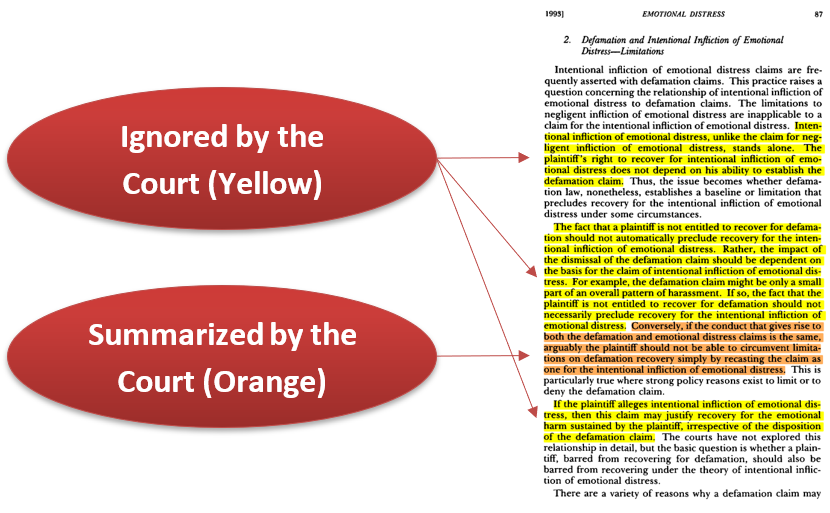
That sequence matters. The word “Conversely” matters. It signals that the sentence Judge Miller relied upon was not the whole rule, but the opposite side of a more qualified discussion. Quoting only that limiting sentence, while omitting the surrounding language that said IIED stands alone and is not automatically defeated when defamation fails, made the source appear to support a broader rule than it actually stated.
The mismatch is even more striking here because I brought the defamation claims, not Marie. So the court’s anti-circumvention rhetoric did not just narrow Steenson. It blurred the actual structure of the pleadings.
The Court Said No Supporting Case Existed — After Citing Cafferty Itself
Judge Miller then wrote that Plaintiffs cited no case, in Minnesota or elsewhere, sustaining an emotional-distress claim on such a theory, and that the court could find none. This was not a case the court overlooked. It was a case the court had already used — and one Plaintiffs had repeatedly cited as well.
Six months earlier, in his December 6, 2022 order, Judge Miller himself cited Cafferty v. Garcia’s of Scottsdale while discussing Marie’s IIED claim. He wrote:
Marie’s IIED claim against Sean requires proving that she “suffered severe emotional distress” that was the “result of the extreme and outrageous conduct.” Langeslag, 664 N.W.2d at 869. She must show “a causal connection between the conduct and the emotional distress.” Id. at 869. Her distress is not actionable if it was caused by “preexisting conditions” that were not “specifically aggravated by [Sean’s] conduct.” Id. Moreover, if some preexisting condition gave her “a peculiar susceptibility to such distress,” then she cannot recover for distress caused by that condition, in excess of what a reasonable person would experience, unless Sean “had knowledge” of the condition. Cafferty v. Garcia’s of Scottsdale, Inc., 375 N.W.2d 850, 853 (Minn. App. 1985).
(December 6, 2022 Order, Doc. 366, at 36.)
That was not a passing reference. Judge Miller cited Cafferty precisely for the proposition that made the case relevant here: when a plaintiff has a peculiar susceptibility to emotional distress, the defendant’s knowledge of that susceptibility matters. And Cafferty was not merely somewhere in the background of the case. Plaintiffs cited Cafferty repeatedly in their summary-judgment opposition briefing, including multiple direct citations and additional Id. references. So by the time Judge Miller later claimed no supporting case had been cited and none could be found, Cafferty had already been identified by both the court and Plaintiffs as a directly relevant Minnesota authority.
In other words, the court had already identified — and Plaintiffs had again squarely presented — the very Minnesota authority most relevant to the theory it later claimed did not exist.
This is not a minor inconsistency. Cafferty is important because it expressly recognizes that conduct may become extreme and outrageous when the actor knows the plaintiff is peculiarly susceptible to emotional distress and proceeds in the face of that knowledge. That is not some remote side issue. That is the core of Marie’s theory.
That is why the contradiction matters so much. Courts can distinguish authority. They can say a case is not close enough. But that is not what happened. Instead, the order told the reader that no such authority existed at all. That is a very different claim.
For more on that problem, see Ignoring Previously Used Caselaw.
The Restatement Was Trimmed Where the Law Mattered Most
The same pattern appears in Judge Miller’s use of the Restatement.
The summary judgment order acknowledged that a plaintiff’s peculiar susceptibility can matter. But in discussing comment f, it moved quickly to the limiting language about hurt feelings while omitting the part that explains why knowledge matters: conduct may become “heartless, flagrant, and outrageous” when the actor proceeds in the face of that knowledge. Westlaw’s Quick Check tool comparing the order (document 1, left column) with the actual Restatement text (right column) shows the omissions behind ellipses:
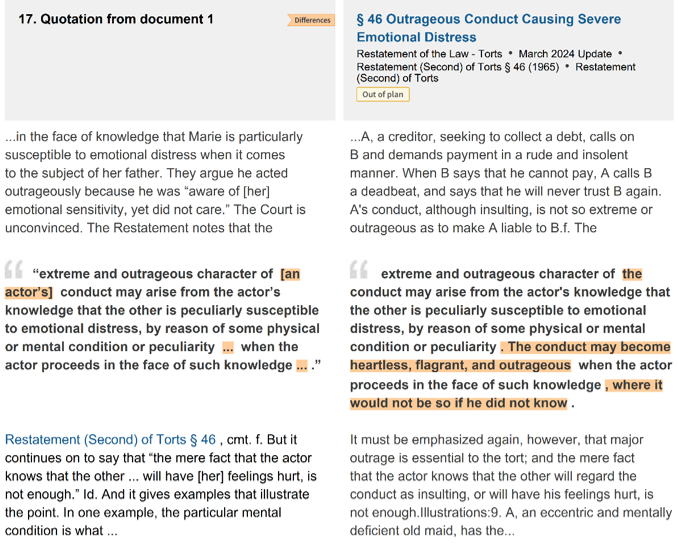
That omitted concept was not filler. It was the hinge of the rule. Marie’s theory was precisely that Sean proceeded after learning of her particular vulnerability and after being informed that his first contact had caused serious emotional harm.
The order also quoted comment h for the proposition that it is for the court, in the first instance, to determine whether conduct may reasonably be regarded as extreme and outrageous. True enough. But the very next sentence says that where reasonable people may differ, the issue is for the jury. That omitted sentence matters enormously at summary judgment. Quoting only the gatekeeping half of comment h while omitting the jury half narrows the Restatement at exactly the point where the judge-jury boundary matters most.
And then there is comment j, which the order effectively ignored altogether. Comment j addresses severity and peculiar susceptibility. It recognizes that exaggerated emotional distress may still be actionable when it results from a peculiar susceptibility of which the actor had knowledge. That was not a sideshow in this case. It was central to it.
Those are not trivial omissions.
But the problem did not stop with ellipses. The Court’s treatment of the Restatement’s illustrations was even more revealing.
In its analysis, the Court implied that comment f contained only two relevant illustrations, stating: “In one example…” and “In the other example…,” before concluding: “This case is far more like the second example than like the first.” But comment f does not contain only two illustrations. It contains five, numbered 9 through 13.
That matters because two of those five illustrations — illustrations 11 and 12 — are far more similar to the facts and evidence in this case than the two the Court chose to quote. Both illustrations focus specifically on the actor’s knowledge of the other person’s peculiarities, sensitivities, or medical condition, and on when liability may arise because the actor proceeds in the face of that knowledge.
The Court quoted illustration 10, then skipped over illustrations 11 and 12, and then quoted illustration 13. In other words, it quoted one illustration from before the most relevant examples and one from after them, while omitting the two illustrations in the middle that most directly addressed conduct undertaken with knowledge of the other person’s susceptibility.
A visual comparison makes the point even clearer:
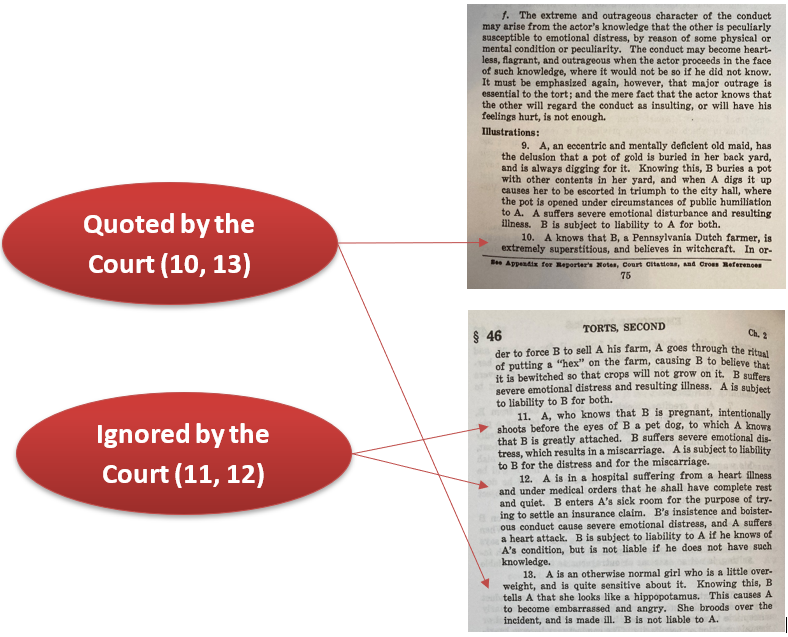
Illustration 11: A, who knows that B is pregnant, intentionally shoots before the eyes of B a pet dog, to which A knows that B is greatly attached. B suffers severe emotional distress, which results in a miscarriage. A is subject to liability to B for the distress and for the miscarriage.
Illustration 12: A is in a hospital suffering from a heart illness and under medical orders that he shall have complete rest and quiet. B enters A’s sick room for the purpose of trying to settle an insurance claim. B’s insistence and boisterous conduct cause severe emotional distress, and A suffers a heart attack. B is subject to liability to A if he knows of A’s condition, but is not liable if he does not have such knowledge.
Those two illustrations are not peripheral. They go to the heart of Marie’s theory: knowledge matters. They show that liability may arise when a defendant proceeds in the face of known vulnerability and causes severe emotional harm. That is far closer to Marie’s evidence than either a “hex” or an insult about body weight.
The Court’s miscitation changed the meaning of the Restatement by concealing the illustrations most relevant to the facts before it. At a minimum, that omission is difficult to reconcile with careful, good-faith engagement with the source. The Court did not simply overlook illustrations 11 and 12. It quoted one illustration from before them and another from after them, while leaving the most relevant examples out of the analysis entirely.
The Court Also Leaned on a Different Restatement Framework
And there is another problem. The issue was not only what Judge Miller left out of the Restatement. It was also what Restatement framework he chose to rely on.
Minnesota’s IIED doctrine was adopted from Restatement (Second) of Torts § 46. Yet in both his December 6, 2022 order and his June 16, 2023 summary-judgment order, Judge Miller repeatedly cited the Restatement (Third) of Torts while narrowing Marie’s claim.
That alone might not matter much if the newer Restatement had been cited only in passing. But the Court used it repeatedly to emphasize narrowness, gatekeeping, public-policy limits, First Amendment concerns, and the idea that some emotional harm must simply be tolerated without legal recourse. At the same time, it omitted passages from that same source that would have highlighted vulnerability, knowledge, motive, repeated conduct, recklessness, and the jury’s role.
So the problem was not simply that the Court used a different Restatement framework. The problem was that it used that framework selectively.
For more on the omitted language problem, see Ellipses, Omitted Text, and the Appearance of Bias.
The “Magical Power” Straw Man
Judge Miller then compared this case to Restatement illustrations involving a witchcraft “hex” and an overweight girl who was called a hippopotamus and got her feelings hurt. He concluded that this case was more like the second illustration and reasoned that Plaintiffs had not shown that contact with Marie’s father had some kind of “magical power” over Marie, divorced from rational processes. He then recast Plaintiffs’ position as the claim that Sean acted outrageously because he knew Marie would be “unreasonably” outraged.
Her claim was not that contact with her father operated by magic. Her claim was that Sean contacted her estranged and abusive father, learned that the first contact caused severe distress, and then proceeded anyway. That is not witchcraft. That is knowledge, recklessness, and repeated conduct in the face of known vulnerability. By shifting the issue from abuse-related fear to “magical power,” the order did not fairly characterize the claim. It replaced it with a straw man that was easier to reject.
And the phrase “particularly prone to offense for any reason” flattened Marie’s specific history of childhood abuse and visceral fear into generic oversensitivity. That rhetorical move was not neutral either. It transformed a claim grounded in abuse, fear, history, and notice into one about mere irrational offense.
The Missing Text Messages Matter
This case was not litigated on a complete record. The communications between Sean and Lisa surrounding the contacts with Marie’s father were deleted from both phones and were not recoverable. That missing evidence matters because the court later leaned on the notion that Sean’s conduct was not “directed at” Marie.
But when the relevant communications have been deleted, how can that conclusion be stated with confidence at summary judgment?
Those messages could have shown why the contacts were made, what Sean and Lisa said before and after they were made, whether Marie’s distress was discussed, whether additional contacts were planned in response to Craig and Marie’s objections, and whether frightening Marie was part of the purpose. Once those communications were gone, the record was incomplete in one of the very places where intent and direction mattered most.
That is why the deletion issue is not merely a discovery sidebar. It is part of the merits analysis. Missing evidence should have counseled caution, not confidence.
For more on the deletion pattern, see A Judicial Blind Eye and Coordinated Deletion of Evidence.
The Record Contained Notice, Repetition, and Severe Distress
Even Judge Miller’s own factual recitation showed that Sean sent additional correspondence after learning that Marie had discovered his first contact with her father. The order also acknowledged that Craig and Marie’s emails informed Sean that Marie was especially sensitive on the subject of her father. That should have made knowledge and repetition central to the legal analysis. Instead, those facts were minimized while the authorities that gave them legal significance were narrowed or omitted.
The summary-judgment record contained still more. It included historical evidence supporting the seriousness and longstanding nature of Marie’s fear. In 1987 medical records, doctors observed that Marie was “deathly afraid of returning home.” That evidence did not prove the entire case by itself, but it was directly relevant to whether contact with her father implicated a peculiar susceptibility to emotional distress and whether the severity of her reaction was grounded in something far more concrete than ordinary upset.
The same minimizing pattern appeared in the Court’s treatment of Marie’s distress itself. In recounting the June 4, 2020 events, Judge Miller wrote only that “Marie suffered emotional distress upon learning that Sean had contacted” her father. But Plaintiffs did not present the Court with some vague or abstract claim of upset. Plaintiffs presented evidence of a panic attack on June 4, including a contemporaneous security-system video, along with additional health records, personal notes, other video evidence, and medical expert opinions supporting the conclusion that Sean’s actions caused severe emotional distress.
That distinction matters. A judge’s choice to describe a panic attack merely as “emotional distress” is not neutral when the severity of distress is itself a required element of the claim. Nor is it insignificant that the order did not mention the June 4 security-system video at all. The result was to make Marie’s reaction sound general and subjective, rather than immediate, visible, and documented.
The record also showed repetition after notice. During oral argument on summary judgment, Judge Miller himself raised the point directly with defense counsel:
THE COURT: Let me ask, you would agree though that after Sean became aware that Marie was aware that there was a letter sent to [Marie’s father], I’m just gonna use his first name, —
MR. TENTINGER: Mm-hmm.
THE COURT: — that he sent correspondence after that.
MR. TENTINGER: That is correct.
THE COURT: Okay.
(Doc. 421, Tr. 20:14-22.)
That exchange is important because it confirms that the Court understood Sean’s later contacts did not occur in ignorance. They occurred after Marie’s awareness of the first letter was known, and after Sean had reason to understand the significance of that contact. In other words, the record did not merely support notice and repetition. It contained an express acknowledgment of both.
What the Order Left Out of the Record
And the summary-judgment record was stronger than the order acknowledged.
According to Plaintiffs’ March 1, 2023 filing (Doc. 398), the record included far more than a generalized claim that Marie was upset. It included several contemporaneous security-system videos from June 4, 2020 showing Marie’s distress after learning of Sean’s first contact with her estranged father; four additional videos from July 2, 2020 showing her distress after learning of Sean’s second contact; and a February 18, 2021 security-system video capturing a flashback episode so severe that Marie hyperventilated and was unable to breathe.
The record also included Marie’s 1987 medical records, along with three separate mental-health evaluations — by Dr. Steven H. Berger, Howard J. Friedman, Ph.D., and Dr. Ken Young — that supported Marie’s narrative. (Dr. Young was Defendants’ medical expert, but Dr. Young’s report was introduced into the record by Plaintiffs.)
That matters because this was not merely abstract testimony about hurt feelings. It was a record that included contemporaneous video, historical medical corroboration, and multiple expert evaluations supporting severity, causation, and known vulnerability. Yet Judge Miller’s summary-judgment order did not discuss those specific videos, did not mention the 1987 records, and did not mention Berger, Friedman, or Young at all. Instead, the order reduced June 4 to the statement that Marie “suffered emotional distress upon learning” Sean had contacted her father, noted Craig’s later email stating that she had experienced a panic attack, and then dismissed the IIED claim as a matter of law.
At summary judgment, that difference matters. A court is not required to accept a plaintiff’s characterization of the evidence. But when the record, viewed in the light most favorable to the nonmoving party, contains concrete evidence of visible distress, longstanding fear, and expert support, an order that leaves those items unmentioned risks making the claim appear far thinner than the record actually was.
That does not mean Marie had to win. But it does mean the claim was not the hollow caricature reflected in the order’s rhetoric. The record contained evidence far more concrete than the order’s sanitized summary suggested.
For more on the summary-judgment record itself, see Dismissing an IIED Claim at Summary Judgment.
What the Later Appellate Ruling Does Not Erase
The Court of Appeals later affirmed dismissal of Marie’s IIED claim on a different rationale, concluding that Sean’s conduct was not “directed at” Marie because the letters were sent to her father rather than to her. Readers should know that. But a later affirmance on different grounds does not retroactively validate every step of the district court’s reasoning. A court can reach the same result for a different reason and still leave serious questions about whether the first court fairly represented the law, the authorities, and the record.
And that brings us back to the missing text messages. If the communications between Sean and Lisa surrounding the contacts with Marie’s father had been deleted and could not be recovered, then the certainty of the “not directed at Marie” conclusion becomes even harder to defend. At a minimum, the deletion of that evidence should have counseled caution, not confidence.
Why This Belongs in the Distorting the Law Series
This post belongs in the Distorting the Law series because the pattern is familiar:
- a separate claim is reframed into a different one;
- a source is quoted as though it supports the opposite of what it says in context;
- key Restatement language is omitted where it most matters;
- a previously cited Minnesota case suddenly becomes impossible to find;
- missing evidence is treated as though it eliminates disputed intent altogether;
- and the result is presented as legally inevitable.
Minnesota’s IIED tort may be narrow. But a narrow tort is still entitled to an honest reading. If a court is going to dismiss an IIED claim at summary judgment, it should do so by applying the full rule, not a trimmed version of it; by acknowledging the cases that exist, not by saying none exist; and by addressing the claim the plaintiff actually brought, not a more convenient substitute.
That is the deeper problem here. Marie’s IIED claim was not just dismissed. It was first distorted and then dismissed.
What Judicial Fairness Requires
In the end, judicial decisions do not preserve public trust merely by reaching an outcome. They preserve it by showing the parties — and the public — that justice was done.
Minnesota’s own Code of Judicial Conduct sets that expectation. It requires judges to perform their duties fairly and impartially, and explains that fairness requires a judge to be objective and open-minded.
That is not a technicality. It is the foundation of public trust. The Minnesota Supreme Court has said the same in equally clear terms: a judge must promote public confidence in the judiciary, avoid impropriety and the appearance of impropriety, and perform judicial duties in a way that assures parties their case is being fairly judged.
“[I]mpartiality is the very foundation of the American judicial system.”
“To maintain public trust and confidence in the judiciary, judges should avoid the appearance of impropriety and should act to assure that parties have no reason to think their case is not being fairly judged.”
Greer v. State, 673 N.W.2d 151, 155 (Minn. 2004);
Pederson v. State, 649 N.W.2d 161, 164–65 (Minn. 2002).
And fairness is impossible when a judge stops being objective, stops being open-minded, or gives the parties reason to doubt that the law was applied with impartial care.
This article is part of Justice-Denied.org’s ongoing Distorting the Law series examining how legal standards, quotations, and precedent were handled in Stevenson v. Stevenson.
