

Distorting the Law:
Motion to Amend Complaint
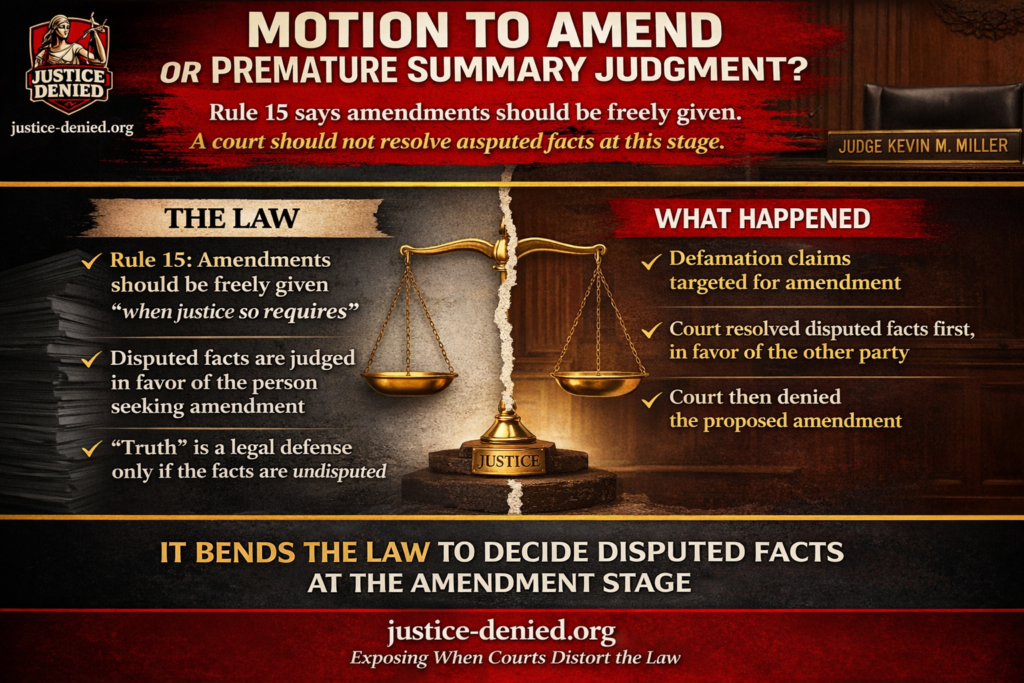
When we moved to amend our complaint in Stevenson v. Stevenson, the governing rule was not supposed to be restrictive. Minnesota Rule 15 provides that leave to amend “shall be freely given when justice so requires.” Courts do retain discretion to deny amendments that would be futile. But that doctrine has limits. It does not authorize a judge to weigh disputed facts, reject the nonmoving party’s evidence, and then use those factual conclusions to deny amendment.
That distinction mattered here.
The Backstory the Court Could Not Ignore
Part of the difficulty in following this ruling is that the proposed amendments did not arise in a vacuum. One of the tort claims already in our case was defamation per se. The background matters because the statements we sought to add were not random details. They were part of a broader pattern of serious accusations about criminal and dishonest conduct.
My estranged son, Sean Stevenson, had been listening to stories from his mother, to whom I had been married for approximately 18 months in the early 1980s. Rather than asking for my side of the story — the context only I could provide — he chose to accept what he had been told and then repeated accusations to my adult daughters. Those accusations included theft, insurance fraud, and even purported plans to burn Sean and Renee’s house down and collect the insurance proceeds. The lack of supporting facts did not seem to matter. I had no criminal history whatsoever.
That was the context in which we sought leave to amend.
Two of the specific defamatory statements we attempted to add help illustrate the point:
53(f) “[Craig] had moved every single one of [his] possessions (and much of [Renee’s] including all the money) out of the house.”
53(g) “Finally, she [Renee] found out that you [Craig] had secretly put your name on the fire insurance for the house, even though my mother had bought it and it was in her name.”
Based on new evidence uncovered during discovery, we also sought leave to add Ashley Anderson as a defendant and to add a conspiracy claim tied to Intentional Infliction of Emotional Distress (IIED).
Notably, defendants did not oppose adding Ashley Anderson to the case. Nor did they oppose the addition of a conspiracy charge on the IIED claim.
That makes what followed more revealing. The court did not reject the proposed amendment wholesale. Instead, it permitted the parts defendants did not oppose, while trimming away several of the defamation-related allegations they had specifically targeted.
At the October 8, 2021 hearing, our counsel argued exactly that point. If the court was going to rely on summary-judgment principles to assess futility, then it still had to respect the rules that govern summary judgment. Disputed facts could not be decided away. In defamation claims, Jadwin v. Minneapolis Star & Tribune Co. makes the issue especially clear: substantial truth may be decided as a matter of law only when the underlying facts are not genuinely disputed.
Judge Kevin M. Miller’s order acknowledged the futility doctrine, but then moved beyond it. The court did not deny the entire motion. It granted the motion in part, allowed Ashley Anderson to be added as a defendant, and permitted the new civil-conspiracy claim related to Intentional Infliction of Emotional Distress (IIED). But it also struck four targeted defamation allegations — paragraphs 53(f), 53(g), 54(b), and 99 — after concluding that some were “substantially true” and one was privileged.
That makes the ruling more selective, not less troubling.
Rather than rejecting the amendment outright, the court effectively trimmed away the very allegations defendants had specifically targeted. In other words, the amendment was allowed — but only after the court used a merits-style screen to cut out disputed facts and context.
How Defendants Framed the Issue
The briefing and hearing help explain how that happened.
Defendants did not oppose adding Ashley Anderson as a party. What they opposed was the inclusion of the new defamation allegations and the factual material supporting the conspiracy theory. Their position was that those additional statements would not survive summary judgment, and that we could not simply rely on the proposed amended complaint itself. At the hearing, defense counsel argued that we had to “show some support here” and that the summary-judgment standard applied.
That framing mattered because Judge Miller’s order largely followed it.
The order concluded that statements in paragraphs 53(f), 53(g), and 99 were “substantially true,” that we had not provided evidence supporting falsity, and that those allegations therefore could not survive summary judgment. On the surface, that may sound like an ordinary futility ruling. In practice, it looked like something more troubling: a motion to amend being treated as a vehicle for premature fact-finding.
Paragraph 53(g): The Word Was “Secretly”
One of the clearest examples was paragraph 53(g), which alleged that I had “secretly” put my name on the fire insurance for the house while married to my first wife, Renee. That accusation was not merely about whether a name had been added to a policy. The word that carried the sting was “secretly.” It implied concealment, lack of consent, and dishonest conduct. In ordinary terms, the accusation suggested insurance fraud — criminal conduct, not a harmless misunderstanding.
But I did not present mere argument on that issue. I submitted a sworn declaration stating that my father (Renee’s insurance agent) suggested that my name be added to the policy, told me Renee’s permission was required, called Renee himself, obtained her permission, and reported back that she agreed. The declaration further stated that Renee later separately suggested adding my name to another policy, and that I did not add my name to any of Renee’s policies without her knowledge or consent.
That is not “no evidence.” That is sworn evidence directly disputing the defamatory sting of the accusation.
Under Minnesota summary-judgment law, a court does not choose between competing factual accounts on a pretrial motion. Summary judgment is proper only when there is no genuine issue of material fact. And under Jadwin, substantial truth becomes a legal question only when the underlying facts are undisputed.
So when Judge Miller wrote that I had not provided evidence supporting a reasonable interpretation of falsity, despite the sworn declaration directly disputing the allegation that I acted “secretly,” the ruling appears to have crossed an important line. Instead of asking whether the proposed claim was legally viable if the facts were viewed properly, the order appears to have resolved the factual dispute against me.
Paragraph 53(f): A Partial Truth Does Not Automatically Defeat a Broader Defamatory Sting
Paragraph 53(f) raised a similar problem. The accusation was not merely that I removed my own belongings from the house. The broader statement accused me of taking Renee’s possessions and all the money.
That broader sting was false.
I presented evidence in the form of actual paid invoices showing that I had not taken any of the money Renee gave me and used it for my business as she alleged. To the contrary, the records showed that I had spent that money — along with an almost exactly matching amount of my own money — on improvements to the house, which she kept after the divorce.
Our counsel also argued that Minnesota defamation law does not allow a court to isolate one arguably true fragment and ignore the broader defamatory sting of the full accusation. That point matters. In defamation law, the “gist” or “sting” of the statement controls. A partial kernel of truth does not automatically sanitize a broader accusation.
Yet the order treated this disputed accusation as “substantially true” as a matter of law.
That, too, looks less like a careful futility analysis and more like an early merits determination dressed in the language of summary judgment.
Paragraph 99, Ashley Anderson, and Selective Trimming
Paragraph 99 presents a different concern, and the hearing transcript makes that concern even sharper.
Our counsel explained that paragraph 99 was not itself one of the allegedly defamatory statements in the relevant defamation section. Instead, it was a factual allegation concerning Ashley Anderson’s involvement in an upsetting Christmas-card incident and the surrounding conspiracy narrative — including taking the photo used for the card and assisting in the mailing process.
That point matters for two reasons.
First, it suggests the court may not have been analyzing paragraph 99 for what it actually was. If a paragraph is contextual factual material bearing on conspiracy and participation, treating it as though it were itself a standalone defamatory statement misses the point of the allegation.
Second, it highlights the selective nature of the ruling. Judge Miller found that Ashley’s alleged conduct arose out of the same occurrence or series of occurrences as the underlying claims. He allowed her to be added as a defendant. He also allowed the new civil-conspiracy claim to proceed. Yet he simultaneously struck at least part of the factual narrative we argued helped explain Ashley’s involvement.
In other words, the court allowed the party and the conspiracy label, but cut away part of the supporting context.
Our counsel also noted another wrinkle: materially similar substance appeared elsewhere in the pleading as well. That makes the decision to strike paragraph 99 look less like careful legal line-drawing and more like selective or inattentive trimming.
Not Every Part of the Order Was Equally Weak
To be fair, not every challenged part of the ruling stood on the same footing. Paragraph 54(b) involved litigation privilege, and Minnesota law gives broad protection to statements sufficiently related to judicial proceedings. Our counsel effectively acknowledged that point as to using that statement as a standalone defamation allegation, while still arguing that it could remain elsewhere in the pleading for context.
That portion of the order therefore stands on firmer legal ground.
But one stronger ruling does not cure the rest.
The Real Distortion
The deeper problem here is not that Judge Miller cited a nonexistent doctrine. He did not. Futility is real. Summary judgment is real. But legal doctrines are not applied correctly merely because a judge uses the right labels.
The distortion appears in how those labels were used.
A liberal Rule 15 motion became a mechanism for deciding disputed facts. A summary-judgment concept was invoked without honoring the rule that factual disputes must be viewed in favor of the nonmoving party. And a defamation doctrine about substantial truth was applied as though the underlying disputes had already vanished.
Minnesota law did not require Judge Miller to allow every proposed amendment. But it did require him to apply Rule 15 and summary-judgment principles correctly. When a court uses “futility” to short-circuit disputed facts, the issue is no longer just amendment procedure. It becomes something more serious: the use of legal terminology to justify factual conclusions the court was not yet entitled to make.
That is why this ruling deserves scrutiny.
The law was not supposed to function as a shortcut around factual disputes. It was supposed to protect the integrity of the process. When a motion to amend is turned into premature summary judgment, that integrity is lost — and the law is not being applied. It is being bent.
What Judicial Fairness Requires
In the end, judicial decisions do not preserve public trust merely by reaching an outcome. They preserve it by showing the parties — and the public — that justice was done.
Minnesota’s own Code of Judicial Conduct sets that expectation. It requires judges to perform their duties fairly and impartially, and explains that fairness requires a judge to be objective and open-minded.
That is not a technicality. It is the foundation of public trust. The Minnesota Supreme Court has said the same in equally clear terms: a judge must promote public confidence in the judiciary, avoid impropriety and the appearance of impropriety, and perform judicial duties in a way that assures parties their case is being fairly judged.
“[I]mpartiality is the very foundation of the American judicial system.”
“To maintain public trust and confidence in the judiciary, judges should avoid the appearance of impropriety and should act to assure that parties have no reason to think their case is not being fairly judged.”
Greer v. State, 673 N.W.2d 151, 155 (Minn. 2004);
Pederson v. State, 649 N.W.2d 161, 164–65 (Minn. 2002).
And fairness is impossible when a judge stops being objective, stops being open-minded, or gives the parties reason to doubt that the law was applied with impartial care.
This article is part of Justice-Denied.org’s ongoing Distorting the Law series examining how legal standards, quotations, and precedent were handled in Stevenson v. Stevenson.
