

Distorting the Law:
“Setting Aside the Fact” at Summary Judgment
When a court has to set aside a material fact in order to grant summary judgment, the question is no longer whether the record was one-sided. The question is whether the court set aside the rules with it.
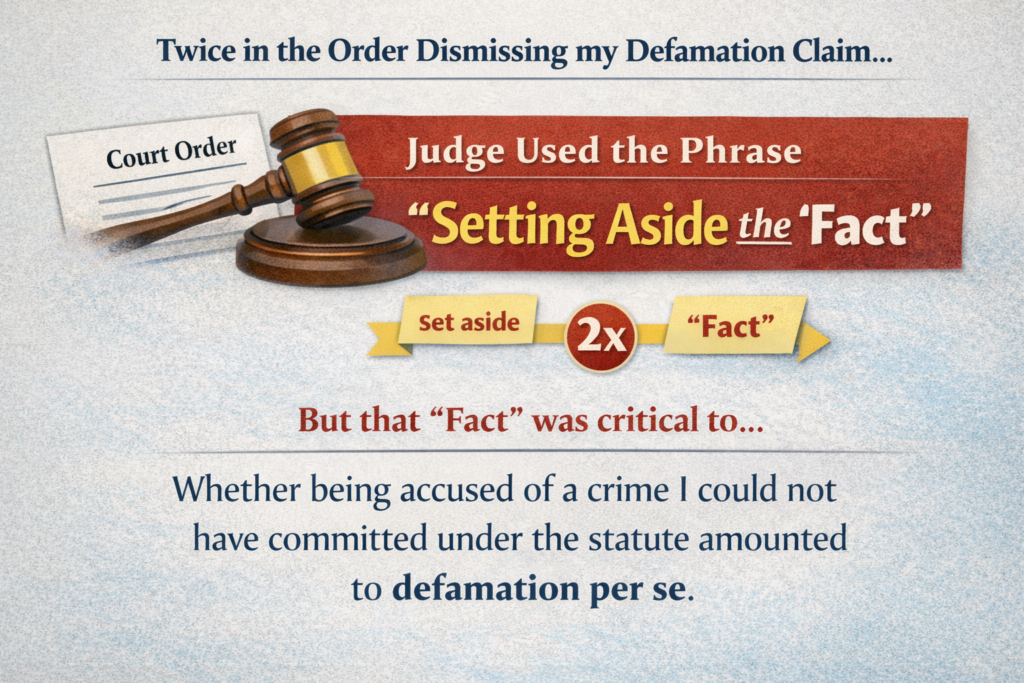
Sometimes a single phrase reveals more than pages of legal analysis. In my case, Stevenson v. Stevenson (56-CV-20-2928), that phrase was Judge Kevin Miller’s — “setting aside the fact” — used twice in the order dismissing my defamation claim at summary judgment. The fact he chose to set aside was not a minor detail. It was that my now ex-wife, Renee, and I were married at the time of the alleged taking of property — a fact the court itself acknowledged was a defense to criminal liability.
That matters because summary judgment is not supposed to work by subtracting away legally significant facts. A court may conclude that a fact is immaterial. It may conclude that even taking the nonmoving party’s evidence as true, the law still requires dismissal. But it is not supposed to identify a fact that helps the nonmoving party, recognize that the fact has legal significance, and then simply bracket it out before moving on to the real analysis.
Minnesota law is especially clear on this point. Summary judgment is proper only when there is no genuine issue of material fact. (That means the court may disregard only facts that are immaterial or unsupported — not material, record-supported facts and the reasonable inferences they support.) The court’s role is not to weigh evidence, assess credibility, or choose among competing factual inferences.
The Minnesota Supreme Court has said exactly that: “[w]eighing the evidence and assessing credibility on summary judgment is error.” Minn. R. Civ. P. 56; Hoyt Props., Inc. v. Prod. Res. Grp., L.L.C., 736 N.W.2d 313, 320 (Minn. 2007). Minnesota courts also repeatedly state that the evidence must be viewed in the light most favorable to the nonmoving party, with doubts and factual inferences resolved against the movant. Fabio v. Bellomo, 504 N.W.2d 758, 761 (Minn. 1993); Montemayor v. Sebright Prods., Inc., 898 N.W.2d 623, 628 (Minn. 2017); Staub v. Myrtle Lake Resort, LLC, 964 N.W.2d 613, 620 (Minn. 2021).
Distorting the Law – Setting Aside the Fact
What Prompted This Lawsuit
This lawsuit did not arise from a single isolated comment. It grew out of a family conflict that reignited in 2019 after my estranged son, Sean, reentered contact with my family, attended events with us, and then became involved in disputes about an earlier failed 2006 visit and about what my sister, Lisa, and Renee were saying about me and my marriage. As those disputes escalated, they spilled into emails, text messages, and other written communications. My defamation claims focused on specific statements within those communications that I believed falsely accused me of criminal conduct or implied criminal conduct.
For purposes of this post, the key statement came in an August 10, 2019 text exchange between Sean and my adult daughter, who is Sean’s half-sister. In that exchange, Sean told her that one of the few things he remembered bringing Renee to tears was her memory of being “stolen from” and betrayed. That phrase did not appear in a vacuum. It was part of Sean’s effort to persuade my daughter to accept his and Renee’s version of what had happened when my marriage to Renee ended many years ago.
That context matters. This was not a vague rumor or a stray remark overheard by strangers. It was a direct accusation, sent by my adult son to my adult daughter, in the middle of a larger family dispute. And because the accusation was that I had effectively committed theft against Renee, it naturally carried the sting of a false accusation of crime.
That is why the court’s later move was so important. Once the accusation is understood clearly — who said it, to whom, and in what context — the central issue comes into focus: could a court dismiss a defamation-per-se claim by “setting aside” the very fact that undercut whether the accusation could legally amount to theft at all?
When the Court Has to “Set Aside the Fact”
Judge Miller’s order did not merely note the marriage issue and move on. It expressly acknowledged that, because Renee and I were married, the accusation that I had “stolen” from her did not fit the crime of theft in the ordinary legal sense once the governing statute was taken into account. That should have been a critical point. In a defamation-per-se case based on an alleged accusation of crime, whether the accusation actually amounts to a crime is not a side issue. It is central.
And theft was not conceded. I denied stealing anything from Renee.
Yet after recognizing that problem, the order pivoted. Setting aside the fact that Renee and I were married, the court wrote, Minnesota theft law would otherwise apply. Then, a page later, the court returned to the same move again, stating that the issue was really my intent and once more setting aside the fact of the marriage.
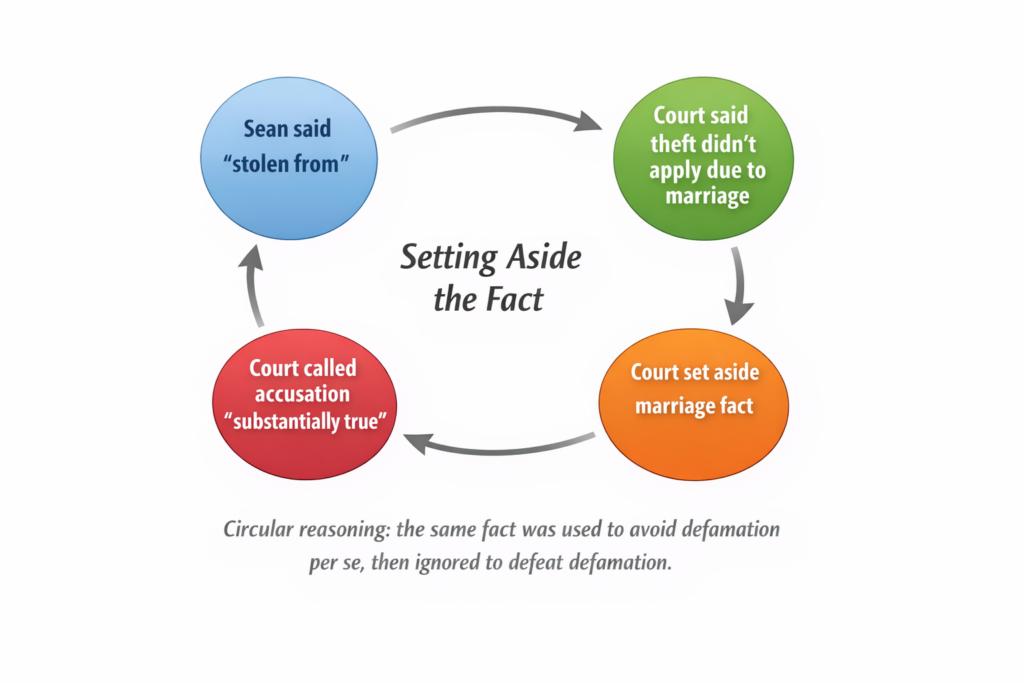
That was not just a turn of phrase. It was the mechanism by which the court took an accusation that plainly charged me with theft (“stolen from”), set aside the statutory fact that undercut that charge, and then treated the accusation as close enough to the truth to defeat my defamation claim.
The order did not say the fact of marriage was irrelevant. It acknowledged that the fact mattered, then moved past it anyway.
Minnesota Law Does Not Permit This Move
This is where Minnesota summary-judgment law matters. A court may disregard a fact if it is truly immaterial or unsupported by the record. But it may not grant summary judgment by acknowledging a fact favorable to the nonmoving party, recognizing that the fact matters, and then resolving the remaining inferences against that party anyway.
Minnesota Rule of Civil Procedure 56 requires that there be no genuine issue as to any material fact. The district court’s function on summary judgment is not to decide facts, but only to determine whether genuine factual issues exist. DLH, Inc. v. Russ, 566 N.W.2d 60, 69 (Minn. 1997). The evidence must be viewed in the light most favorable to the nonmoving party. Fabio, 504 N.W.2d at 761. The court must not weigh facts or determine the credibility of affidavits and other evidence. Montemayor, 898 N.W.2d at 628. All doubts and factual inferences must be resolved against the moving party. Staub, 964 N.W.2d at 620.
Those are not empty phrases. They mean that once a court recognizes both a legally significant fact and a live factual dispute, the court is not free to push that fact aside and then adopt the inference favoring dismissal. If reasonable people could draw different conclusions from the evidence, summary judgment is supposed to stop there.
The Sentence That Gives the Game Away
One sentence in the order makes the problem even clearer:
“Craig does deny that he intended to permanently deprive Renee of the property in question.”
That sentence is powerful because it shows the court expressly recognized a live dispute over intent. Intent was not conceded. Intent was not established. Intent was disputed.
And what happened next? Rather than treating that dispute as a reason summary judgment should fail, the order immediately pivoted to the opposite inference. The court reasoned that because the property was not returned until prompted, the opposite inference could reasonably be drawn. It then pointed to my temporary control over the property and my act of displaying the money to another person, concluding that it was “more than arguable” that my conduct manifested indifference to Renee’s rights.
That is the heart of the problem. Summary judgment is not the stage where a judge is supposed to acknowledge a disputed issue of intent and then resolve the competing inference against the nonmoving party. If reasonable people could draw different conclusions from the same evidence, the court is supposed to stop there. That dispute belongs to a jury. Minnesota says exactly that. Summary judgment is a “blunt instrument” and is inappropriate when reasonable persons might draw different conclusions from the evidence presented. Staub, 964 N.W.2d at 620; see also DLH, 566 N.W.2d at 69–70.
Judge Miller’s own order correctly recited the governing rule earlier in the opinion: summary judgment is appropriate only when there is no genuine issue of material fact, and the court’s role is not to decide facts but only to determine whether genuine factual issues exist. But on this issue, the order did exactly what that rule forbids. It acknowledged the dispute, then weighed the competing inferences anyway.
Even Taking My Version as True
The order tried to solve this by saying that even assuming my version of the facts is true, an ordinary person could still interpret the conduct as theft. But that only restates the problem in a different form.
If my version of the facts was to be taken as true, then my denial of criminal intent had to be taken seriously too. A court cannot say it is crediting the nonmoving party’s version while simultaneously using the surrounding circumstances to prefer the opposite inference on the very element the court has just acknowledged is disputed.
That is not viewing the evidence in the light most favorable to the nonmoving party. It is selecting the interpretation most favorable to the movant, then labeling that interpretation “reasonable” enough to end the case. Minnesota’s appellate cases make clear that a court may not weigh the evidence this way on summary judgment. Hoyt, 736 N.W.2d at 320; Montemayor, 898 N.W.2d at 628.
Why the Theft Accusation Mattered
Minnesota law treats false accusations of crime as defamation per se. The words do not have to expressly name the offense if, in their ordinary acceptance and in context, they would naturally be understood as imputing a crime. And if the words are capable of carrying that meaning, the jury decides whether they were in fact so understood.
That is why the theft issue mattered so much. Sean accused me of having “stolen” from Renee. But Minnesota’s theft statute is built around taking “property of another.” And the statutory language in effect during my 1982–1984 marriage used a spousal exception, providing that the definition applied unless “the actor and the victim are husband and wife.”
(The current statute now says “spouses,” but the language in effect during my 1982–1984 marriage said “husband and wife.”)
Judge Miller himself acknowledged that Renee and I were married at the time — a fact he described as a defense to criminal liability — and he also acknowledged that I denied intending to permanently deprive Renee of the property. In other words, the court recognized both a legal obstacle to the theft theory and a factual dispute about criminal intent.
The historical reason the statute reads this way is not flattering, but it is important. The Minnesota Supreme Court explained that the old common-law rule rested on the fictional doctrine of the legal unity of spouses — the idea that prosecuting one spouse for theft from the other would undermine that “unity.” The court also noted an additional historical justification: the husband’s former ownership and control of the wife’s property. Those are outdated ideas, but they help explain why Minnesota’s theft statute contained the spousal exception during the years of my marriage.
There is another reason the theft issue deserves closer attention. Sean’s earlier accusation was not limited to the silver certificates. In the July 2019 email, he claimed that I had moved every single one of my possessions and much of Renee’s, “including all the money,” out of the house. As I explain in Distorting the Law – Motion to Amend Complaint, that broader accusation was false, and I had invoices showing that I had not taken Renee’s money for myself.
The much narrower issue involved several silver certificates that were mixed into our combined coin collections — collections that included my coins, my dad’s coins, and some of Renee’s coins. Because I was the only person who knew which coins belonged to whom, I moved the box to my shop to sort it out. When I did, I noticed the silver certificates, kept the one that was mine, and returned the rest along with Renee’s coin collection.
That matters because it shows how the analysis moved. The original sting was broad: that I had stolen from Renee, including all the money. But when Judge Miller later addressed Sean’s August 2019 “stolen from” statement at summary judgment, the order did not defend that broad accusation on its own terms. Instead, it shifted to the much narrower issue of the silver certificates and coins and then treated that narrower issue as enough to make Sean’s accusation substantially true. The accusation stayed broad, but the justification became narrow. That mismatch is one more reason the issue should not have been resolved against me as a matter of law.
Judge Miller’s own words make the problem hard to miss:
“Sean did explicitly use the word ‘stole,’ which denotes the crime of theft. However, it is clear from context that Sean could not be referring to the literal crime of theft. This is because it is clear that the events to which Sean was referring occurred while Craig and Renee were still married.”
That passage should have ended the matter. If the accusation was framed in terms of theft, but the governing statute and the undisputed fact of marriage meant it could not literally be theft, then the court had every reason to recognize the defamatory sting of accusing me of a crime I could not have committed in the way Sean described. Instead, the order used that very point as a stepping stone to a different conclusion.
The circularity in Judge Miller’s reasoning is hard to miss. The order acknowledged that Sean explicitly used the word “stole,” which ordinarily denotes the crime of theft. It then reasoned that, because Renee and I were married at the time, Sean’s statement did not amount to a literal accusation of theft. But instead of stopping there, the order set that same marriage fact aside and used the silver certificates and coins to conclude that the accusation was still substantially true. In effect, the court used the marriage fact to say there was no real theft accusation, then ignored that same fact to say the accusation was close enough to theft to defeat defamation.
The Court of Appeals Repeated the Standard, But Not the Problem
The Minnesota Court of Appeals later recited the correct summary-judgment standard, stating that the evidence must be viewed in the light most favorable to the nonmoving party and that a genuine issue of material fact exists when the record could lead a rational fact-finder to rule for that party.
But when the court turned to the theft issue, it did not confront Judge Miller’s repeated “setting aside the fact” move. Instead, it compressed the issue into a much narrower formulation: I admitted that, while Renee and I were married, I removed property that belonged to Renee, and truth is a complete defense to defamation. From there, it affirmed.
That omission matters. The appellate opinion did not squarely address whether it was proper to set aside a material fact the district court itself had identified as a defense to criminal liability. It did not grapple with the district court’s recognition that intent was disputed. And it did not ask whether the district court had impermissibly resolved competing inferences against me as the nonmoving party.
The Court of Appeals said it was reviewing the summary-judgment decision de novo, and it recited the familiar rule that the evidence must be viewed in the light most favorable to the nonmoving party. But the opinion that followed did not meaningfully engage the district court’s actual method. It did not confront Judge Miller’s repeated decision to “set aside” a material fact. It did not address the district court’s acknowledgment that I denied any intent to permanently deprive Renee of the property.
And it did not ask whether the district court had impermissibly chosen between competing inferences. In that sense, the Court of Appeals invoked de novo review in words, but its analysis read more like acceptance of the district court’s framing than an independent review of whether summary judgment was lawfully granted. A true de novo review should have applied the same Minnesota principles the court cited elsewhere: no weighing of evidence, no credibility determinations, and no resolution of reasonable factual inferences against the nonmoving party. Montemayor, 898 N.W.2d at 628; Staub, 964 N.W.2d at 620.
Compare Wakasugi v. 3M
The contrast with Wakasugi v. 3M is striking.
There, the Court of Appeals reversed summary judgment because the employee produced evidence that could support a reasonable inference that the employer had effectively chosen her for elimination before the formal skills assessment took place. The court emphasized that on summary judgment it had to construe the evidence and all reasonable inferences in the light most favorable to the nonmoving party, and it held that genuine issues of material fact required a trial.
That is how summary judgment is supposed to work. When the record supports competing inferences, the court does not choose the one it finds more persuasive and then end the case. It sends the case forward.
That makes Wakasugi a revealing comparison. In that case, evidence of preselection and conflicting inferences meant summary judgment was inappropriate. In my case, by contrast, the district court expressly recognized a disputed issue of intent, then resolved the competing inference against me anyway.
Judge Randall Slieter served on both panels. That makes the difference in approach especially difficult to ignore.
Compare Accredited v. Gold Path
Accredited v. Gold Path (March 2, 2026) provides another useful comparison.
In Accredited, the Court of Appeals held that statements such as “CON,” “frivolous,” and “legally extort consumers” were not mere opinion when they were capable of being proven true or false. Those statements, the court said, should have gone to the jury. The court also criticized the district court for altering its treatment of the challenged statements too late in the case.
That logic sits uneasily beside my case. If calling a mechanics’ lien “frivolous” or accusing a company of “conning” consumers can present jury-worthy factual sting, why was “stolen from” in my case reduced to a judge-decided gloss? Why, in one case, does the Court of Appeals insist that the sting of the words be treated as a factual issue for the jury, while in another it allows the sting to be drained away by reframing the statement around the movant’s preferred interpretation?
Judge Jon Schmidt served on both the Stevenson and Accredited panels. Again, the cases are not identical. But the contrast in method is hard to miss.
What Summary Judgment Does Not Permit
Summary judgment is not a device for judicial editing.
It does not allow a court to identify a fact that helps the nonmoving party, acknowledge that the fact matters, set it aside, recognize a dispute over intent, and then choose the inference that favors dismissal.
It does not allow a court to say, in effect, “even though intent is disputed, and even though the statement itself includes a fact that negates criminal liability, I find the opposite interpretation more persuasive.”
That is not the absence of a factual dispute. That is adjudication by inference-weighing.
Why This Phrase Matters
Judge Miller’s phrase matters because it reveals the move more honestly than the legal analysis around it.
When a court says it is “setting aside the fact”, it is telling the reader that a fact exists, that the court sees it, and that the court is choosing not to let that fact control the outcome. When the fact being set aside is a defense to criminal liability, and when the court also acknowledges that intent is disputed, the problem becomes impossible to ignore.
That is why the sentence about intent belongs at the center of this story. It shows that the issue was not a complete lack of proof. The issue was that the court recognized a live factual dispute and still resolved the case anyway.
And that is why this belongs in the Distorting the Law series.
Because when a court has to set aside the fact in order to grant summary judgment, it may be setting aside the law with it.
What Judicial Fairness Requires
In the end, judicial decisions do not preserve public trust merely by reaching an outcome. They preserve it by showing the parties — and the public — that justice was done.
Minnesota’s own Code of Judicial Conduct sets that expectation. It requires judges to perform their duties fairly and impartially, and explains that fairness requires a judge to be objective and open-minded.
That is not a technicality. It is the foundation of public trust. The Minnesota Supreme Court has said the same in equally clear terms: a judge must promote public confidence in the judiciary, avoid impropriety and the appearance of impropriety, and perform judicial duties in a way that assures parties their case is being fairly judged.
“[I]mpartiality is the very foundation of the American judicial system.”
“To maintain public trust and confidence in the judiciary, judges should avoid the appearance of impropriety and should act to assure that parties have no reason to think their case is not being fairly judged.”
Greer v. State, 673 N.W.2d 151, 155 (Minn. 2004);
Pederson v. State, 649 N.W.2d 161, 164–65 (Minn. 2002).
And fairness is impossible when a judge stops being objective, stops being open-minded, or gives the parties reason to doubt that the law was applied with impartial care.
This article is part of Justice-Denied.org’s ongoing Distorting the Law series examining how legal standards, quotations, and precedent were handled in Stevenson v. Stevenson.
