
Introduction
Courts often say that every case depends on its own facts.
That is true.
But judicial consistency is not about identical outcomes. It is about method. It is about whether similar legal concepts are handled in a recognizably consistent way. It is about whether disputed facts are preserved for a jury in one case, but resolved by the court in another. It is about whether procedural safeguards apply evenly.
A recent Otter Tail County defamation case, Precision Locating, LLC and Arvig Enterprises, Inc. v. Martin D. Starkebaum, Court File No. 56-CV-25-198 (“Starkebaum”), provides a useful comparison.
In that case, Judge Kevin Miller issued several pretrial orders involving Facebook statements, defamation, alleged criminal conduct, damages, truth or falsity, public-concern speech, qualified privilege, expert testimony, and motions in limine.
Those issues are familiar.
They also overlap in meaningful ways with the issues Judge Miller addressed in our case, Stevenson v. Stevenson, Court File No. 56-CV-20-2928.
The contrast is striking.
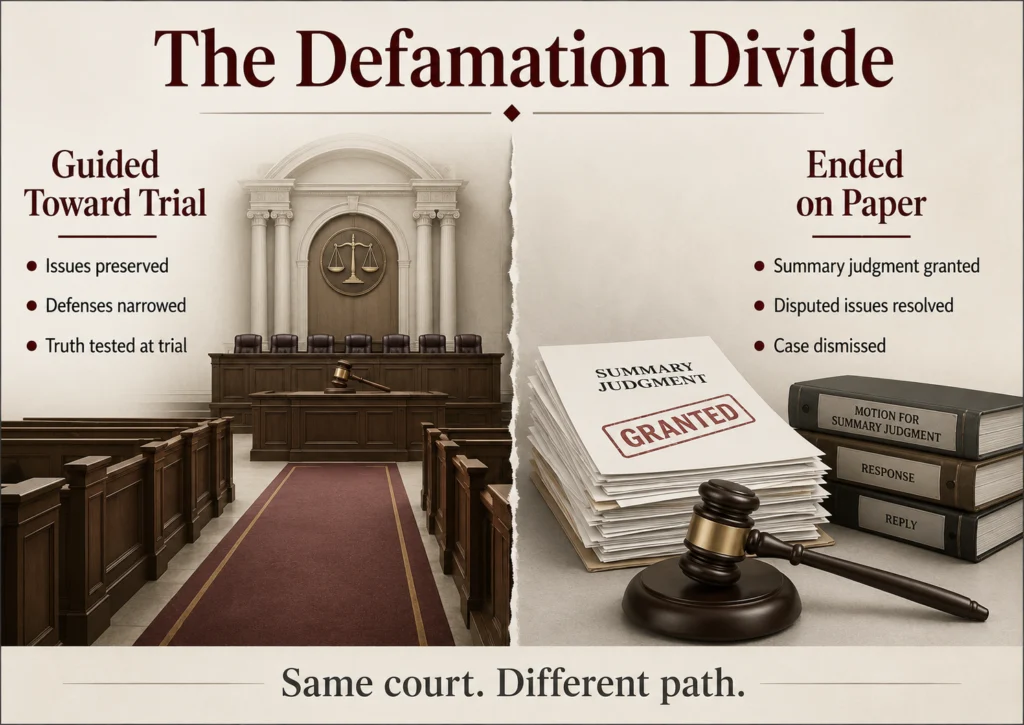
The earlier Starkebaum rulings preserved a path to trial. The July 14, 2026 scheduling order set a four-day jury trial beginning December 7. The court has since removed that setting for another mediation effort. Sources: Scheduling Order (July 14, 2026), p. 1; October 27, 2026 order, pp. 1–2.
In our case, the defamation case was ended at summary judgment.
The Transcript Makes the Contrast Sharper
The March 15, 2023 summary-judgment transcript from our case shows that these issues were not overlooked by our counsel. See Doc. 421, pp. 36–38.
Our attorney argued that summary judgment was improper because the facts were disputed, the defense had misstated or omitted material facts, and the court could not weigh evidence at that stage. He specifically told the court that “summary judgment can only be granted” when material facts are undisputed and that the court “cannot weigh evidence” on summary judgment.
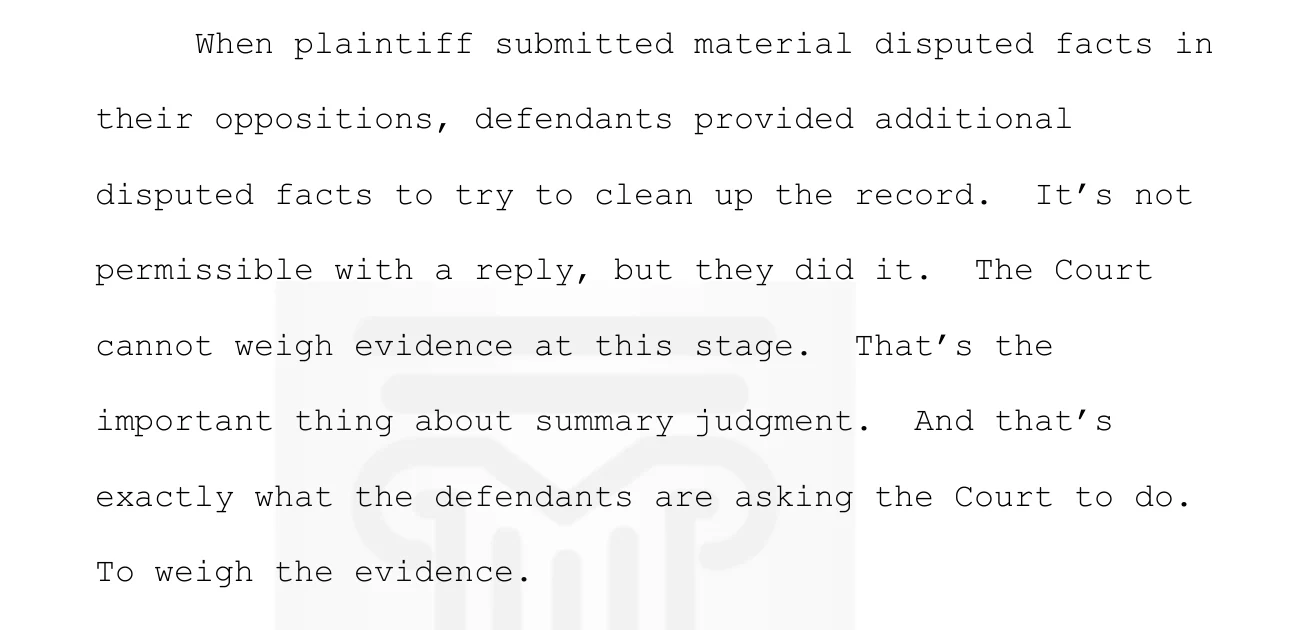
Stevenson v. Stevenson, No. 56-CV-20-2928, Doc. 421, Transcript of Proceedings (March 15, 2023), p. 37.
He also emphasized that our case was not merely a “family dispute,” not a criminal case, and not a family-law case. It was a civil case about words that caused significant harm, and he argued that Minnesota law provides remedies for defamation, defamation per se, and intentional infliction of emotional distress.
The later order did not simply say the facts were undisputed and the law required dismissal. It made broad legal determinations about meaning, context, truth, falsity, intent, and whether statements could reasonably be understood as being an accusation of a crime. Judge Miller granted summary judgment, dismissed the complaint, and dismissed all other pending motions as moot. See Doc. 429, pp. 13–14, 18–33; id. at pp. 1, 33 (disposition and mootness).
A Late Dispositive Motion Was Rejected in Starkebaum
One of the clearest contrasts involves damages.
In Starkebaum, the defendant attempted to dismiss the plaintiffs’ claims for lack of damages through a motion in limine.
A motion in limine is usually a pretrial request asking the court to decide whether certain evidence, testimony, or arguments should be allowed or excluded at trial. It is typically a trial-management tool. It is not usually the proper vehicle for ending claims altogether.
Judge Miller recognized that problem. He found that the defendant’s motion was not really a motion in limine. It was a dispositive motion, and it would have been more appropriately brought as a summary-judgment motion. Because the dispositive-motion deadline had passed, he denied it. See Doc. 196, Order Denying Motion to Dismiss Claims for Lack of Damages (filed July 1, 2026), pp. 1–2.
That was a careful procedural ruling.
The court did not allow a party to use a trial-management motion as a backdoor summary-judgment motion. The case was preserved for trial, even though Judge Miller warned that the plaintiffs would eventually need to identify damages before jury instructions.
In our case, of course, the procedural posture was different. The defendants filed an actual summary-judgment motion.
But the contrast remains important. In Starkebaum, Judge Miller protected the boundary between evidentiary motions and dispositive motions. In our case, once the case was before him on summary judgment, he resolved broad issues that we believe belonged to a jury.
Criminal Accusations and the Conditional Admission
The transcript adds an important detail.
At our summary-judgment hearing, Judge Miller asked our attorney which category of defamation per se we were relying on. Our attorney answered: crime.
Judge Miller then asked whether he should look to the particular elements of a crime to determine whether the statements were actionable per se. Our attorney explained that a statement does not need to set out the full definition of a crime. It may be enough if the statement alleges or implies a crime, such as false imprisonment, murder, being capable of murder, or conspiracy to commit murder. See Doc. 421, pp. 42–44, 61–62.
That exchange is significant because Judge Miller’s later order did exactly what our attorney warned against. The order analyzed the alleged statements through the lens of specific crimes, including domestic abuse, false imprisonment, and theft. It concluded that the challenged statements did not allege an “actual crime,” did not reasonably imply such an allegation, and, in the false-imprisonment discussion, moved into the statutory and jury-instruction elements of that offense. See Doc. 429, pp. 18–22.
The April 6, 2026 hearing transcript adds a distinction to this comparison. Starkebaum had admitted that the Facebook statements would be defamatory per se if false, with damages presumed on that premise. He denied the requested admission that Precision was entitled to more than $250,000. Truth and responsibility for the publication remained contested. Sources: Doc. 148, Ex. I, original PDF p. 153 (response p. 6), Requests 17–19; April 6 hearing transcript excerpts, Index 230, pp. 35–36 and 43.
That concession narrowed the legal-classification issue. The comparison that follows concerns how the court handled truth-or-falsity evidence and disputed inferences.
The Facebook post in that case accused the plaintiffs of hiring “pedophiles/rapist[s]” while locating school fibers. In addressing evidence related to that statement, Judge Miller acknowledged that “rape” is not the term used in Minnesota’s criminal sexual conduct statutes. But he did not treat that terminology issue as fatal. Instead, he allowed or reserved evidence related to criminal sexual conduct because it could bear on the truth or falsity of the Facebook post. See Doc. 202, Order Regarding Plaintiffs’ Motion in Limine to Exclude Irrelevant and Prejudicial Evidence (filed July 3, 2026), pp. 2–5.
That is a powerful contrast.
In Starkebaum, imprecise criminal terminology did not prevent the court from treating the accusation as potentially tied to criminal conduct and truth or falsity.
Just as importantly, the Starkebaum orders do not appear to use the same element-by-element criminal parsing that Judge Miller used in our summary-judgment order. I have discussed that concern separately in Distorting the Law: The Elements of a Crime. The point is simple: defamation law asks how ordinary people would understand the accusation in context. It does not normally require a defamatory statement to read like a criminal complaint, jury instruction, or statutory checklist.
The Starkebaum evidentiary rulings left truth-or-falsity evidence available for trial, against the background of that conditional admission. In our case, statements implying murder, domestic abuse, false imprisonment, or theft were analyzed narrowly and ultimately found insufficient to support defamation per se. The two records therefore present a comparison about the handling of evidence and disputed meaning, with different starting points on the per-se classification.
The Case Law Makes the Contrast Stronger
The contrast is not just factual. It also appears in the way defamation case law was used.
In Starkebaum, Judge Miller cited Maethner v. Someplace Safe, Inc. and Bol v. Cole to reject broad defense theories. Under Maethner, he concluded that the Facebook post was not speech on a matter of public concern. Under Bol, he concluded that the post was not protected by qualified privilege. Those rulings stripped away major defenses and helped preserve the case for trial. See Doc. 194, Order Denying Motion in Limine to Determine Defenses (filed July 1, 2026), pp. 2–4.
In our case, Judge Miller cited a much broader body of defamation law. Some of that law favors careful contextual analysis. Minnesota law recognizes that words do not need to accuse someone of a crime in express terms if ordinary listeners would naturally and presumably understand them as charging a crime. Judge Miller’s order itself cited that rule.
But the order then moved in the opposite direction. It relied on older and more limiting cases involving ambiguous, figurative, or colloquial language, and then analyzed the statements through the lens of specific criminal elements.
There is another, more subtle contrast. The age of the cases does not make them wrong; old precedent can still be good law. But the age and context of the authorities can shape how broadly or narrowly a court understands allegedly defamatory language in modern communications. In Starkebaum, the key defamation authorities cited by the court were relatively modern cases such as Maethner and Bol. In our case, the order cited modern cases too, but some of the authorities used to narrow whether the statements accused me of a crime were much older and highly context-specific, including nineteenth- and early twentieth-century cases involving perjury, adultery, and older forms of social usage.
I have discussed this broader concern before in Distorting the Law: Antiquated Cases. The issue is not that an old case can never be cited. Courts sometimes rely on older precedent because it remains valid, controlling, and directly on point. The concern arises when antiquated or poorly fitting cases are used to narrow modern claims, especially when newer and better-fitting Minnesota authority is available.
With the per-se classification conditionally conceded in Starkebaum, the court still had to decide what evidence could test truth or falsity. Those rulings kept relevant criminal-history evidence available or reserved it for trial. In our case, the court’s treatment of meaning, context, and truth helped end the case at summary judgment. That is the evidentiary contrast the records allow readers to examine.
That is the contrast.
In Starkebaum, imprecise language such as “pedophiles/rapist[s]” did not prevent the court from treating criminal-history evidence as relevant to truth or falsity. The court even noted that “rape” is not the statutory terminology used in Minnesota criminal-sexual-conduct statutes, but still allowed or reserved evidence related to the accusation.
In our case, statements implying murder, domestic abuse, false imprisonment, theft, or insurance-related wrongdoing were analyzed narrowly, element by element, and dismissed as legally insufficient.
That difference in method is the point.
The public does not need every defamation case to reach the same outcome. The records still invite scrutiny of why truth-or-falsity evidence remained available for factfinding in Starkebaum, while the disputed statements in our case were held legally insufficient at summary judgment.
Truth and Falsity Were Preserved for Trial in Starkebaum
In Starkebaum, the plaintiffs moved to exclude evidence related to criminal-history records involving nonparty employees. One record involved a sealed juvenile matter. Another involved an old conviction. Judge Miller refused to exclude the evidence simply under Rules 609 or 404 because, in his view, the evidence was not being used for impeachment or character propensity. It was being offered to address the truth or falsity of the Facebook statement.
He reserved part of the issue for trial and required the offering party to explain how it obtained the sealed juvenile record. See Doc. 202, Order Regarding Plaintiffs’ Motion in Limine to Exclude Irrelevant and Prejudicial Evidence (filed July 3, 2026), pp. 2–5.
That is a trial-preserving approach.
In our case, truth and falsity were resolved very differently.
On the theft issue, Judge Miller acknowledged that I denied the required intent. I explained that I was simply sorting through joint marital property — a shared coin collection — in preparation for the impending divorce from my first wife. But the court then reasoned that the fact that I did not return the property until prompted could support the opposite inference. In reality, the entire episode took place in a very short period of time, and I simply had not finished sorting the coins yet. The order concluded that, even assuming my version of the facts was true, it was a reasonable interpretation that I engaged in what an ordinary person would describe as theft. See Doc. 429, pp. 22–25.
When I first read that part of the order, my reaction was simple: how could being accused of a crime I could not have committed not be treated as defamation per se — or at least be serious enough for a jury to hear? If a false accusation of criminal conduct is one of the classic categories of defamation per se, then the court’s reasoning seemed to turn that protection inside out. The accusation was treated as reasonable even after the court acknowledged the very intent issue that would determine whether it was criminal at all.
Justice-Denied discussed that problem separately in an AI analysis titled False Allegation of Theft. The core issue is not merely that Judge Miller disagreed with our view of the evidence. The concern is that the order acknowledged facts and legal barriers that undercut a theft accusation, then moved past them and used an adverse inference about intent to justify treating the accusation as substantially true or fairly interpretable.
In essence, Judge Miller decided a disputed issue that was supposed to be decided by the trier of fact — the jury. That reasoning is difficult to reconcile with the summary-judgment principle our counsel emphasized at the hearing: courts are not supposed to weigh evidence or choose between competing inferences at summary judgment.
I do not see comparable logic in the Starkebaum orders. The court did not appear to say that a criminal accusation was legally impossible, set that fact aside, and then still use the accusation as a reasonable interpretation. Instead, the court treated truth or falsity as something to be tested through evidence, discovery, and trial.
There is another important difference. In the Starkebaum orders reviewed, Judge Miller did not appear to set aside disputed factual issues in order to reach a dispositive result. He preserved truth-or-falsity questions for trial, reserved evidentiary issues where necessary, and required further explanation before deciding whether certain evidence would be admitted.
In our case, the opposite pattern appeared. Facts and inferences favorable to us were discounted, bypassed, or treated as legally insufficient even where they went directly to meaning, intent, truth, falsity, and context. I have discussed that broader problem in Distorting the Law – Setting Aside the Fact. The concern is not merely that the court reached a different conclusion. The concern is that one case preserved factual disputes for trial, while our case was ended only after disputed facts and favorable inferences were effectively moved out of the way by the judge himself.
In Starkebaum, truth-or-falsity evidence was preserved for trial.
In our case, disputed meaning, intent, and inference were resolved on paper so that a jury never saw those issues.
The October Hearing Makes the Jury-Role Contrast Harder to Miss
The October 2025 hearing transcript in Starkebaum adds another important contrast. See Doc. 99, Transcript of Proceedings (October 2, 2025 hearing; filed October 22, 2025), pp. 10–12, 22–24.
At that hearing, the defense argued that the defamation claim should not proceed because the defendant did not personally make the Facebook post. Judge Miller did not simply accept that framing. Instead, he recognized that if a person directs someone else to make a post, the issue may not be resolved merely by saying, “I wasn’t the one who put it on there.”
The plaintiffs in Starkebaum were not claiming only that the anonymous poster acted alone. They alleged that the defendant was involved in causing the post to be made. Judge Miller recognized that such a dispute could involve circumstantial evidence, language usage, credibility, and competing testimony.
In fact, Judge Miller stated that those kinds of arguments were getting close to factual issues for the finder of fact, not the judge. He noted that trials often involve one person saying one thing and another person saying something else.
That is a powerful contrast with our case.
At our summary-judgment hearing, our counsel made the same basic point: the facts were disputed, the court could not weigh evidence, and contradictions in the record were for a jury to decide. Yet our case was dismissed at summary judgment anyway.
There is another noteworthy detail. At the October hearing, Judge Miller pushed back when the defense tried to maintain a truth defense while also arguing that related discovery was unnecessary. He questioned whether the plaintiffs were supposed to guess where the truth might lie without depositions. That reflects a trial-oriented concern for factual development before claims or defenses are decided.
In Starkebaum, circumstantial evidence, language usage, credibility, and competing inferences appeared to point toward trial.
In our case, circumstantial evidence, language usage, credibility, and competing inferences were resolved on paper.
Public Concern and Qualified Privilege Were Rejected in Starkebaum
The Starkebaum defendant argued that the Facebook post was protected public-concern speech. Judge Miller rejected that defense.
That issue was not one-sided. The Facebook post referred to alleged sexual misconduct, children, and work locating buried fiber-optic cables near schools. Taken together, those subjects have an obvious public-safety dimension, so someone could reasonably argue that the post addressed a matter of public concern.
But Judge Miller took a narrower, context-specific view. He concluded that the statements were not matters of public concern because they were directed toward the plaintiffs and three employees, rather than toward criminal sexual conduct or child sex abuse in society generally. He barred the defense of protected speech under the First Amendment.
That may be a defensible ruling. The important point is how context was used. In Starkebaum, context was applied in a way that rejected a broad defense and preserved the plaintiffs’ case. In our case, context, implication, disputed intent, and competing inferences were used in a way that narrowed our claims and helped end the case.
Judge Miller also rejected qualified privilege. He reasoned that the Facebook post was made in a Facebook group rather than to law enforcement or another party who could act on the allegations, and that the statements were speculative or based on conjecture rather than reasonable or probable cause.
Those were meaningful plaintiff-favorable rulings in a defamation case.
The point is not that Starkebaum was wrongly decided. The point is that Judge Miller demonstrated that he can reject broad defense theories, treat defamatory accusations seriously, and preserve a case for trial.
That makes the handling of our case harder to understand.
The IIED Contrast Sharpens the Divide
The summary-judgment transcript also shows that our attorney argued the intentional-infliction-of-emotional-distress claim should not be dismissed. He argued that Sean used Marie’s estranged father as a tool to harm Plaintiffs, specifically Marie, and that medical evidence and expert reports supported the severity of Marie’s distress. See Doc. 421, pp. 64–66.
Judge Miller’s later order nevertheless held that Sean’s conduct, even when viewed in the light most favorable to us, “patently” failed to meet the extreme-and-outrageous standard. He dismissed the IIED claim and then dismissed civil conspiracy because the underlying tort claims failed. See Doc. 429, pp. 25–32.
I have discussed that issue separately in Distorting the Law: Intentional Infliction of Emotional Distress. The concern is that the IIED claim was not evaluated as a full course of conduct, with the surrounding context and the plaintiff-favorable facts preserved. Instead, the conduct was narrowed and abstracted until it became easier to dismiss.
Again, the legal issues are not identical to Starkebaum. But the judicial posture is different. In Starkebaum, the court repeatedly reserved or narrowed issues for trial. In our case, the court decided the legal sufficiency of the entire case and ended it.
The Contrast in Judicial Method
This comparison does not require speculation about what was in Judge Miller’s mind. The public record is enough to raise the question.
In the earlier Starkebaum rulings, the same judge preserved disputed issues for trial, rejected broad defense theories, kept criminal-history evidence available to test truth or falsity, and refused to let a trial-management motion become an untimely dispositive motion. The October 27 mediation order changed the calendar without deciding the disputed publication or its truth.
The October 2025 hearing makes that contrast even sharper. In Starkebaum, Judge Miller appeared to recognize that causation, authorship, language usage, credibility, circumstantial evidence, and competing testimony were potentially questions for the finder of fact.
In our case, the same judge:
- granted summary judgment and dismissed the complaint;
- dismissed all other motions as moot;
- analyzed whether the statements implied specific crimes;
- resolved questions of meaning, intent, truth, falsity, and interpretation;
- discounted or bypassed plaintiff-favorable facts and inferences;
- did not discuss the Cafferty authority described below;
- quoted McKee without its adjacent jury rule;
- did not mention the medical records or three independent medical examination reports described below;
- dismissed the defamation-per-se and IIED claims; and
- dismissed the civil-conspiracy claim because the underlying tort claims had been dismissed.
The case-law point is specific, not categorical. McKee v. Laurion was expressly presented during the hearing (Doc. 421, pp. 3 and 15), and the order later used its “gist” and “sting” language (Doc. 429, p. 24). But the order did not include McKee’s statement that, as a general rule, truth or falsity is a question for the jury—even though Plaintiffs’ hearing presentation repeatedly argued that disputed truth, falsity, and competing inferences could not be weighed at summary judgment (Doc. 421, pp. 36–38 and 62).
For IIED, the order framed Plaintiffs’ theory as harm caused by Sean’s decision to contact Marie’s estranged father. It then stated that “Plaintiffs cite no case, in this or any other jurisdiction” sustaining an emotional-distress claim “based on such a theory,” and that “the Court discovers none” (Doc. 429, p. 28). Yet Plaintiffs had cited Cafferty v. Garcia’s of Scottsdale, Inc. in their summary-judgment opposition (Doc. 394, pp. 39–40 and 42), and Judge Miller had previously cited Cafferty for the significance of a defendant’s knowledge of a plaintiff’s “peculiar susceptibility” (Doc. 366, p. 36). The later order did not discuss Cafferty or explain why its known-susceptibility rule did not apply to Plaintiffs’ IIED theory.
The evidentiary point is likewise limited to the written order. Plaintiffs placed Marie’s 1987 medical records in the record at Doc. 210, Ex. B, and three IME reports at Doc. 398, Exs. B, D, and F. The defense IME followed the Court’s order granting Defendants’ motion to compel an examination (Doc. 205, pp. 1–2 and 7). At the hearing, Plaintiffs’ counsel told the Court that three experts—including Defendants’ own expert—attributed emotional distress to Defendants’ actions and argued that a jury should decide severity (Doc. 421, pp. 64–66). The written IIED analysis does not mention those records, reports, or examiners (Doc. 429, pp. 25–32).
The transcript from our case makes the comparison clearer. Our counsel warned that the facts were disputed. He warned that the court could not weigh evidence. He argued that defamation per se does not require the statement to recite every statutory element of a crime. He argued that words can cause serious harm and that Plaintiffs were entitled to their day in court.
The case was dismissed anyway.
Readers can decide for themselves what that contrast suggests. At minimum, it raises serious questions about consistency, neutrality, and whether the same judicial method was applied to both cases.
The Public’s Right to Consistency
The public does not need every defamation case to come out the same way.
Different facts can lead to different outcomes. Different motions can lead to different rulings. Different records can justify different results.
But the public is entitled to expect consistency in judicial method.
The earlier Starkebaum rulings kept a factfinding path open; the case is now directed to further mediation. Stevenson ended through summary judgment. Examining those procedural histories requires attention to the different motions, the conditional admission in Starkebaum, and the way the court handled disputed evidence.
The question is whether the same courthouse door opens the same way for everyone.