

Introduction
Update, August 26, 2026: On August 21, Svendsen filed a two-page request for clarification and for permission under Minnesota General Rule of Practice 115.11 to move for reconsideration. The filing largely tracks the record-based concerns below and raises an additional question about the reach of paragraph 4. This article now incorporates that filing. At that time, Justice-Denied had not reviewed the May 22, 2026 or November 21, 2025 hearing transcripts. The filed transcripts have now been reviewed; the October 8 update below incorporates them.
Update — September 17, 2026: By the time the parties filed their September 16 pretrial papers, the public docket still showed no ruling on Svendsen’s August 21 request for clarification or permission to seek reconsideration, and no decision on the motions heard June 22. On September 15, Judge Miller granted Svendsen a renewed full fee waiver. That order did not address or alter the separate $999 discovery-expense award.
Update — September 22, 2026: On September 18, Judge Miller denied Svendsen’s motion for partial summary judgment and his motion under Rules 60.02 and 54.02, and granted the HRA summary judgment. The memorandum found genuine issues of material fact concerning liability, but held that the information submitted to the court did not establish a genuine factual dispute over damages. A September 16 HRA filing stated that Svendsen had produced documentation for $1,934.20 in U-Haul, hotel, and gas expenses. The order did not discuss that filing. The now-filed June 22 transcript, p. 31:4–22, records Svendsen telling the court that he had supplemented his disclosures with a U-Haul receipt, fuel charges, and a motel record. Buck declined the court’s invitation to respond. The order does not address that supplementation or distinguish discovery production from proper submission in the summary-judgment record. Although the order’s operative paragraph identifies Svendsen’s request as arising under Rules 60.02 and 54.02, the memorandum analyzes Rule 60.02 and does not separately address Rule 54.02.
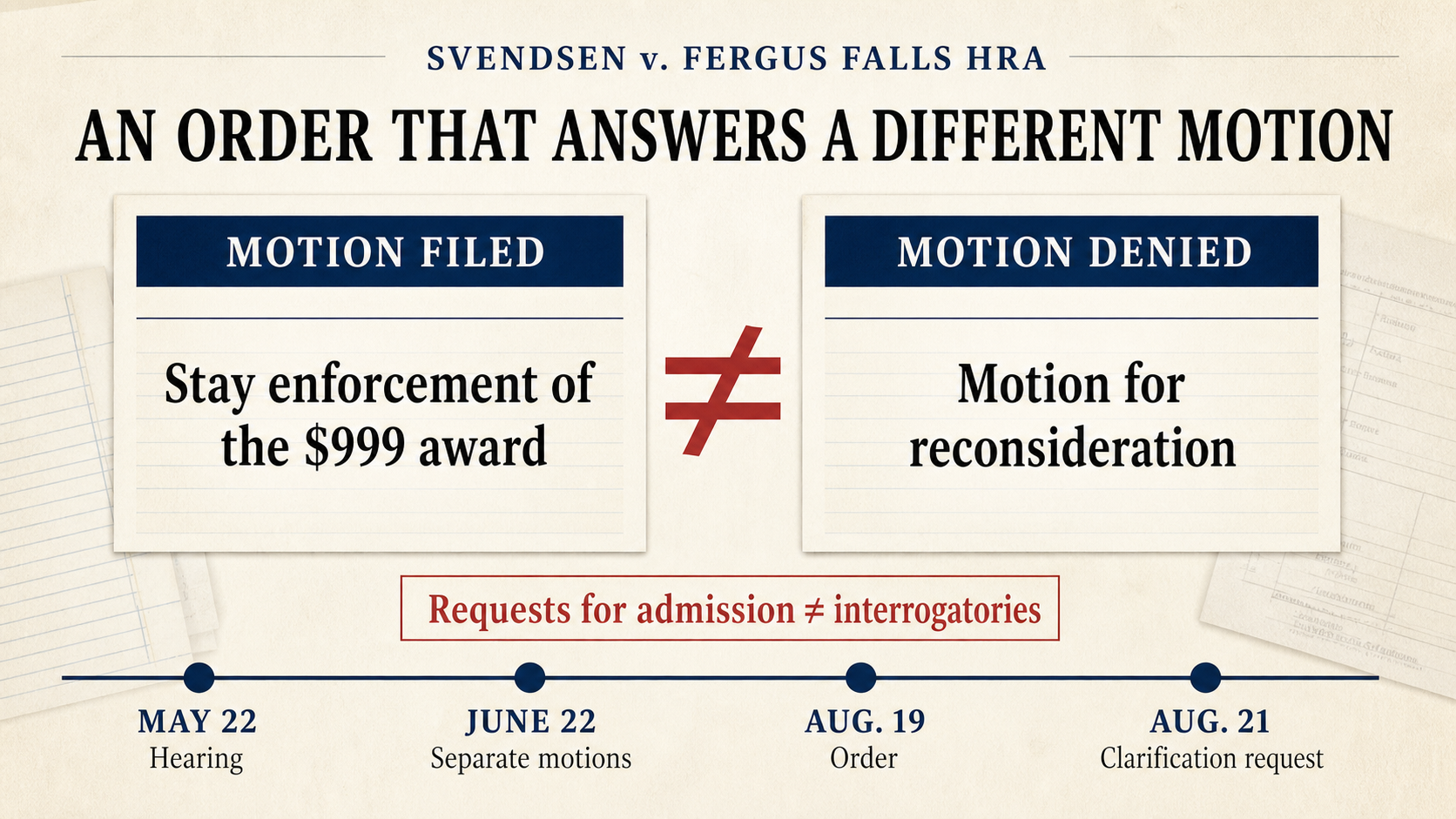
On August 19, 2026, Otter Tail County District Judge Kevin M. Miller issued a five-page order resolving three disputes in Stephen Roy Svendsen v. Pamela Joy Minten, et al., Court File No. 56-CV-24-1426.
The court denied Svendsen’s request to stay enforcement of a $999 discovery-expense award, denied his request for relief concerning a late-produced email, and granted the Fergus Falls Housing and Redevelopment Authority a protective order limiting further discovery.
The principal concern is not simply that Svendsen lost each motion. It is that the written order does not meaningfully decide some of the issues presented and leaves the parties with potentially consequential uncertainty about their discovery obligations.
Case background: how the lawsuit narrowed
Stephen Roy Svendsen is a self-represented former tenant of Riverview Heights, a subsidized-housing property managed by the Fergus Falls Housing and Redevelopment Authority. He filed this state-court case in June 2024 against the HRA, the City of Fergus Falls, and several employees. His complaint grew out of the HRA’s decision not to renew his lease and alleged breach of contract, defamation, religious discrimination, retaliation, negligent recordkeeping, and related claims.
In March 2025, Judge Miller dismissed the City, the individual defendants, and all claims except part of Svendsen’s breach-of-contract claim against the HRA. The surviving claim asks whether the HRA violated the lease when it declined to renew it. The court limited the claimed contract damages to $3,500. That history explains why the August order repeatedly compares the volume of discovery with a $3,500 amount in controversy.
The August 19 order did not decide who should win the remaining contract claim. It addressed three disputes about how the pending case was being conducted:
- The $999 stay request. In February 2026, after denying earlier discovery motions, the court ordered Svendsen to reimburse the HRA $999 for expenses. Svendsen later asked the court to pause enforcement of that payment while he sought further review.
- The late-produced email. Svendsen argued that the HRA had not timely disclosed a 2022 email and that he was prejudiced when the HRA produced and used it in later motion papers.
- The protective-order motion. The HRA argued that Svendsen’s interrogatories and hundreds of requests for admission had become disproportionate to the remaining $3,500 contract claim. It asked the court to stop or sharply limit further discovery.
This article therefore examines whether the August order accurately identified and explained those procedural motions. It does not attempt to decide the underlying lease dispute.
Svendsen v. Fergus Falls HRA: could a catch-all denial reach a different hearing?
The order begins by stating that the matter came before the court for a May 22 motion hearing. Its memorandum identifies the three disputes submitted on that schedule: the stay request, the undisclosed-email motion, and the HRA’s protective-order motion.
Paragraph 4 then states:
“Any motion not expressly addressed in this order and memorandum is hereby denied.”
In his August 21 letter, Svendsen states that three separate matters—his partial-summary-judgment motion, his motion invoking Rules 60.02 and 54.02, and the HRA’s summary-judgment motion—were heard June 22 and taken under advisement at Docket Index 275. A summary-judgment motion asks the court to decide a claim without a trial because the moving party contends that no genuine dispute of material fact exists and that the law entitles it to judgment. Svendsen’s Rules 60.02 and 54.02 motion asked the court to revisit earlier rulings while the case remained pending. He asks the court to clarify that paragraph 4 applies only to matters submitted May 22 or, if the court intended it to reach the June motions, to permit a focused reconsideration motion.
The opening paragraph and memorandum support a reading limited to May 22, but paragraph 4 contains no such qualifier. That wording created uncertainty when the order was issued. The September 18 order subsequently decided the June 22 motions expressly, resolving the question of whether they remained pending; it did not correct the August catch-all language.
The same problem appears within the May 22 record. Svendsen’s response to the protective-order motion included an embedded request to strike settlement-context material from attorney Jack Buck’s declaration. The August order never identifies or analyzes that request; paragraph 4 appears to deny it silently.
A stay motion becomes a reconsideration motion
Svendsen asked the court to stay enforcement of the $999 expense award “pending reconsideration or appeal.” The August order correctly identifies the requested relief as a stay.
But the court did not analyze whether a stay was available or appropriate. Instead, its entire substantive explanation was:
“The rules of civil procedure do not authorize a motion for reconsideration.”
The order then concluded:
“As a result, Plaintiff’s motion for reconsideration must be denied.”
That does not answer the motion the court had just identified. Svendsen requested a stay. The court denied a motion for reconsideration.
The distinction had been expressly presented in the written briefing. Svendsen’s reply objected to the HRA’s characterization of his filing as a reconsideration motion.
In plain English, a stay is a temporary pause in enforcement; it does not erase the underlying order. Rule 62.01 gives a district court discretion to pause enforcement while it decides certain specified post-decision motions, including a Rule 60 motion for relief from an order.
Svendsen’s papers also invoked Rules 60.02(f) and 54.02. Rule 60.02 lists grounds on which a party may ask to be relieved from a final judgment, order, or proceeding; subsection (f) is a catch-all for another reason that may justify relief. Rule 54.02 addresses rulings entered before a lawsuit is completely finished. An interlocutory decision is such a mid-case ruling: it decides an issue but does not end the entire lawsuit. When an order resolves fewer than all claims or parties and has not been expressly made final, Rule 54.02 says it remains subject to revision before final judgment.
Svendsen therefore argued that the court had procedural authority to pause enforcement or revisit the $999 award even though the Rules of Civil Procedure do not create a freestanding motion labeled “reconsideration.” Minnesota General Rule of Practice 115.11 supplies a separate, narrow route: a party may ask by a letter of no more than two pages for permission to file a reconsideration motion, but the court grants permission only upon a showing of compelling circumstances.
None of these provisions guaranteed Svendsen relief. Rule 62.01 is discretionary and applies while particular motions are pending; Rule 115.11 imposes a demanding threshold. The problem is that the August order does not say whether any of these routes applied or why they failed. Nor does it analyze the other grounds identified in the stay papers: substantial justification, circumstances that might make an expense award unjust, evidentiary support for the amount, the court’s prior fee-waiver determination concerning Svendsen’s indigency, or the parties’ comparative hardship.
The court may have had valid grounds to deny a stay. Those are not the grounds the written order articulated.
The order’s Johnson v. Johnson citation is printed as “563 N.W.2d 77, 8.” That pinpoint page cannot be correct because the reported opinion begins at page 77. The quoted proposition appears at page 78, so the missing “7” appears to be a typographical error.
That typo is minor and would not undermine the ruling by itself. The substantive concern is the role the citation plays: the order uses the statement that the civil rules do not authorize reconsideration as its entire explanation for denying a stay. It does not analyze whether enforcement should be paused under Rule 62.01, whether relief was available under Rules 60.02 or 54.02, or whether a Rule 115.11 request could be made with the court’s permission.
Two days after the order, Svendsen used the Rule 115.11 procedure. He filed a two-page letter asking for permission to present a focused reconsideration motion and asserting compelling circumstances. The filing does not establish that reconsideration must be granted. It does make the incompleteness of the order’s categorical statement concrete.
“Set V interrogatories” do not exist
The operative protective-order language contains a second objective defect.
The order states:
“Defendant HRA shall not be required to answer Plaintiff’s set V interrogatories.”
But there were no “Set V interrogatories.” The document before the court was titled Plaintiff’s Fifth Request for Admissions to Defendant Fergus Falls HRA.
It was served under Rule 36, not the interrogatory provisions of Rule 33. It contained seven exhibit-authentication matters and numbered requests 173 through 193—approximately 28 matters.
The memorandum later refers correctly to the “fifth set of requests for admissions,” so “interrogatories” was likely a drafting error. But it remains uncorrected in the operative portion of the order—the portion telling the parties what they must and need not do—and creates ambiguity about what the HRA was excused from answering.
That distinction has potential legal consequences. Under Minnesota Rule of Civil Procedure 36.01, a matter ordinarily is admitted unless a timely answer or objection is served or the court allows additional time.
An order excusing answers to “interrogatories” does not literally excuse answers to requests for admission.
The order also finds that Svendsen served “300 requests for admissions” and describes them as an undue burden. The record indicates that the figure may describe requests accumulated across multiple sets, rather than Set V alone. But the order never clearly identifies which sets the HRA was excused from answering:
- The HRA requested broad protection from hundreds of requests.
- The court discussed 300 requests.
- The operative order mentioned only Set V.
- Set V contained approximately 28 matters.
- The memorandum said the defendants need not answer “this set.”
The incorporated memorandum may permit the parties to infer what the court intended. Court orders, however, should state discovery obligations clearly—particularly when Rule 36 attaches automatic consequences to unanswered requests.
Where did $999 come from?
The August order refused to stay a $999 expense award entered in February 2026. The earlier order quoted Rule 37.01(d)(2), criticized Svendsen’s failure to certify a good-faith discovery conference, and directed him to pay exactly $999.
What the written order did not contain was:
- a billing affidavit;
- the number of attorney hours;
- an hourly rate;
- an itemized expense calculation; or
- an explanation of why $999 represented reasonable expenses.
Rule 37 permits reasonable expenses after an opportunity to be heard, subject to exceptions for substantially justified motions and circumstances that would make an award unjust.
When the reasonableness of attorney fees is challenged, the Minnesota Supreme Court has said a district court must provide a concise but clear explanation of its reasons. See Milner v. Farmers Insurance Exchange.
The amount is one dollar below another $1,000 threshold in Minnesota law. Minn. Stat. § 609.02, subd. 3, defines a misdemeanor as an offense punishable by no more than 90 days in jail, a fine of no more than $1,000, or both. In State v. Oberton, the Minnesota Supreme Court carried that legislative ceiling into a different context, stating that a court ordinarily should limit a punitive sanction for direct criminal contempt to 90 days and a $1,000 fine unless the conduct is extraordinary.
Those authorities do not govern Miller’s award. He labeled the $999 payment “reasonable expenses” under Rule 37—not a criminal fine or contempt sanction—and the written order does not cite either authority. The one-dollar difference therefore does not establish why he selected $999. It does, however, make the absence of a calculation more conspicuous: nothing in the written record ties the amount to counsel’s hours, rates, or expenses actually incurred.
The filed November 21, 2025 transcript, pp. 12 and 15–17, records the HRA’s request for expenses and Svendsen’s opposition. It contains no billing itemization, attorney hours, hourly rate, or calculation yielding $999. Judge Miller took the motions under advisement without announcing an amount. The transcript therefore does not supply the calculation missing from the written order.
On the written record, however, the exact $999 figure remains unexplained. Svendsen raised that problem in support of his stay request. The August order did not address it.
The late-produced email
Svendsen also sought relief concerning a September 19, 2022 email from HRA Executive Director Mikel Olson to Pamela Minten. The email contained a link to the federal public-housing lease regulation at 24 C.F.R. § 966.4.
The HRA produced the email on November 7, 2025, sixteen days after its initial formal discovery response. It was produced at the same time the HRA used it in opposition to Svendsen’s pending sanctions motion.
The August order held that the HRA complied with its supplementation obligation because it produced “an additional email that was found.” It found no prejudice because Svendsen had possessed the email for six months by the May 2026 hearing.
That explanation leaves several questions unanswered:
- When was the email found?
- Who found it?
- Why was it absent from the initial response?
- Did earlier data requests or search representations encompass it?
- Was Svendsen disadvantaged when the HRA could use the email in its November opposition even though he had not possessed it when preparing his opening motion?
Svendsen’s August 21 letter sharpens the timing issue. Possession of the email for six months before the May hearing does not answer his claimed prejudice during the earlier briefing: the HRA first produced and used the email with its November 7 opposition, after Svendsen had filed his opening memorandum. The court could still find the sequence harmless, but the written order addresses only the later period.
This is not a clear-cut discovery violation. Rule 26.05 permits supplementation when a party learns that an earlier response was incomplete. Production sixteen days after the formal response and well before trial could reasonably be considered timely or harmless.
At the May hearing, Buck said an additional email had been found and argued that the supplementation was timely. He did not identify who found it or when the HRA learned that its earlier response was incomplete. Judge Miller announced no additional findings resolving those questions. May 22 transcript, pp. 3–5.
One allegation should not be included in evaluating this dispute: the privilege log is not demonstrably inconsistent with Bates 000985. The produced page contains a substantial black redaction above the visible 2022 email, consistent with the log’s description of a redacted 2025 attorney-client communication.
Proportionality required more than the amount in controversy
Minnesota Rule of Civil Procedure 26.02 requires discovery to be proportional to the needs of the case. The relevant considerations include:
- the importance of the issues;
- the amount in controversy;
- the parties’ relative access to information;
- their resources;
- the importance of the discovery in resolving the issues; and
- whether the burden outweighs the likely benefit.
The August order quotes those factors but concentrates primarily on two considerations: the $3,500 amount in controversy and the cumulative number of requests for admission.
Those are legitimate considerations. Hundreds of requests in a $3,500 contract case can impose a disproportionate burden. But the order quotes only the first of two adjacent sentences in Svendsen’s response: “These are not requests about the merits.” The next sentence reads: “They are requests that establish an undisputed timeline of discovery responses—exactly what Rule 36 is designed to capture.”
The omitted sentence does not prove that the requests were proportional. It materially qualifies the statement on which the order relied: Svendsen was distinguishing merits admissions from requests intended to establish a discovery chronology, not conceding that Set V lacked a case-related purpose.
The order does not meaningfully address the other side of proportionality: that the HRA controlled much of the relevant information, that the case was scheduled for a multi-day jury trial, and that properly targeted admissions can reduce the time and expense of proving undisputed matters.
The court had broad authority to limit discovery. The concern is the lack of a set-by-set explanation and the resulting uncertainty over what the order actually protected.
Near the deadline, the same problems remained
The hearing occurred May 22, 2026, and Judge Miller filed the order 89 days later. On the apparent submission timeline, that placed the ruling one day short of Minnesota’s 90-day decision period. See Minn. Stat. § 546.27.
Yet the order misidentified the relief Svendsen requested, treated requests for admission as interrogatories, and left the scope of its operative provisions uncertain.
Similar defects appear in Miller’s Stevenson orders. Our Stevenson–Svendsen comparison traces the discovery restrictions and summary-judgment decisions in both cases. Taken together, the pattern raises a legitimate public-interest question: whether docket pressure is producing abbreviated review—orders that dispose of consequential motions without the record-specific analysis and precision they require.
Whatever the institutional explanation, the recurring result is the same: decisions that move cases forward while leaving material errors, omissions, and ambiguities unresolved.
What the filed transcripts establish
Update — October 8, 2026: The four hearing transcripts were filed on October 7 at MCRO Indexes 304–307. Justice-Denied compared the filed versions with the copies previously reviewed; their substantive text matches.
- The stay request. The judge identified a stay request, and Buck argued that Rule 62 did not apply without a judgment and corresponding motion. The judge took the matter under advisement without orally applying a stay standard. May 22 transcript, pp. 3–5.
- Discovery timing. Discovery was stayed on December 9, 2024, pending the dismissal ruling; the March 6 order reopened discovery on the surviving lease claim. On May 22, 2026, Miller suspended responses to the contested requests pending his written protective order. That suspension preceded the June 22 summary-judgment hearing. December 9 transcript, p. 25:20–24; May 22 transcript, p. 12:3–9, 18–23.
- The purpose of admissions. Svendsen explained that admissions offered an affordable substitute for depositions and addressed whether events in the defense’s own documents amounted to lease violations. The August memorandum does not discuss that explanation. May 22 transcript, pp. 8:24–9:4 and 10:15–23.
- The $999 award and privilege. The November hearing supplied no itemized calculation of $999. It also confirms that Svendsen challenged privilege on ordinary grounds, not solely through the crime-fraud exception; the HRA defended the communications as legal advice. November 21 transcript, pp. 8:20–9:25 and 14–17.
- The June motions. Svendsen expressly identified Rule 54.02 as authority to revise an interlocutory order and told the court about his supplemented relocation records. The September order does not separately analyze that revision authority or address the supplementation. June 22 transcript, pp. 9:13–10:16 and 31:4–22.
The transcripts clarify the chronology and the arguments presented. They do not supply the judicial explanations missing from the written orders: the stay analysis, the $999 calculation, the treatment of the supplemented expense records, or the separately invoked Rule 54.02 authority.