

Concurrent Injustice: Minnesota’s “Volume Discount” for Predators
Why Minnesota’s Sentencing Guidelines Fail Victims of Abuse
For the first 50 years of my life as a Minnesota citizen, I never gave much thought to the justice system. I had never stepped inside a courtroom. I had never been deposed. I had never needed a lawyer.
I assumed that if something terrible happened, the system would work.
I was wrong.
Without warning, I became the target of people who knew I was an adult survivor of childhood abuse. My trauma was exposed. My private pain became public. And suddenly, I found myself depending on a legal system I had always trusted from a distance.
It failed me.
That experience taught me something devastating: for survivors of abuse, silence guarantees injustice. But speaking up offers no such guarantee of justice in return.
Victims are told to be brave. To come forward. To tell the truth. To trust the process.
But what happens when the process asks everything of victims—and delivers almost nothing in return?
The High Cost of Coming Forward
Take the recent case of Zvi Levran, the former physician at Lake Region Healthcare sentenced in Minnesota and Michigan sexual abuse cases. Mr. Levran was known locally as the “hockey doc.” On April 7, 2026, he was sentenced in Otter Tail County District Court to 15 years in prison after pleading guilty to three counts of felony criminal sexual conduct.
You can read the story about his sentencing hearing on the Fergus Falls Daily Journal website here.
On paper, 15 years sounds significant.
In reality, it changes nothing.
The Illusion of Accountability
Levran is already serving a 10-to-25-year sentence in Michigan for 28 separate crimes. The Minnesota sentence was ordered to run concurrently with his Michigan sentence.
In legal language, “concurrent” means the sentences are served at the same time.
In plain English, it means Minnesota likely added zero days to the time he will spend behind bars.
Zero.
That matters—not just because of this case, but because of what it tells every victim watching.
To bring an abuser to justice, victims are often required to endure:
- The disclosure: telling family, friends, and loved ones about deeply personal trauma.
- The scrutiny: sitting through invasive interviews with police, prosecutors, and investigators.
- The retraumatization: reliving humiliation, fear, and pain in painful detail.
- The upheaval: disrupting work, family life, and emotional stability in pursuit of accountability.
They are asked to revisit the worst moments of their lives because they are promised that truth matters.
And then, when the process is over, they learn that their courage did not add a single day of punishment.
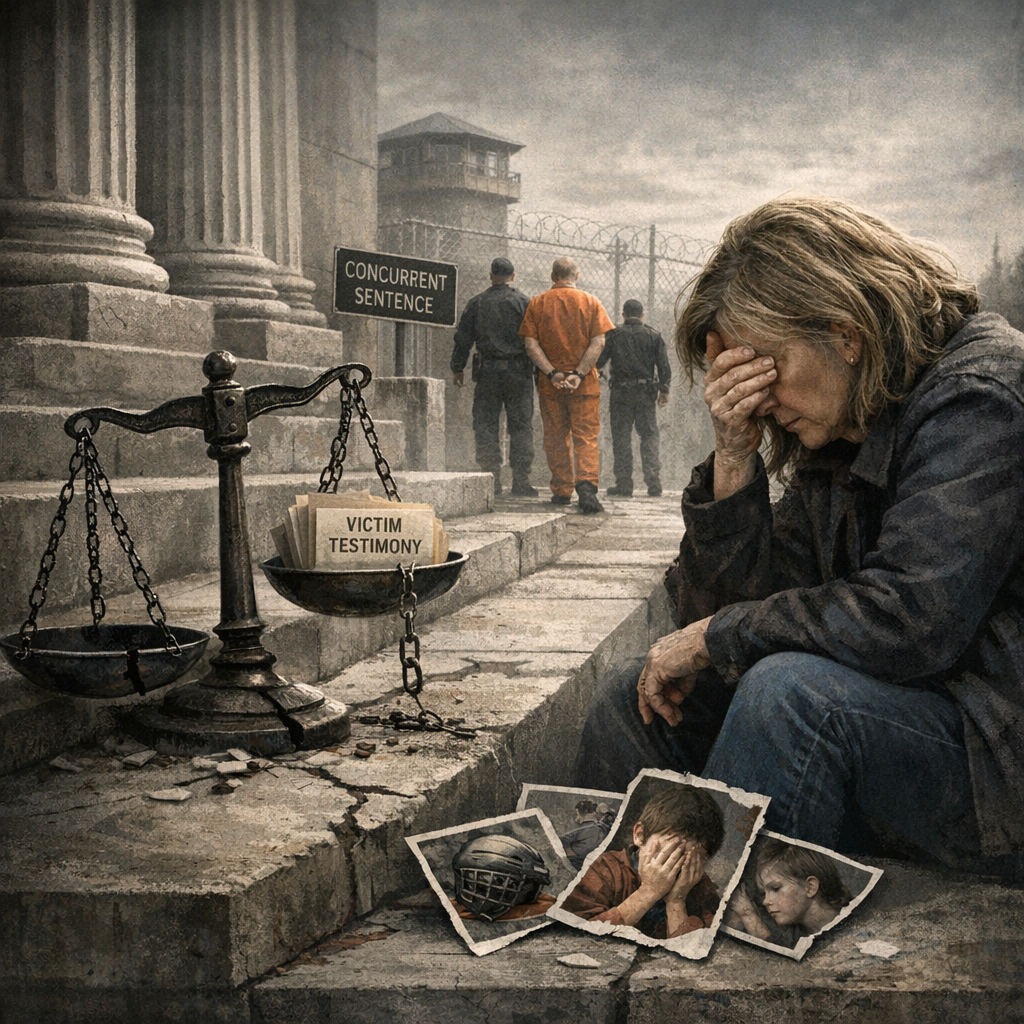
A “Volume Discount” on Human Suffering
What message does that send?
To victims, it says: your suffering counts less because someone else suffered first.
To predators, it says: once you have harmed enough people, additional victims may carry no additional consequences.
That is not justice. That is a sentencing structure that can function like a volume discount on human suffering.
I understand that judges operate within sentencing guidelines. I understand that courts are cautious about departures that could be reversed on appeal.
But understanding the rules does not require accepting their moral failure. A system that treats one victim’s trauma as effectively absorbed by another victim’s case is not delivering justice. It is delivering efficiency at the expense of dignity.
Beyond the Courtroom: The Weight of the Aftermath
And the damage goes far beyond one courtroom.
This kind of outcome leaves victims feeling minimized, marginalized, and silenced. It teaches future survivors that speaking up may change nothing. It erodes public trust in a system that depends on that trust to function.
I am a mother. And I am outraged—not only for the victims in this case, but for the children who may one day wonder whether coming forward is worth the cost.
This is supposed to be a justice system. But this is not justice.
It is a façade.
It is a farce.
One day, Levran may walk free. His victims will not. They will carry the weight of what happened to them for the rest of their lives.
Minnesota’s citizens and legislators need to confront this reality. A crime against one child should never be effectively canceled out by a crime against another. Every victim deserves to know that their pain matters. Every crime deserves meaningful accountability.
Minnesota’s children deserve no less.
