

When Seeking Justice Means Surrendering Your Privacy
How a Lawsuit Opened the Door to Surveillance, Fear, and the Loss of Safety at Home
The moment I saw the unfamiliar car creeping slowly past our home, lingering just long enough to study the property, I knew something was wrong. Days later, that uneasy feeling was confirmed: a private investigator had been hired to question my family, photograph our home, and follow our movements—all because I had turned to the courts for protection. I entered the legal system believing it would help stop the invasion of my privacy. Instead, I learned that the process of seeking justice can become an invasion of its own.
Before this ordeal, Craig and I had never sued anyone. We never imagined we would. Like most people, we believed that if someone crossed a serious line, a simple explanation, or at most a cease-and-desist letter, would be enough to make them stop. Litigation is expensive—very expensive—and most reasonable people understand that once attorneys become involved, it is wiser to stop harmful conduct than to escalate it.
The Breaking Point: From Lawyer Letters to Litigation
That was our hope when we sent four lawyer letters in an attempt to avoid court. We wanted the harassment to stop—specifically, the ongoing contact with my estranged father, a man I feared deeply, and the sharing of my private information with him. To us, the letters were not legal maneuvering; they were a plea for peace and safety.
To the other side, it appeared to be a game of cat and mouse. One message mocked the situation: “Looks like I’ll need a defamation attorney lol.”
The other side then boasted in a negative Google review for their first attorney that they had told us to “pound sand.” We soon filed suit in Otter Tail County District Court. Even then, we would likely have accepted a sincere apology and a promise to stop. Instead of resolving the matter, however, the defendants escalated it.
One of the earliest things they did was hire a private investigator, and his first call was to my estranged father.
Soon my siblings began calling, asking why a private investigator was contacting them to ask probing questions about my life—questions about my hospitalization as a teenager, about leaving home at sixteen, about my marriage, my health, and even our home security. It was unsettling to realize that deeply personal parts of my life were being discussed with strangers, not because of any criminal allegation, but because I had filed a civil lawsuit.
The Blue Jaguar: When the Courtroom Comes Home
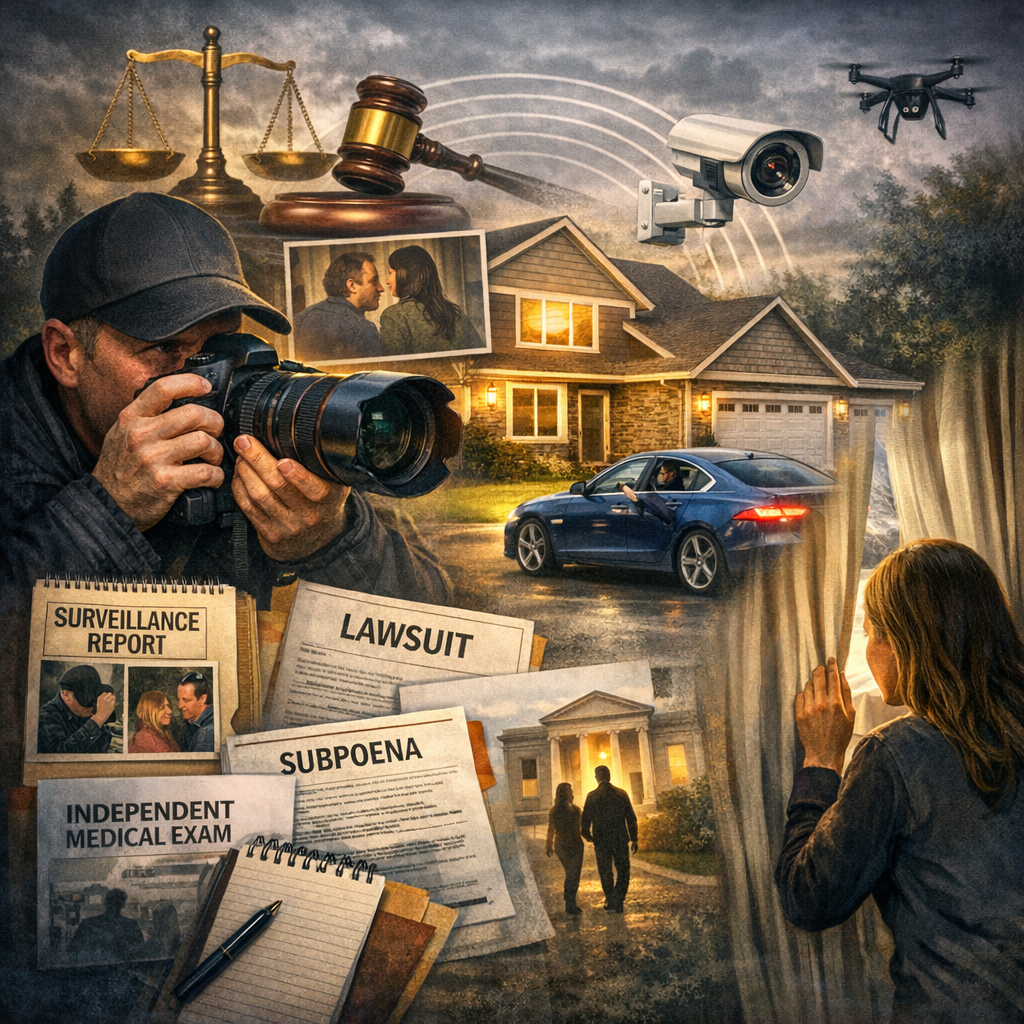
Then one day, one of my daughters called out to me, alerting me to a strange car outside our home. Instantly, I suspected this was the private investigator. He was slowly circling the area, parked awkwardly in the road with the front of the car pointed toward our house, studying the property from different angles. After a few minutes he drove through the neighboring cul-de-sac, then turned onto another nearby street. I watched as he got out of the car, opened the trunk, removed what appeared to be camera equipment, and began taking photographs of our home and business.
I noted the car: a blue Jaguar with North Dakota plates.
A few days later, another sibling called to say that he, too, had spoken with the investigator before realizing whose side he was on. Before we hung up, I asked if he remembered what kind of car the investigator had been driving. He paused, then said slowly, “Ohhhh yeah—it was a blue Jaguar.”
That confirmation was deeply unsettling. The stranger outside my home had not been my imagination. It was real. The sense of privacy and safety I had once taken for granted suddenly felt fragile, and I realized that filing a lawsuit had opened the door to scrutiny far beyond the courtroom.
The investigator’s outreach expanded quickly. Family members, former coworkers, old friends, church contacts, employers from decades earlier—even people we barely knew and some we didn’t know at all—were contacted. The process was exhaustive. Whatever the purpose, the result was the same: private details of our lives were being explored and discussed far beyond anything that seemed necessary.
Even pastors from churches we had attended were contacted. After the lawsuit ended, I called one retired pastor to explain what had happened and asked whether he remembered speaking with the investigator. “No,” he assured me, “but if I did, I would have had nothing but good things to say about you and Craig!” That reassurance was comforting, but it did not erase the violation of knowing that so many people were being drawn into deeply personal matters simply because we sought legal relief.
Despite all that effort, nothing meaningful appeared to have been uncovered. But the disruption to our privacy was very real.
The Hidden Surveillance of an “Independent” Exam
The next surprise came in May of 2022, when I was ordered to undergo an Independent Medical Examination (IME) to support my claim of emotional distress. Because it was a psychological examination, it could easily have been conducted remotely via Zoom—especially since Craig and I both had physical limitations that made long drives difficult. The defense objected and insisted that the examination be conducted in person, and that Craig not be present. The Court granted the request – basically everything they asked for.
So on May 18, 2022, Craig and I made a four-hour round trip for a four-hour psychological evaluation in St. Cloud. I cooperated fully, confident that the truth was on my side, and when the examiner completed his report, his findings supported the emotional distress I had described.
More than a year later, however, we discovered why the defense may have been so insistent on an in-person examination.
After summary judgment, the defendants filed a motion seeking reimbursement for costs. Buried in the filing was a request for reimbursement for more than 21 hours of surveillance conducted on the day of my IME. Someone had followed me—or us—for nearly an entire day, and we had no idea.
The purpose of the surveillance was never clearly explained. But the cost request showed that $2,855 had been spent monitoring our activities that day. When I later asked Craig what he had done while waiting during my four-hour examination, he told me he had visited a gas station twice to use the bathroom, then walked around outside the building, watched the birds, and waved at passing cars. The contrast was striking: while we were simply trying to comply with a court-ordered examination, investigators were spending hours documenting our every move.
Counting the Personal Cost of Accountability
The request for reimbursement was ultimately denied, but the emotional cost remained. By then, the realization had sunk in that litigation does not only cost money. It can cost peace, privacy, and the sense of security you once felt in your own home.
That was one of the hidden costs of seeking justice.
People often think of litigation in terms of legal fees, hearings, and court rulings. But they rarely talk about what it feels like to have strangers questioning your family, photographing your property, and tracking your movements—all because you turned to the legal system for help. The financial burden of litigation is obvious. The personal cost is much harder to quantify.
For me, that personal cost included fear, stress, and the unsettling realization that seeking justice can require surrendering pieces of your privacy along the way. It was one of the hardest lessons of this process.
But it also taught me something else: courage is not the absence of fear. Courage is choosing to continue despite fear—enduring the personal cost because truth matters, and refusing to be silenced by intimidation.
For anyone enduring litigation in order to hold wrongdoers accountable, know this: you are not alone. The process can feel invasive, exhausting, and isolating. But even when others attempt to take your peace of mind, they do not get the final word.
You still have a voice.
Use it.
