

The Number Went Down. The Pattern Did Not.
What the Minnesota Board on Judicial Standards’ 2025 Annual Report adds to the story.
Last year, I wrote about a troubling reality in Minnesota’s judicial-discipline system in Eroding Trust, One Dismissal at a Time: the Minnesota Board on Judicial Standards (BJS) received a record number of complaints in 2024 and summarily dismissed almost all of them.
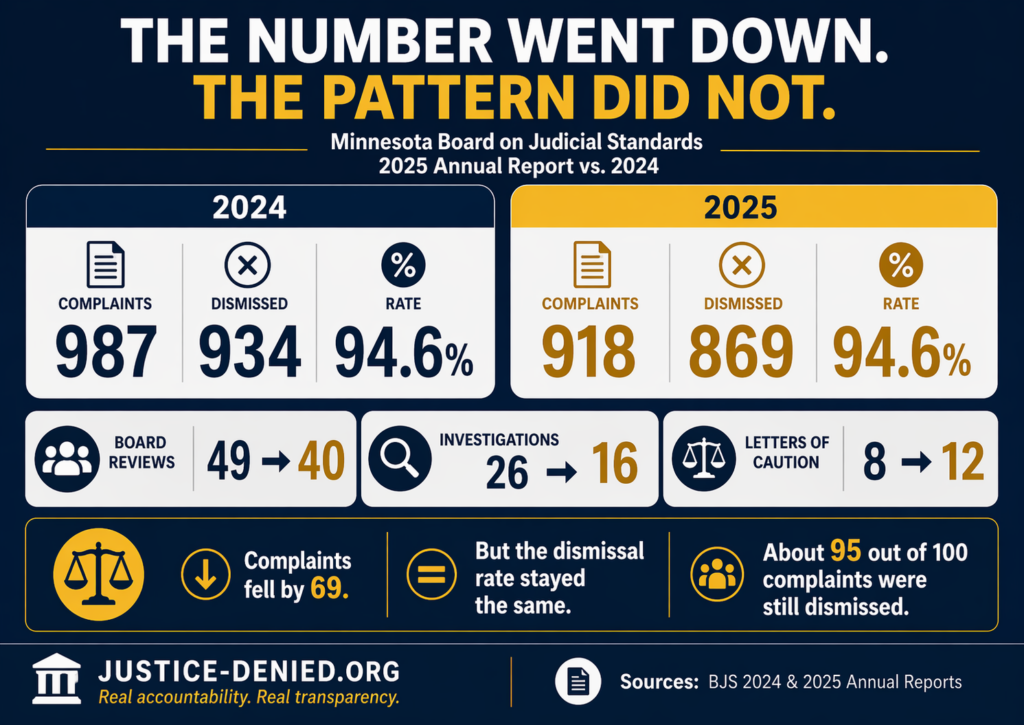
Now the 2025 Annual Report is out. At first glance, it may look like the picture improved. The total number of complaints dropped from 987 in 2024 to 918 in 2025.
But the more revealing number barely moved at all.
In 2024, BJS summarily dismissed 934 of 987 complaints. In 2025, it summarily dismissed 869 of 918 complaints. That means the summary-dismissal rate remained essentially the same — about 94.6% in both years.
So yes, the raw number went down.
But the operating pattern did not.
A smaller total, but the same result
The new report shows 69 fewer complaints than the year before. Yet the Board still disposed of the overwhelming majority at the very front end.
That matters, because a drop in volume should ordinarily create at least some room for closer review. Instead, the 2025 numbers still describe a system in which summary dismissal remains the norm, not the exception.
And the report provides other figures that sharpen that concern:
- 918 complaints were received and reviewed in 2025.
- Only 49 files were opened based on written complaints alleging matters within the Board’s jurisdiction.
- Only 40 of the new complaints opened in 2025 were considered by the Board in 2025.
- The report says 23 complaint files and Board-initiated investigations were dismissed in 2025, while eight remained open at year’s end.
Those numbers do not read like a system meaningfully expanding public-facing scrutiny. They read like a system still filtering out almost everything before deeper review occurs.
The percentages tell the story more clearly than the headlines
Raw totals can create the impression of movement when the underlying structure has barely changed.
That is exactly what happened here.
- 2024: 987 complaints received, 934 summarily dismissed.
- 2025: 918 complaints received, 869 summarily dismissed.
That is a decline in volume, but not a meaningful change in approach.
When an oversight body continues to summarily dismiss roughly 95 out of every 100 complaints, year after year, the public is entitled to ask whether this is really functioning as a searching accountability process — or as a highly efficient intake-and-rejection system.
The Board’s own report still points back to the same structural problem
In When the Message Doesn’t Match the Reality, I argued that Minnesota’s judicial-oversight system appears caught between two competing narratives.
On the one hand, the public message is one of integrity, impartiality, accountability, and confidence in the judiciary. On the other hand, the annual numbers continue to show a system in which the overwhelming majority of complaints are disposed of before they ever receive fuller Board attention.
The 2025 report does not resolve that tension.
It reinforces it.
The Board continues to describe its mission in terms of preserving public confidence, enforcing the Code of Judicial Conduct, and educating judges and the public. But public confidence is not sustained by mission statements alone. It is sustained when the public can see that serious complaints are being examined with rigor, independence, and transparency.
And when the numbers continue to show a summary-dismissal rate of roughly 94.6%, the message and the measurable reality still do not line up.
Some of the 2025 developments deserve recognition
To be fair, the 2025 report is not simply a duplicate of the 2024 story.
There were notable developments on the back end:
- 12 letters of caution were issued in 2025, up from 8 in 2024.
- 3 deferred disposition agreements were issued in 2025, up from 2 in 2024.
- The Minnesota Supreme Court imposed public discipline in one matter in 2025, after none in 2024.
Those are real developments, and they should not be ignored.
But they do not change the central point. Even if some matters resulted in meaningful action after deeper review, the public-facing intake picture remains overwhelmingly dominated by summary dismissal.
That is still the front door of the system. And that front door is still closing on nearly everyone.
The resource question looks even harder to avoid
The 2025 report also adds weight to a question that Minnesota policymakers should no longer be able to sidestep: does the Board have the staffing and funding necessary to do what the public expects it to do?
According to the report, the Board’s base budget remained $520,000 per year, with an additional $125,000 special account for major cases. Its staff remained lean: an Executive Secretary, a part-time staff attorney, and an executive assistant.
At the same time, complaint volume remained extraordinarily high by historical standards. Even after the decrease in 2025, the Board still received 918 complaints — far above the levels reported just a few years ago.
If Minnesota wants meaningful judicial accountability, then this matters.
A state cannot publicly promise trustworthy judicial oversight while funding the oversight body at a level that appears structurally mismatched to the volume of complaints it now receives.
Efficiency is not the same thing as accountability
The Board has explained that summary dismissal helps avoid the inefficiency of sending plainly non-jurisdictional complaints to the full Board. That rationale makes sense as far as it goes.
But when summary dismissal becomes the overwhelming norm, the public is entitled to ask a more difficult question:
That question becomes even more important when some complainants are not simply venting about an unfavorable ruling, but instead submitting documented timelines, transcripts, filings, and records-based allegations that raise broader concerns about fairness, impartiality, or abuse of authority.
No oversight body can expect public trust by telling the public, in effect, “trust us, we are careful,” while the numbers keep showing that almost everything is screened out before meaningful scrutiny occurs.
What the 2025 report really shows
The new report did not erase the concerns raised by the 2024 statistics.
It sharpened them.
The total number of complaints went down, but the percentage summarily dismissed stayed virtually the same. That means the core pattern identified last year did not materially improve.
The Board did issue more letters of caution. It did report meaningful disciplinary action in a public case. But the larger operational picture still looks like a system where dismissal at intake remains the dominant outcome.
That is not a minor detail.
That is the story.
Minnesota deserves a system the public can actually trust
None of this means every complaint should succeed. Of course not. Many complaints will always be weak, outside the Board’s jurisdiction, or unsupported.
But when an oversight body dismisses roughly 95% of complaints in back-to-back years, the burden is no longer on the public to pretend that nothing is unusual.
The burden is on the system to explain why.
Is this primarily a resource problem? A structural design problem? An investigative bottleneck? A transparency problem? Some combination of all four?
Whatever the answer, Minnesota citizens should not be expected to accept slogans in place of scrutiny.
Public confidence in the judiciary is too important for that.
Conclusion
The Minnesota Board on Judicial Standards’ 2025 Annual Report offers new numbers, but it points to an old problem.
The number of complaints went down.
The pattern did not.
And until Minnesota confronts that reality — with more transparency, more resources, and a system that the public can actually evaluate — the gap between the message and the measurable reality will continue to erode trust.
Because a watchdog that dismisses nearly everything at intake is not preserving confidence.
