

An Open Letter to Minnesota’s Judicial System
Justice is not preserved by authority alone. It is preserved when people can see that the law was applied fairly, the record was honored, and every litigant was truly heard.
To the judges of Minnesota, to the appellate courts, and to the oversight bodies entrusted with preserving confidence in the rule of law:
This letter is written in respect, but also in urgency.
The Promise the Public Is Asked to Trust
Minnesotans are told to trust the judicial system because it is supposed to be governed by law rather than power, by principle rather than preference, and by fairness rather than force. That trust is not sustained by robes, titles, or the finality of judgments alone. It is sustained only when litigants and the public can see that the system is doing what it promises to do.
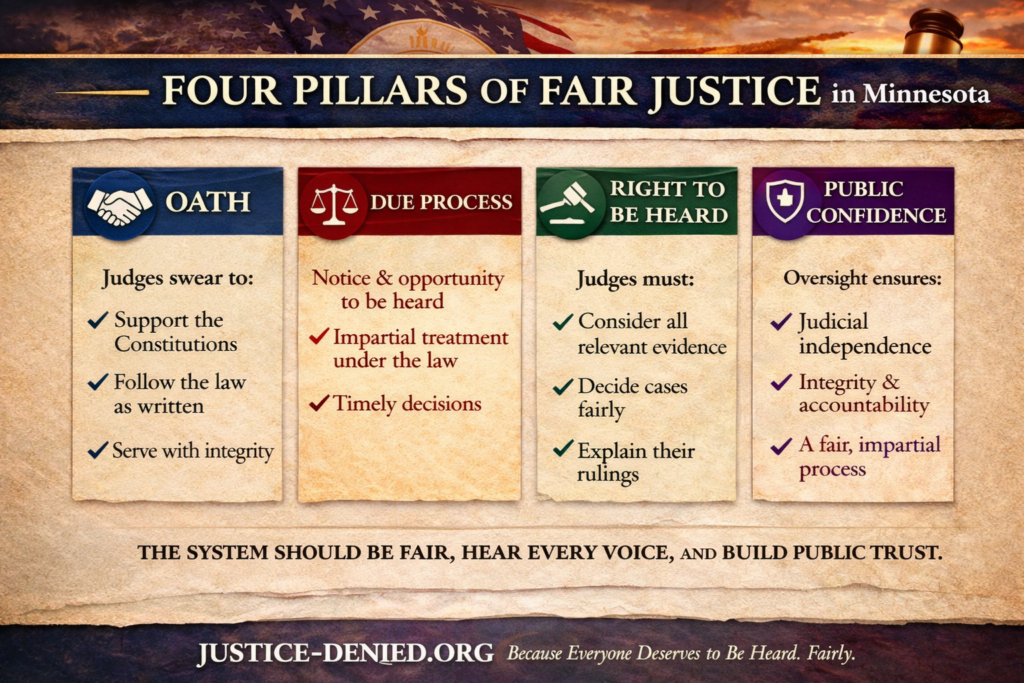
The Oath and the Constitutional Guarantee
That promise begins with the oath.
Under Minnesota law, public officers must swear to support the Constitution of the United States and the Constitution of the State of Minnesota, and to faithfully discharge the duties of office to the best of their judgment and ability. Judges are not exempt from that promise. They are among its highest stewards.
That promise is also written into the constitutions themselves.
The Fourteenth Amendment forbids the State from depriving any person of life, liberty, or property without due process of law. Minnesota’s Constitution likewise protects due process and goes further, declaring that every person is entitled to a remedy in the laws for injuries or wrongs and to obtain justice “freely and without purchase, completely and without denial, promptly and without delay.” Those are not ornamental words. They are a public commitment about what justice in Minnesota is supposed to look like.
What the Judicial Canons Require
The Minnesota Code of Judicial Conduct gives those constitutional promises practical meaning. It requires judges to act in ways that promote public confidence in the independence, integrity, and impartiality of the judiciary. It requires judges to uphold and apply the law fairly and impartially. It requires competence, diligence, thoroughness, and preparation. It requires that every person with a legal interest in a proceeding be accorded the right to be heard according to law. It forbids judges from independently investigating facts and requires them to consider only the evidence presented and any facts properly subject to judicial notice. And it requires disqualification whenever a judge’s impartiality might reasonably be questioned.
These duties matter because justice is not only about the result. It is about the process by which that result is reached.
A litigant can lose and still believe the system worked—if the court engaged the record honestly, addressed the core arguments, applied the law as written, and showed through word and action that both sides were heard. But when evidence appears ignored, when governing authorities appear selectively applied, when serious concerns are brushed aside rather than confronted, or when neutrality itself seems reasonably open to question, public trust is damaged whether or not the final ruling remains intact.
The Appellate Duty to Do More Than Close the File
That is why the judiciary’s responsibility does not end at the trial-court level.
The Minnesota Constitution vests judicial power in the courts. It gives the Court of Appeals appellate jurisdiction over all courts except the Supreme Court, and it gives the Supreme Court appellate jurisdiction in all cases. With that authority comes a public obligation: not merely to affirm outcomes when possible, but to ensure that the law was faithfully applied and that serious claims of unfairness, partiality, or procedural breakdown receive real scrutiny.
The appellate process is where many litigants are told the system corrects itself. If appellate review becomes too deferential to obvious irregularities, too dismissive of serious concerns, or too willing to prioritize closure over confidence, then one of the public’s last safeguards begins to fail.
When Oversight Loses Legitimacy
Oversight bodies carry a different, but equally important, burden.
The Minnesota Board on Judicial Standards states that its mission is to promote and preserve public confidence in the independence, integrity, and impartiality of the judicial system by enforcing the Judicial Code and educating judges and others regarding proper judicial conduct. In its own reporting, the Board has recognized a truth that should never be forgotten: a society cannot function without an effective, fair, and impartial procedure to resolve disputes, and the continued acceptance of judicial rulings depends on public recognition that the judiciary is worthy of respect and trust.
Those are the right principles. But they must be felt by the public, not merely stated in annual reports.
And if the Board lacks the resources, staffing, or authority necessary to provide meaningful oversight, it should say so plainly. It should candidly tell the public and the Legislature what is required to do its job properly, and request the level of funding and support necessary to fulfill its mission. What it should not do is allow the appearance of accountability to stand in for accountability itself. A facade of oversight does not preserve public confidence. It erodes it.
Oversight that is invisible, unpersuasive, or seemingly indifferent to serious concerns may preserve procedure while losing legitimacy. A system does not build trust by insisting that trust exists. It builds trust by showing that no judge, no court, and no institution is above the standards it invokes for others.
We Are Not Alone
We also write with a growing awareness that we are not alone.
Based on the response to Justice-Denied, our experience is not entirely unique. We are hearing from other Minnesotans who describe lives disrupted, livelihoods damaged, families strained, and faith in the justice system deeply shaken. Their stories are not all identical. Their cases are not all the same. But the pattern in what they describe is troublingly familiar: they believed they were not heard, not heard fully, or not heard fairly.
That should not happen in a truly fair system.
When people have already gone to the district courts, then to the appellate courts, then to oversight entities, and still come away believing that no one meaningfully confronted what happened to them, the damage goes beyond any single case. At that point, the system is not merely losing disputes. It is losing trust. And for many people, it feels as though there is nowhere else to go.
Worse still, some people do not merely lose trust in the system.
That may be one of the most damaging consequences of all. A system that is supposed to provide justice should not leave people feeling exposed, revictimized, or afraid that seeking help will only deepen the harm. Yet that is what happens when people believe that speaking up may lead to further injury, further loss of privacy, or further mistreatment without meaningful protection or remedy.
When that happens, the damage extends beyond any single ruling. People become hesitant to come forward. They become reluctant to trust courts, lawyers, or oversight bodies. And a system that was meant to be a refuge begins to look, to many, like another source of danger.
That should alarm every institution that claims to exist in the service of justice.
Symptoms of a Larger Problem
We have read some of the opinions. We have seen the obligatory nod to a “tragic accident” while justice itself seemed to be trampled in the analysis. We have seen discovery blocked, evidence deleted, and lies told. We have seen a serious claim treated as “forfeited” on a rationale that appears not to have been required of others raising the same kind of issue. We have seen case-changing arguments or filings rejected due to a technicality. We have seen outcomes defended as routine even where the appearance to the public is anything but routine.
Those are not just isolated frustrations. They are symptoms of a larger problem.
The public is losing confidence in the judicial system, and the more closely many people examine how the system actually functions, the more pervasive the problem appears. That is what we learned in our own case. And based on what we have read and what others are now telling us, it appears to be what they have learned as well.
The Public’s Question
This is why the question before Minnesota’s judicial system is larger than any one case—and why it can no longer be dismissed as the complaint of a single dissatisfied litigant.
Those questions matter because public confidence is not an abstract metric. It is the accumulated judgment of ordinary people who watch how the system behaves when allegations are uncomfortable, when errors are difficult to admit, and when correcting the record would require institutional humility.
What the Public Has a Right to Expect
The law does not demand perfection from judges. The Code itself recognizes that good-faith legal or factual error can occur. But the public has a right to expect more than technical survival. It has a right to expect honesty, neutrality, diligence, and visible fairness. It has a right to expect that judges will not investigate facts outside the record, that they will decide cases based on lawful evidence, that they will hear the parties before them, and that they will step aside when impartiality might reasonably be questioned.
Those expectations are not abstract. They translate into concrete responsibilities for every actor inside the system.
What Integrity Looks Like in Practice
If the judicial system wants to restore public trust, the path forward is not mysterious. It begins with people inside the system doing what integrity has always required: telling the truth, correcting error, and putting justice ahead of ego, convenience, or institutional self-protection.
As we have written elsewhere, it is not dishonorable for a judge to admit error. It is honorable. It is a sign of integrity to correct a wrong once it becomes clear. A system that values truth should not treat self-correction as weakness. It should treat it as one of the clearest signs of honesty and judicial maturity.
Judges can re-engage the record when serious concerns are raised. They can acknowledge when they overlooked something important, vacate or revise rulings when justice requires it, explain their reasoning candidly, and step aside when impartiality might reasonably be questioned. They can show that authority does not depend on infallibility.
Law clerks can honor the same duty of integrity by disclosing conflicts or relationships that could create a reasonable appearance problem, by ensuring that drafts accurately reflect the record and the governing law, by resisting any temptation to shade facts or authorities, and by speaking up internally when they see a material error rather than quietly allowing it to harden into an order.
Oversight bodies can do more than close files. They can confront serious allegations with visible seriousness, explain outcomes in a way that promotes public understanding, acknowledge when patterns of concern are emerging, and, if resources are inadequate, say so openly and seek the staffing, funding, and authority necessary to provide meaningful oversight.
Lawyers can refuse to treat unfairness as a tactical opportunity. They can correct misstatements, disclose controlling authority, stop exploiting procedural technicalities to preserve obvious wrongs, and remember that their role as officers of the court carries obligations not only to clients, but to the integrity of the system itself.
None of those actions require perfection. They require honesty, humility, and the courage to correct course. And until those qualities are treated as strengths rather than threats, public confidence will continue to erode.
This Is the Appeal
To the Minnesota judiciary, then, this is the appeal:
Honor the oath not as ceremony, but as discipline.
Treat due process not as a slogan, but as a lived guarantee.
Remember that “justice without denial” also means justice without distortion.
Remember that “promptly and without delay” does not mean hurried at the expense of fairness.
Remember that litigants are not obstacles to be managed. They are citizens whose trust is placed, often unwillingly, in your hands.
And to the appellate courts and oversight bodies:
When the record raises serious concerns, confront them.
When a litigant claims not merely that the outcome was wrong, but that the process itself was not fair, do not answer with silence, labels, or reflexive deference.
Explain.
Engage.
Show the public that the system is capable not only of authority, but of accountability.
The Standard Already Exists
Because in the end, the legitimacy of a judicial system rests on more than its power to issue orders. It rests on whether the people subject to those orders can still believe that law, not preference, governed the result.
Minnesota’s constitutions, statutes, and judicial canons already describe the standard.
The public is simply asking the judicial system to live up to it.
Editor’s note: This letter is written from lived experience, but it is not written for one litigant alone. It is also written for the growing number of Minnesotans who have walked away from the courts believing they were heard neither fully nor fairly—and with nowhere else to turn.
