

Writing Back Against Revictimization
When abuse victims are ignored, blamed, or mocked by the judicial system, telling the truth in their own words can become an act of survival.
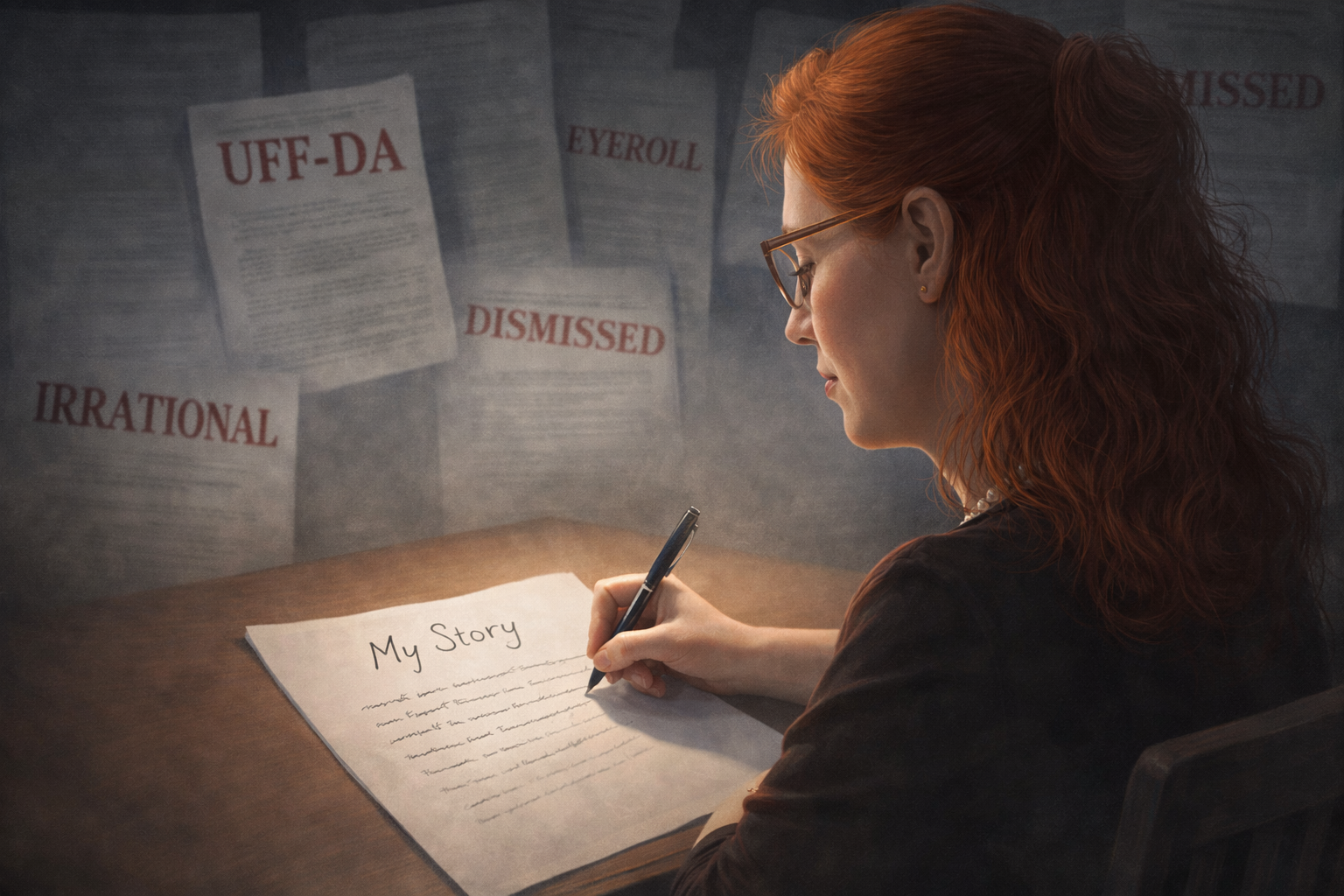
There is a special kind of pain that comes when you finally find the courage to speak about abuse, only to discover that the people and institutions who should listen instead minimize it, reframe it, or talk over you.
Many abuse victims know this feeling.
First, you survive the abuse itself. Then you survive the silence around it. Then, if you dare to speak, you may find yourself facing a system that seems to put the victim on trial while the perpetrator fades into the background.
Researchers and victim-services authorities have long recognized this second injury. It is often described as secondary victimization or revictimization — the deepening of trauma when survivors are met with blame, disbelief, stigmatization, or dismissive treatment by the very systems that should help them.
A Childhood Built on Fear
I know that feeling personally, because for me, it began long before any courtroom.
I was physically and verbally abused as a child. Some of that abuse began before I was even old enough to understand what was happening. I grew up in a home where fear was the atmosphere. We were not free to speak, to cry, or even to laugh. I remember yelling, slaps, blood, hiding, nightmares, and the constant dread that we were going to “get it.”
By age fifteen, I was hospitalized. At sixteen, after a counselor told me I had to get out, I packed my belongings in two paper bags, left home, slept on a couch for months, and worked up to three jobs to support myself. I wrote more about that part of my life in Bullied by the Judicial System.
Like many abuse victims, I learned early that silence felt safer than disclosure.
That silence followed me into adulthood. I built a life. I became a wife, a mother, a business owner, and a woman people saw as capable and composed. Very few people knew what my childhood had really been like.
That, too, is common among abuse victims. People often assume that if a survivor looks functional, the past must be behind her. But trauma does not disappear simply because someone learns how to carry it quietly.
Trauma lives in the body. It lives in the nervous system, in the startle response, in the fear that can return instantly when something reopens an old wound.
When the Past Comes Crashing Back
In my case, old terror came roaring back when people deliberately contacted the person from my childhood of whom I was deathly afraid.
The panic attacks returned. The nightmares returned. The fear returned.
The emotional distress became so overwhelming that it contributed to my delaying medical care for a lump in my breast — a delay that ended with a breast-cancer diagnosis, a mastectomy, and the knowledge that the cancer had spread to my lymph nodes. I described that painful chapter in Marie’s Breast Cancer Journey.
Abuse victims are often asked why they react so strongly. Why they do not simply “move on.” Why they cannot think like someone who has never lived with terror.
But trauma does not operate on a neat timetable. Fear that was learned in childhood does not become irrational simply because decades have passed.
And what I wanted in that moment was not anything extraordinary. It was simple. It was human. It was the kind of relief any survivor longs for after spending years trying to outrun old fear.
I wanted the fear to recede again.
I wanted the nightmares to stop again.
I wanted to feel safe again.
I wanted to feel whole again.
I wanted to believe that after all those years, the worst of it was finally behind me.
But that is not what happened.
Instead, old wounds were reopened, old terror came rushing back, and by the time I reached the judicial system, I was already carrying all of that with me.
What It Feels Like When the System Blames You First
That is why it was so devastating to run into a judicial system that, in my experience, did not understand abuse victims at all.
When survivors enter the legal system, they are often already carrying shame, self-doubt, and the fear of not being believed. They do not need sarcasm. They do not need condescension. They do not need a system that seems to examine their reactions more critically than the conduct that harmed them.
Yet that is how it can feel.
A system that blames the victim first and the perpetrator last does more than reach the wrong moral conclusion. It recreates the emotional structure of abuse itself.
It tells you that your fear is too much. Your pain is too inconvenient. Your outrage is excessive. Your boundaries are less important than someone else’s comfort. Your suffering is something to be met with rolled eyes, managed, or brushed aside.
That is not justice. That is institutionalized minimization.
The Office for Victims of Crime has recognized the importance of treating victims with dignity and respect rather than using legal process in ways that further harm them. Abuse victims know exactly why that matters.
And in my case, that message did not stay abstract. It found its way into the very language used to describe what I had lived through.
How Marginalization Sounds on Paper
In our case, that marginalization was not subtle.
Judge Miller’s summary judgment order used language that, to me, felt deeply dismissive of what abuse victims live with. My fear was framed as something “completely divorced from rational processes.” My outrage was described as “unreasonably” outraged. The response of ordinary people was reduced to a “groan or eyeroll” and “Uff-Da.” Conduct that had devastating consequences in my life was minimized as “petty oppression.”
To some readers, maybe those phrases seem rhetorical.
To an abuse victim, they are not.
They feel familiar.
They sound like one more version of the same old message survivors have heard all their lives:
You are overreacting.
You are too emotional.
You are irrational.
You are the problem.
Your pain is exaggerated.
Your voice does not matter as much as the comfort of others.
That is one reason abuse victims often feel drowned out, marginalized, ridiculed, and revictimized by the judicial system. The language may be polished. It may appear in an order instead of a hallway confrontation. But the emotional effect can be strikingly similar.
The Protective Order That Protected Nothing
For abuse victims, privacy is not a minor procedural issue. It is tied to safety, dignity, and control.
I entered litigation believing that at the very least, the most sensitive parts of my history would be protected. I believed the court’s word. I believed that confidentiality would mean something. I believed that deeply personal material — including abuse-related testimony and private medical information — would be handled with caution and respect.
Instead, I experienced what I can only describe as a protective order that protected nothing.
For a survivor, that kind of failure is not abstract. It is not technical. It is personal.
It tells you that even after everything you have lived through, your privacy can still be exposed, contested, minimized, or treated as negotiable.
And when that happens, it is hard not to feel that once again, the burden falls on the victim to absorb the damage while others argue over whether the damage counts.
That is one reason so many abuse victims walk into the system hoping to be heard and come away feeling silenced.
Why Abuse Victims So Often Feel Silenced
My experience is personal, but it is not unique.
Many abuse victims come into the legal system hoping to be heard and leave it feeling erased. They discover that credibility is often measured through a lens that does not understand trauma. They learn that fear may be treated as instability, emotion as exaggeration, and silence as weakness. They find themselves dissected instead of protected.
And when they do speak forcefully — when they show anger, grief, panic, or outrage — that too can be used against them.
This is one of the impossible traps abuse victims face:
If they stay quiet, they are doubted.
If they speak up, they are “too emotional.”
If they are frightened, they are “irrational.”
If they are angry, they are “unreasonable.”
But abuse does not produce tidy emotions. Trauma does not make people sound detached and polished. Real survivors often sound hurt because they are hurt.
Studies on survivors’ experiences with the legal system describe these patterns clearly: survivors may encounter blame, disbelief, and stigmatizing reactions that make the legal process feel harmful in its own right. That is one reason the phrase secondary victimization resonates so strongly with so many victims.
Why Writing for Justice-Denied Has Been Therapeutic
That is one reason writing for Justice-Denied has been so therapeutic for me.
Writing does not erase what happened. It does not undo the abuse, the panic attacks, the humiliation, the health consequences, or the feeling of being drowned out.
But writing gives me something the system often did not.
It gives me a voice.
It allows me to tell my own story in my own words, instead of living under the version painted by the other side or flattened by the judicial system itself. It allows me to say that there is nothing irrational about an abuse victim fearing her abuser. It allows me to say that panic is not melodrama. It allows me to say that silence is not healing.
Most of all, it allows me to name what happened without waiting for permission from people who already decided not to understand.
For me, Justice-Denied has become more than a website. It has become a place where I can breathe. A place where I can speak the truth plainly. A place where I do not have to pretend that abuse victims are always polished, perfectly composed, and easily understood.
We are often frightened.
We are often exhausted.
We are often ashamed of things that were never our fault.
And when systems ridicule, marginalize, or erase us, the damage can run very deep.
That may be one reason expressive writing can help some trauma survivors process distress and reclaim a measure of agency. It is not a substitute for justice. But it can be one way of refusing to let silence have the last word.
Telling the Story Ourselves
But there is another truth too.
When survivors speak anyway, that matters.
When they write anyway, that matters.
When they refuse to let the final version of their story be written solely by perpetrators, lawyers, or courts, that matters.
I write because I know I am not the only one.
I write because too many abuse victims have been made to feel small, unstable, dramatic, or disposable when what they really were was wounded.
I write because there are other women, and other survivors, who know exactly what it is like to be blamed first and protected last.
I write because being heard — even on a web page, even after years of silence — pushes back against the lie that our pain does not count.
And I write because, after everything, I still have a voice.
This time, it is my own.
