

When the Courthouse Proves the Point
Otter Tail County’s own Law Day event helps explain why so many litigants no longer trust the courts to recognize an appearance problem when they see one.
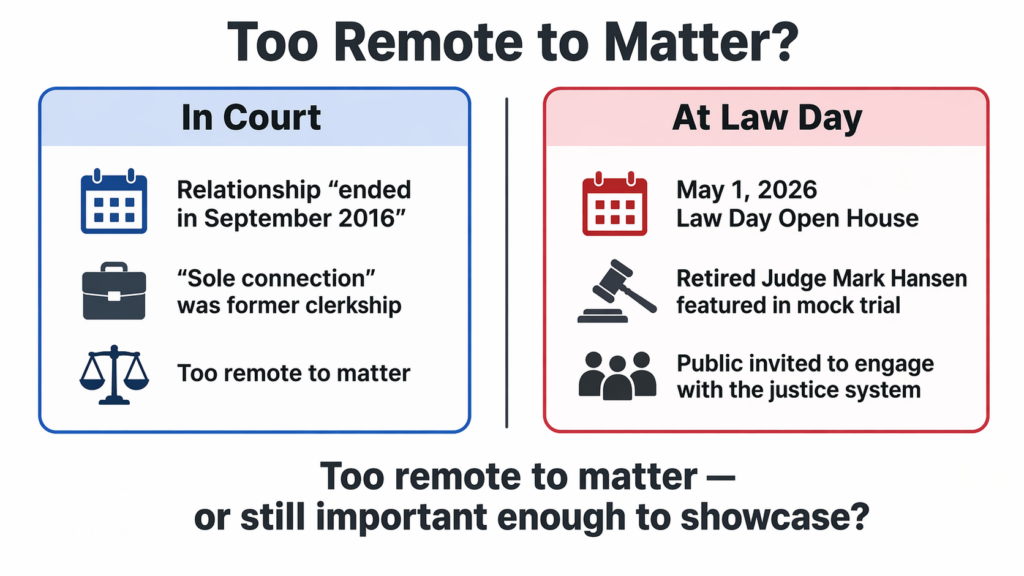
On May 1, 2026, Otter Tail County will host a public Law Day Open House at the historic courthouse in Fergus Falls, and we encourage the public to attend. According to the county’s own public materials, the event is designed to help the public explore the justice system, engage directly with judges, courthouse staff, and justice partners, and learn how the system works. One featured event is a main mock trial in the historic courtroom featuring retired Judge Mark Hansen.
It matters because when we raised concerns about undisclosed judicial relationships in our own case, the continuing significance of Judge Mark Hansen’s role within the Otter Tail County courthouse was minimized rather than meaningfully confronted.
At the first hearing in our case, after defense attorney Kirsten Hansen disclosed that retired Judge Mark Hansen was her father, Judge Kevin Miller responded:
“I’ve seen him around a little bit as a retired judge when he was still doing that.”
That short statement did a great deal of work. It framed Judge Hansen’s role as peripheral, outdated, and too insignificant to create a reasonable concern about impartiality.
But the record we later filed told a much different story.
What We Put Before the Court
In sworn filings supporting our recusal motion, we did not offer vague suspicion. We offered specifics.
In my supplemental declaration, I laid out Minnesota Court Records Online (MCRO) data showing that after Judge Hansen’s 2016 retirement, he continued participating in judicial proceedings on a substantial scale. According to that filed declaration, Judge Hansen participated in 754 hearings in 2017, 1,056 hearings in 2018, and 301 hearings in 2019. In total, the declaration states that he participated in 2,111 hearings after retirement, including 704 in Otter Tail County. The declaration further states that on December 6, 2019 alone, Judge Hansen held six hearings in the Master Courtroom at the Otter Tail County Courthouse.
Marie’s sworn declaration added a different kind of evidence. She described being at the courthouse in February 2022 for my deposition, observing Attorney Hansen greeting courthouse staff with what she considered high familiarity, and overhearing Attorney Hansen say that her father had worked past retirement and had worked in Otter Tail County as recently as two years earlier.
Then, after the September 16, 2024 hearing, I filed another sworn declaration explaining that I reviewed additional public records and found more. According to that declaration, on January 20, 2017—more than four months after Judge Hansen’s retirement—James Morrison identified himself in a letterhead as “Law Clerk to the Honorable Mark F. Hansen.” The same declaration states that on January 27, 2017, Morrison was still communicating with counsel regarding that matter, and that Judge Hansen signed an order that same day based on those communications.
What Judge Miller Said Instead
At the September 16, 2024 hearing, Judge Miller stated:
“Mr. Morrison started with Judge Mark Hansen in November of 2013 and became Judge Sharon Benson’s law clerk in September of 2016. Which I will note, is more than four years prior to the filing of the complaint in this matter, and it would have been six years after the filing of the complaint before Mr. Morrison had any other participation in this matter.”
That framing treated the key question as one of elapsed time. It suggested a clean break, followed by a long enough pause to eliminate any reasonable appearance concern.
Judge Miller’s later written order followed the same path. It stated that “[t]he employment relationship between Mr. Morrison and Judge Hansen ended in September 2016,” that the “sole connection” between Morrison and Attorney Hansen was Morrison’s former employment as her father’s law clerk, and that the employment had ended four years before the litigation began. The order further emphasized that eight years had passed since Morrison was employed as Judge Hansen’s law clerk.
When the Court Supplies the Facts
At the September 16, 2024 hearing, Judge Miller did more than reject our appearance concerns. He supplied an additional timeline of his own on the record: Morrison began with Judge Hansen in November 2013, moved to Judge Benson in September 2016, and had no other participation in our case until years later.
Those facts mattered because they helped frame the Morrison-Hansen relationship as cleanly severed, historically remote, and too old to matter.
That precision also matters for another reason. Judge Miller was not appointed to the bench until May 7, 2018. Yet he supplied specific historical employment dates from November 2013 and September 2016 as if they were settled record facts. Those dates were not in the record. They were not facts placed before the court by the parties. They were extra-record facts supplied by the court itself.
That is the due-process concern. The problem is not merely that the court announced a timeline. It is that the court announced a precise pre-bench timeline that was not in the record, then relied on that timeline to minimize the appearance problem before the court.
And those timeline assertions were not the end of the record. After the hearing, I filed a sworn declaration explaining that public MCRO records undercut that narrative. Those records included January 2017 documents in which Morrison still identified himself as “Law Clerk to the Honorable Mark F. Hansen” after Judge Hansen’s retirement. That same declaration also described additional examples suggesting Morrison’s work was not confined to one judge at a time in the tidy way the court’s timeline implied.
Yet the written order repeated the same basic timeline as settled fact. In other words, the problem was not merely that key sworn facts were left unaddressed. It was that the court relied on its own extra-record timeline, treated that timeline as controlling, and then failed to meaningfully grapple with existing and later-filed sworn material pointing the other way.
That is not a minor problem. When a judge supplies important factual premises that were not in the record, and then uses those premises to minimize an appearance concern, litigants are left wondering whether the outcome turned on the record at all.
For readers interested in the deeper due-process problem raised when judges rely on extra-record facts of their own, see When Structural Error Applies for Some.
What the Order Did Not Confront
That is the contrast.
We filed sworn evidence that, according to MCRO, Judge Hansen remained active in Otter Tail County well after retirement, including six hearings in the courthouse’s Master Courtroom on December 6, 2019.
We filed Marie’s sworn account that in 2022 Attorney Hansen said her father had worked in Otter Tail County as recently as two years earlier.
We filed a post-hearing declaration describing January 2017 records showing James Morrison still functioning as “Law Clerk to the Honorable Mark F. Hansen” after retirement.
Yet the order reduced the issue to an employment relationship ending in September 2016 and an attenuated connection too remote to matter.
That is precisely the kind of narrowing that causes litigants to lose faith. Not because every relationship proves actual bias, but because facts that make the appearance problem stronger can simply be left without meaningful engagement.
What the Courthouse Is Telling the Public Now
Now compare that minimizing narrative to the courthouse’s own public messaging.
The courthouse is not presenting retired Judge Mark Hansen as some forgotten figure from a distant era whose role is too stale or attenuated to matter. It is presenting him as a respected and visible part of courthouse life—someone appropriate to feature in a modern public event meant to educate citizens, students, and families about how justice works.
Final appellate judgment in our case was entered on February 26, 2026. Just over two months later, Judge Hansen is scheduled to appear at the courthouse’s May 1, 2026 Law Day event. That timing does not prove anything improper by itself. But it does make it harder to portray Judge Hansen as some remote historical figure whose significance within the Otter Tail County courthouse had long since faded beyond reasonable concern.
And Judge Hansen is not the only example. In April 2026, the Fergus Falls Daily Journal reported that retired Otter Tail County Judge Wally Senyk—Judge Miller’s immediate predecessor on the Fergus Falls bench—was being publicly honored by the United Way Women United as its 2026 Literacy Champion. This underscores a point the minimization narrative ignores: in Otter Tail County, judges and former judges remain publicly respected, locally known, and woven into community life. That is precisely why longstanding courthouse relationships cannot simply be waved away as stale or insignificant.
In other words, the courthouse is publicly affirming what we were told not to take seriously: that retired judges, courthouse relationships, and longstanding institutional familiarity continue to carry meaning inside that building.
This Is About Appearance, Not Mind-Reading
To be clear, the Law Day event does not “prove” that Judge Miller was actually influenced by Judge Hansen, or that any decision in our case was secretly orchestrated behind the scenes. That is not the point.
The point is more basic—and more important.
Judicial ethics rules exist because public trust can be damaged by appearances, undisclosed relationships, and institutional familiarity even when direct proof of actual bias is unavailable. The recusal standard asks whether a judge’s impartiality might reasonably be questioned. That is an appearance standard for a reason.
And reasonable people do notice patterns.
- They notice when a defense attorney is the daughter of a retired local judge.
- They notice when the former law clerk to that retired judge was never meaningfully disclosed before being drawn into the case.
- They notice when that former law clerk is listed as the author of more than a dozen orders in the same case—orders that repeatedly favored Defendants, including the two represented by that judge’s daughter.
- They notice when sworn filings place that retired judge in continuing courthouse activity long after retirement.
- They notice when post-hearing records suggest the clerking relationship did not end as cleanly as the court later described.
- They notice when a judge appointed in 2018 recites precise 2013 and 2016 employment dates as settled fact, even though those dates were never placed in the record by the parties.
- They notice when a court supplies its own extra-record timeline, treats it as controlling, and then fails to meaningfully address sworn facts pointing the other way.
- And they notice when the courthouse itself later showcases that same retired judge as part of its public image of justice.
Why This Connects to “Hometowned”
In Hometowned, I explained that one of the deepest problems in small legal communities is not always open corruption. Sometimes it is something quieter: a culture in which familiarity is so normalized that the system no longer perceives risk in its own relationships.
That is how disclosure becomes optional.
That is how caution gets replaced by comfort.
That is how litigants who are not part of the local network are expected to accept reassurance instead of transparency.
And that is how the system can fail silently—not necessarily through explicit bad faith, but through institutional blindness.
The Law Day announcement fits that pattern with uncomfortable precision. It is not scandalous because a retired judge is participating in a public educational event. It is revealing because the courthouse itself is demonstrating that these longstanding local judicial relationships remain visible, valued, and woven into the public life of the institution.
When Connections “Don’t Count”
In When Connections Don’t Count, I wrote about the disturbing message sent by a system willing to dismiss serious appearance concerns as ethically insignificant.
But normalization is not neutrality.
A court’s confidence in its own normal routines is not the same thing as public confidence in impartial justice. When filed facts pointing toward continuing courthouse familiarity are brushed aside, and the institution later publicly celebrates that same familiarity, the public is entitled to notice the contradiction.
This Is Why Trust Erodes
Public confidence in the judiciary is not preserved by slogans, open houses, or courthouse tours alone.
It is preserved when courts apply the same appearance-of-fairness standard to themselves that they expect the public to respect.
It is preserved when overlapping relationships are disclosed rather than downplayed.
It is preserved when sworn facts that cut against the preferred narrative are actually confronted.
It is preserved when courts do not substitute their own untested factual premises for the record the parties actually built.
And it is preserved when judges understand that what looks normal from inside the courthouse may look very different from outside it.
As I discussed in When the “Author” Disappears, public confidence is not strengthened when authorship, responsibility, and the decision-making trail become harder rather than easier to follow.
Final Thought
Otter Tail County’s Law Day event may be intended to promote faith in the justice system. But for those of us who lived through denied recusal, written minimization, and appellate acceptance of that minimization, it also does something else:
It proves the point.
It shows that retired Judge Mark Hansen was never some irrelevant historical footnote whose courthouse connection was too stale to matter.
He remained sufficiently connected, visible, and institutionally valued to be publicly featured as part of the courthouse’s own image of justice.
That does not prove what happened in chambers.
But it does reinforce why reasonable people could question the appearance of impartiality all along.
The public is entitled to ask:
