

The Disciplinary Files:
The Catherine McEnroe Case
How an admitted false statement became a public attorney-discipline case
Attorney-discipline proceedings can involve years of disputed facts, extensive records, contested hearings, and competing explanations of what occurred.
The disciplinary case involving Minnesota attorney Catherine A. McEnroe was different.
The central misconduct occurred during a criminal trial. McEnroe initially made a knowingly false statement, repeated it, and attempted to conceal it. But when her supervisors confronted her the following day, she admitted what she had done, asked to apologize publicly, and later unconditionally admitted the allegations in the disciplinary proceeding.
The case therefore provides a relatively clear example of how serious misconduct can move from the courtroom, through the Office of Lawyers Professional Responsibility, and into a public Minnesota Supreme Court proceeding.
It also illustrates an important principle: accepting responsibility does not erase professional misconduct, but genuine accountability may substantially affect the discipline imposed.
A Note During a Criminal Trial
McEnroe was an experienced assistant Hennepin County attorney. In January 2023, she was prosecuting a first-degree criminal-sexual-conduct case involving an alleged child victim.
During the child’s testimony, a victim-witness advocate approached the prosecution table and wrote a short note on McEnroe’s notepad:
“venue? HC?”
The note was apparently intended to remind McEnroe to establish that the alleged offense occurred in Hennepin County. McEnroe maintained that venue had already been established.
The judge saw the interaction and became concerned. The advocate had been sitting near the alleged victim’s mother, who had been permitted to remain in the courtroom as a support person even though she was also a witness subject to the court’s sequestration order.
If the mother had given information to the advocate, and the advocate had then passed that information to the prosecutor, the communication could have violated the sequestration order.
The judge called the attorneys to the bench and asked what the advocate had written.
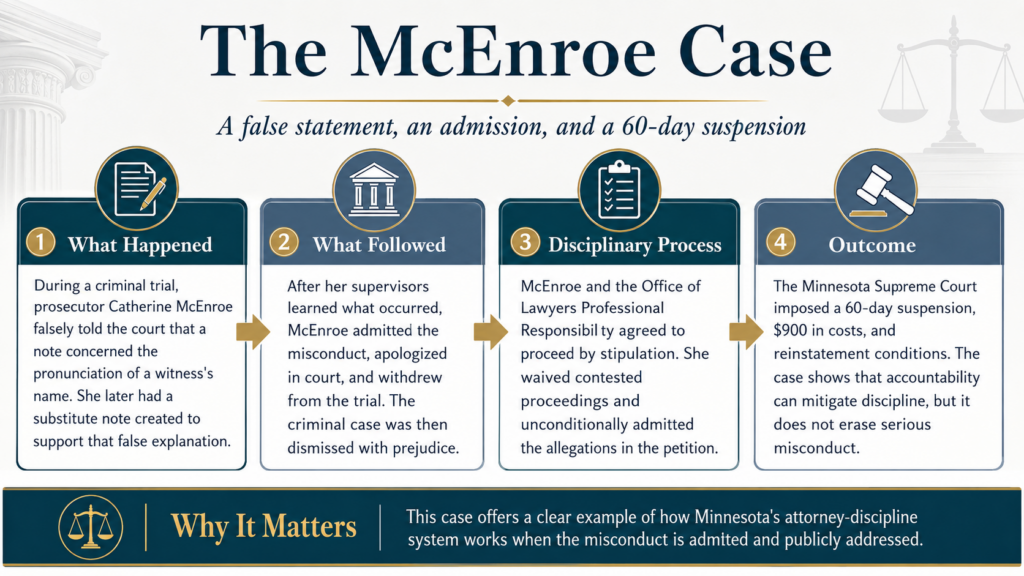
McEnroe told the judge and defense counsel that the note concerned the proper pronunciation of a witness’s Spanish name.
That statement was false.
The disciplinary petition states that McEnroe did not know why she gave that explanation. She maintained that the actual note had no substantive value to the prosecution, but that she was under extreme stress, panicked when the judge became upset, and said the first thing that came to mind.
Whatever the explanation, McEnroe admitted that her statement was knowingly false. (Petition for Disciplinary Action, at 2.)
From a False Statement to a Cover-Up
The misconduct did not end with the initial statement.
Defense counsel asked to see the note. The judge directed McEnroe to speak with the advocate about proper courtroom conduct and to provide the note to the defense.
McEnroe agreed.
Outside the courtroom, however, McEnroe told the advocate that she had represented to the judge that the note concerned the pronunciation of a name. Because the original note did not support that explanation, she directed the advocate to write a second note on another page of the notepad that was consistent with what she had told the court.
The advocate complied. McEnroe then showed the substitute note to defense counsel.
After the trial resumed, the judge asked whether the note had been shown to the defense. McEnroe confirmed that it had. When the judge again asked what the note said, McEnroe repeated that it concerned the phonetic pronunciation of a witness’s name.
The public disciplinary record therefore identifies two related acts of dishonesty:
- McEnroe knowingly misrepresented the contents of the original note to the judge and defense counsel.
- She induced the advocate to create a substitute note and used it to support her false explanation.
The Minnesota Supreme Court later described the second act as dishonest conduct intended to cover up the false statements. (Disciplinary Order, at 1; Petition for Disciplinary Action, at 3.)
The Admission in Court
The trial continued through the afternoon and into the following day.
McEnroe’s supervisors eventually learned what had occurred. They spoke with her during the Friday lunch break, and the disciplinary petition states that she “readily admitted” what she had done.
Her supervisors informed the court.
McEnroe then asked for permission to apologize personally and on the record. In open court, she disclosed both the false statement and her effort to have the advocate create a substitute note. She accepted responsibility and withdrew from the trial, which had only one witness remaining.
The defense had moved to dismiss the prosecution based on prosecutorial misconduct. Before the judge ruled on that motion, the Hennepin County Attorney’s Office moved to dismiss the case.
Because jeopardy had already attached, the dismissal was with prejudice, meaning the prosecution could not simply be started again.
McEnroe’s eventual admission was important. But it came only after the initial false statement had been repeated and supported with a substitute note, and after her supervisors had learned of the misconduct.
The more precise description is therefore not that McEnroe immediately corrected an accidental misstatement. She initially attempted to conceal a deliberate falsehood, but then admitted the full conduct when confronted, apologized publicly, and accepted responsibility in the disciplinary proceeding. (Petition for Disciplinary Action, at 3–4.)
The Rules McEnroe Violated
The disciplinary petition alleged—and McEnroe later admitted—violations of four provisions of the Minnesota Rules of Professional Conduct.
Rule 3.3(a)(1): Candor Toward the Tribunal
A lawyer may not knowingly make a false statement of fact or law to a tribunal or fail to correct a material false statement previously made by the lawyer.
Rule 4.1: Truthfulness in Statements to Others
While representing a client, a lawyer may not knowingly make a false statement of fact or law to another person.
Rule 8.4(c): Dishonesty, Fraud, Deceit, or Misrepresentation
It is professional misconduct for a lawyer to engage in conduct involving dishonesty, fraud, deceit, or misrepresentation.
Rule 8.4(d): Conduct Prejudicial to the Administration of Justice
It is also professional misconduct to engage in conduct prejudicial to the administration of justice.
The initial false statement violated Rules 3.3(a)(1), 4.1, 8.4(c), and 8.4(d). Directing the creation of the substitute note and providing it to defense counsel violated Rules 4.1, 8.4(c), and 8.4(d). (Petition for Disciplinary Action, at 4.)
From Investigation to Public Proceedings
Attorney-discipline investigations ordinarily begin and remain confidential unless the matter reaches a public stage.
The publicly available McEnroe record does not reveal every step of the underlying investigation. It does not identify all information reviewed by the Office of Lawyers Professional Responsibility, every person interviewed, or the discussions that produced the eventual stipulation.
What the public record does show is that McEnroe and the OLPR agreed to move directly into a public Supreme Court proceeding.
Under the ordinary process, proposed charges seeking public discipline may first be considered by a panel of the Lawyers Professional Responsibility Board. If a petition is later filed and contested, the Supreme Court may appoint a referee to conduct a hearing, receive evidence, make findings, and recommend a disposition.
McEnroe agreed to dispense with those steps.
Under Rule 10(a) of the Rules on Lawyers Professional Responsibility, she and the OLPR agreed to:
- dispense with Lawyers Professional Responsibility Board panel proceedings;
- permit the immediate filing of a disciplinary petition in the Minnesota Supreme Court;
- make the matter part of the public record;
- waive her right to answer the petition;
- waive a hearing before a referee;
- waive findings and a recommended disposition from a referee;
- waive Supreme Court briefing and oral argument; and
- unconditionally admit the allegations in the petition.
This was not a negotiated admission to only part of the alleged misconduct. The stipulation states that McEnroe unconditionally admitted the petition’s allegations. (Stipulation for Discipline, at 1–2.)
A Recommended 60-Day Suspension
McEnroe and the OLPR jointly recommended that the Supreme Court suspend her from practicing law for 60 days.
The agreement did not bind the Court. McEnroe acknowledged that the Supreme Court could impose any authorized sanction it considered appropriate.
The OLPR submitted a memorandum explaining why it believed a 60-day suspension was warranted.
The memorandum did not minimize the misconduct:
“There is no doubt respondent’s conduct is serious.”
The OLPR emphasized that the case involved both a knowingly false statement to the court and additional dishonesty intended to conceal that statement. It compared McEnroe’s conduct with other cases in which attorneys or prosecutors had been disciplined for dishonesty.
The OLPR concluded that the most comparable cases involved two instances of dishonest conduct: the original false statement and the attempted cover-up.
But the memorandum also identified substantial mitigating considerations:
- McEnroe demonstrated deep remorse.
- She accepted full responsibility for her conduct.
- She recognized the harm caused to the alleged victim, the court, and the justice system.
- She had experienced extraordinary personal stress.
- She had experienced unaddressed vicarious trauma associated with prosecuting cases involving child sexual abuse.
- She had sought professional help and treatment.
- She had reflected on the causes of her conduct and taken steps to address them.
- The OLPR identified no aggravating factors.
The OLPR also concluded that the false statement had no substantive value to the prosecution and did not concern evidence bearing on the defendant’s guilt or innocence.
Although the criminal case was dismissed, the OLPR reasoned that dismissal was not the inevitable result of McEnroe’s misconduct. Other prosecutors could have completed the trial, only one professional witness remained, and the judge had not yet ruled on the defense motion to dismiss.
Based on the comparable cases, the seriousness of the conduct, and the identified mitigation, the OLPR concluded that a 60-day suspension would recognize the misconduct while remaining consistent with prior disciplinary decisions. (Memorandum in Support of Stipulation, at 4–6.)
The Supreme Court’s Decision
On January 3, 2024, the Minnesota Supreme Court issued its disciplinary order in In re Petition for Disciplinary Action against Catherine A. McEnroe, File No. A23-1615.
The Court stated that it had independently reviewed the file and approved the jointly recommended disposition.
It ordered:
- a minimum 60-day suspension from the practice of law;
- payment of $900 in disciplinary costs;
- compliance with the rule requiring notice to clients, opposing counsel, and tribunals;
- compliance with continuing-legal-education requirements; and
- successful completion of the professional-responsibility examination within one year.
The $900 assessment was an award of disciplinary costs under the Rules on Lawyers Professional Responsibility, rather than a civil-damages award or criminal fine.
A 60-day suspension may be relatively short when compared with longer suspensions or disbarment, but it is more serious than a private admonition or public reprimand. McEnroe temporarily lost the legal authority to practice law and was required to satisfy the Court’s conditions before returning to practice. (Disciplinary Order, at 1–3.)
Conditional Reinstatement
After the minimum suspension period expired, McEnroe submitted an affidavit seeking reinstatement.
On March 18, 2024, the Supreme Court conditionally reinstated her. The Court stated that she had represented that she had complied with the reinstatement requirements except for successful completion of the required professional-responsibility examination.
The OLPR did not oppose her request.
The Court allowed McEnroe to return to practice subject to the condition that she complete the examination and file proof of completion by January 3, 2025. Failure to do so would result in automatic suspension until she provided the required proof. (Conditional-Reinstatement Order, at 1–2.)
What Accountability Changed
McEnroe’s admission did not prevent public discipline.
The Supreme Court’s order expressly recognized that she knowingly made false statements to a court and opposing counsel and engaged in dishonest conduct to cover them up. The misconduct was serious enough to warrant an actual suspension from legal practice.
But her response after the misconduct was exposed mattered.
She admitted what occurred when confronted. She asked to apologize publicly. She did not force the OLPR to prove allegations she knew were true. She waived contested proceedings, unconditionally admitted the petition, expressed remorse, recognized the harm she had caused, and took steps to address the personal and professional pressures identified in the disciplinary record.
Those actions did not erase the misconduct. They provided evidence that the misconduct was recognized, that responsibility was accepted, and that corrective steps were being taken.
The OLPR treated those circumstances as mitigation, and the Supreme Court approved a relatively short suspension.
The case therefore demonstrates the difference between accountability and exoneration. McEnroe was not excused. She was publicly disciplined. But her eventual candor and cooperation affected how the disciplinary system responded.
What the Public Can See
The McEnroe case is unusually useful as an introductory disciplinary case because the public record contains the principal documents needed to understand the result:
- the OLPR’s petition describing the misconduct;
- McEnroe’s stipulation admitting the allegations and waiving contested proceedings;
- the OLPR’s memorandum explaining its recommended sanction;
- the Supreme Court’s disciplinary order; and
- the later conditional-reinstatement order.
Those documents allow the public to see what conduct was charged, what was admitted, which rules were violated, what discipline was recommended, why the OLPR considered that discipline appropriate, and what the Supreme Court ultimately ordered.
What remains outside public view is the confidential investigative stage that preceded those filings. The public documents do not provide a complete investigative chronology or disclose all communications and evidence considered before the stipulation was reached.
That boundary is important. The public record supports firm conclusions about the misconduct McEnroe admitted and the discipline imposed. It does not support speculation about confidential investigative details that were never disclosed.
A Useful Starting Point
The McEnroe case is simple procedurally because the material facts were ultimately undisputed. It was not insignificant.
An experienced prosecutor knowingly misled a judge and defense counsel, arranged for another person to create a substitute note, and repeated the false account in open court. A serious criminal prosecution was later dismissed with prejudice.
But after the misconduct was discovered, McEnroe admitted it, apologized, waived contested disciplinary proceedings, and accepted the consequences.
The disciplinary system responded publicly. The OLPR explained its reasoning. The Supreme Court independently reviewed the record and imposed a suspension.
That makes the case a useful baseline for The Disciplinary Files.
Later cases may involve disputed allegations, incomplete public records, lengthy investigations, failures to cooperate, repeated misconduct, prior discipline, or complaints that never reach a public proceeding. Those cases will be more difficult to evaluate.
The McEnroe case shows what the process can look like when the central facts are admitted and the disciplinary authorities publicly explain both the misconduct and the sanction.
Sources and Record Note
- In re Petition for Disciplinary Action against Catherine A. McEnroe, A23-1615 — disciplinary order
- Petition for Disciplinary Action against Catherine A. McEnroe, A23-1615
- Stipulation for Discipline and Supporting Memorandum, A23-1615
- In re Petition for Disciplinary Action against Catherine A. McEnroe, A23-1615 — conditional-reinstatement order
- Minnesota appellate public case record for A23-1615
- Minnesota Lawyer Search — search “Catherine McEnroe” or Lawyer ID 0219587
- Minnesota Rules on Lawyers Professional Responsibility
- OLPR: Discipline System and Process
Record-access note: The former document-level links on the combined OLPR/LPRB website were retired during the July 2026 website reorganization. Justice-Denied has preserved separate public copies of the disciplinary order, petition for disciplinary action, stipulation and supporting memorandum, and conditional-reinstatement order. Each citation above links to the relevant document and, when applicable, opens at the cited page. The official P-MACS record remains linked for the appellate docket.
