

The Candor Files:
When Attorney Confidence Replaces Candor
How a Statement About Deleted Text Messages Shaped a Critical Discovery Hearing
In litigation, courts depend on attorneys to accurately describe the facts before them. Judges frequently must make decisions based not on every underlying document or piece of evidence, but on the representations made by the lawyers appearing before them.
That responsibility becomes especially important during discovery hearings, where courts are asked to manage disputes involving evidence, depositions, and the scope of information that will be available to the parties.
On September 15, 2022, the parties appeared before Judge Kevin M. Miller for a discovery management hearing involving Defendant Sean Stevenson’s second deposition. The reason for the second deposition was significant: evidence had emerged that Sean had deleted relevant text messages and had provided inaccurate testimony during his first deposition regarding those deletions.
The issue before the Court was not simply whether Sean would sit for another deposition. The parties were asking the Court to determine the appropriate scope of questioning after new forensic evidence revealed a serious discovery problem.
During the hearing, Plaintiffs’ counsel explained that Sean’s first deposition occurred in February 2022 and that it later became apparent Sean had provided false testimony about what he had deleted. Counsel also explained that other depositions had proceeded while the defense apparently knew about the issue, but Plaintiffs did not.
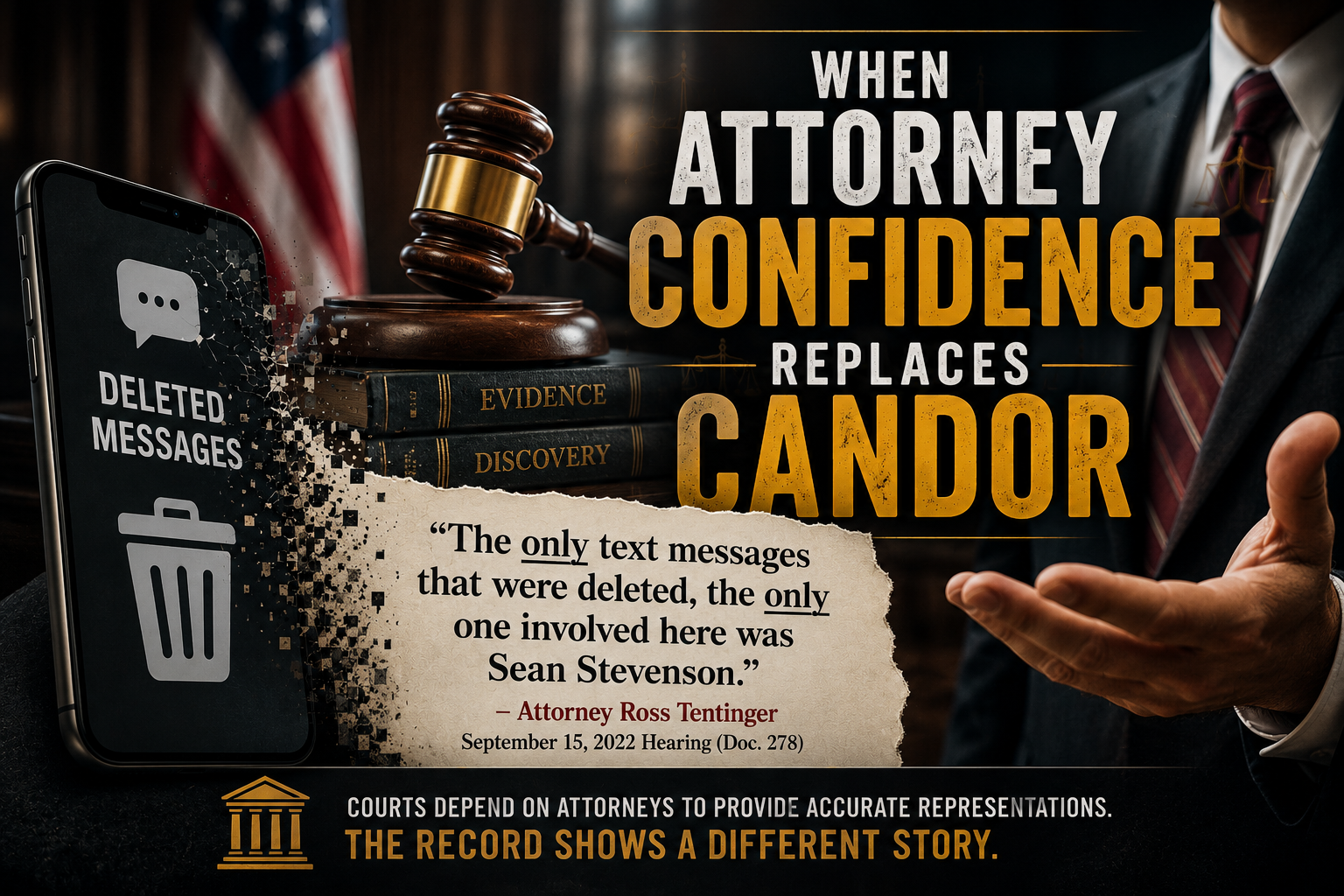
Against that backdrop, defense attorney Ross Tentinger made a statement to the Court about who was involved in deleting text messages.
“The Only One Involved Here Was Sean Stevenson”
When it was his turn to address the Court, Attorney Tentinger stated:
“The only text messages that were deleted, the only one involved here was Sean Stevenson. So, the averments that anyone else was involved isn’t, is incorrect.”
The statement appears in the September 15, 2022 hearing transcript. (Doc. 278)
The statement was categorical. It did not suggest uncertainty or a lack of information. It did not state that Sean was the primary focus of the hearing. It stated that Sean was the only person involved and that assertions involving anyone else were incorrect.
The available record tells a different story.
Lisa’s Own Testimony Documented Deleted Text Messages
At the time of the September hearing, Defendant Lisa Stevenson-Allen had already testified under oath about deleting text messages from her own phone.
During her July 22, 2022 deposition, Lisa repeatedly acknowledged that messages had been deleted or were missing.
She testified:
“They might have — they might have been deleted. I delete texts.”
Later, she stated:
“Well, I typically delete texts….”
When questioned about specific missing messages, she testified:
“I don’t recall deleting those. I know there was one of [Plaintiffs’ daughter] on there, but I don’t recall deleting those, unless I didn’t get them or unless I did delete them.”
Lisa also acknowledged a larger problem with missing messages:
“There’s a lot of texts that are just missing on my phone. I have deleted some, but there’s a whole — there’s months that are just gone, and I don’t know.”
She further explained:
“I have no idea other than I delete texts as part of my job. I automatically delete texts….”
And later:
“They could be deleted or gone like these were. I don’t know.”
Finally, she acknowledged:
“But I do delete texts. You can see from my phone there’s problems with it. I don’t know.”
These were not statements made after the hearing. They were sworn answers given before Attorney Tentinger told the Court that Sean was the only person involved.
The Defense Also Possessed Information About Lisa’s Phone
Lisa’s deposition testimony was not the only evidence relating to her phone.
At the time of the September 15 hearing, Attorney Ross Tentinger represented Lisa Stevenson-Allen and possessed information concerning the forensic examination of her phone. That information included evidence indicating that Lisa—not just Sean—had deleted text messages relevant to the litigation.
Among the information available to the defense was:
- A forensic examination report from Lisa’s phone, completed in May 2022, that had not been produced to Plaintiffs despite having been completed approximately four months earlier.
- That undisclosed report—which was not produced until November 2022—showed that Lisa had deleted nearly every text message exchanged with Sean before submitting her phone for forensic examination.
- Some of the deleted text messages had previously been produced during discovery, demonstrating that messages known to have existed were later removed from Lisa’s phone.
- Screenshots from Lisa’s phone, when compared with Sean’s AT&T telephone records, revealed more than one hundred missing text messages surrounding critical dates in the litigation.
- A detailed analysis of the discovery record showed that Lisa deleted text messages both before and after her February 11, 2022 document production.
Taken together, this information presented a far different picture than the one conveyed to the Court. The issue was not whether counsel remembered every detail of a complex discovery record. It was that a categorical factual representation was made during a discovery hearing where the Court depended on counsel to accurately describe the evidence before it.
Why the Statement Mattered: The Court Was Deciding the Scope of Discovery
The September 15 hearing was a discovery management hearing. The Court was not deciding the ultimate merits of the lawsuit. It was deciding how a second deposition should proceed and what subjects would be appropriate.
That distinction matters.
Judge Miller did not have all of the underlying forensic materials before him. Near the end of the hearing, he specifically stated:
“I don’t even have the forensic reports to know like what would be appropriate or not.”
Because the Court did not have those reports, it necessarily relied on the attorneys’ descriptions of the evidence.
The parties presented very different descriptions of the discovery problem.
Plaintiffs described a broader issue involving deleted communications, multiple defendants’ devices, and the need for latitude in questioning Sean about the newly discovered evidence.
The defense characterized the matter as essentially limited to Sean.
Immediately before the Court addressed deposition parameters, Attorney Tentinger told the Court that Sean was the only person involved in deleting texts.
The transcript does not establish what effect that statement had on the Court’s decision. Courts do not reveal every factor considered internally, and it would be improper to speculate about Judge Miller’s reasoning.
However, the statement clearly affected the factual framework presented to the Court at a critical moment. The Court was being asked to determine how broad the discovery inquiry should be, and that determination depended on an accurate understanding of the scope of the evidence.
Judge Miller ultimately described the situation as unusual:
“This is, this is unique Mr. Schaap. I agree. I haven’t seen this happen really either.”
The Court then attempted to balance competing concerns, allowing Plaintiffs latitude while limiting the second deposition to matters connected to the forensic evaluation and text messages.
The importance of candor is greatest in precisely these moments—when a judge must make decisions based on the factual information supplied by counsel.
The Minnesota Rules of Professional Conduct Require Candor
Minnesota Rule of Professional Conduct 3.3 addresses candor toward a tribunal. It provides that a lawyer shall not knowingly make a false statement of fact or law to a tribunal and requires a lawyer to correct a material false statement when necessary.
The rule recognizes that courts depend on attorneys to present accurate information, particularly when the attorney is advocating before a judge who does not have independent access to every underlying fact.
Other professional conduct rules may also apply when an attorney knowingly engages in dishonesty, fraud, deceit, or misrepresentation, including Rule 8.4(c), or engages in conduct prejudicial to the administration of justice under Rule 8.4(d).
The key questions in any such analysis are:
- Was the statement false?
- Was it material?
- Did the attorney know it was false when made?
Falsity and Knowledge Are Separate Questions
The record provides substantial evidence that the statement that Sean was “the only one involved” was inconsistent with the evidence available at the time.
Lisa had already testified under oath that she deleted texts.
The defense had conducted forensic examinations involving defendants’ phones.
The hearing itself involved discussion of forensic reports and deleted communications.
The remaining question—whether Attorney Tentinger knowingly made a false statement to the Court—is a separate issue. This article does not claim to decide that issue.
But the circumstances are important.
A mistaken statement made in passing is different from a categorical factual representation made during a discovery hearing where the Court is relying on attorneys to explain the evidence accurately.
When the Court Depends on Counsel, Accuracy Matters
The justice system cannot function if courts must assume that attorneys’ factual representations may be incomplete or inaccurate.
Discovery disputes often involve complicated records. Lawyers may disagree about interpretation. They may disagree about relevance. They may disagree about what a court should do.
But disagreement is not the same as misstatement.
When a lawyer tells a court that only one person was involved in a discovery problem, while the record shows another party had also admitted deleting evidence, the court is entitled to an accurate description of the facts.
The statement was made in open court.
The contradiction existed in the record.
And the duty of candor requires that the court receive the clearest possible picture—not a narrower version that omits significant facts.
