

The Disciplinary Files:
The Paul Overson Case
When a technically true statement misled the court
Attorney candor is sometimes discussed as if the rule were simple: do not say anything false to a judge.
The disciplinary case involving Minnesota attorney Paul E. Overson shows why the obligation is broader than that.
According to the disciplinary petition, none of Overson’s words to the court were literally false. But he knew the court had misunderstood the status of an order-for-protection proceeding, and he responded in a way designed to preserve that misunderstanding. He then failed to correct it during or after the hearing.
Overson unconditionally admitted the allegations. The Minnesota Supreme Court imposed a minimum 30-day suspension.
The case offers a concise but important lesson: a lawyer cannot avoid professional discipline merely by choosing words that are technically accurate while knowingly allowing those words to mislead the tribunal.
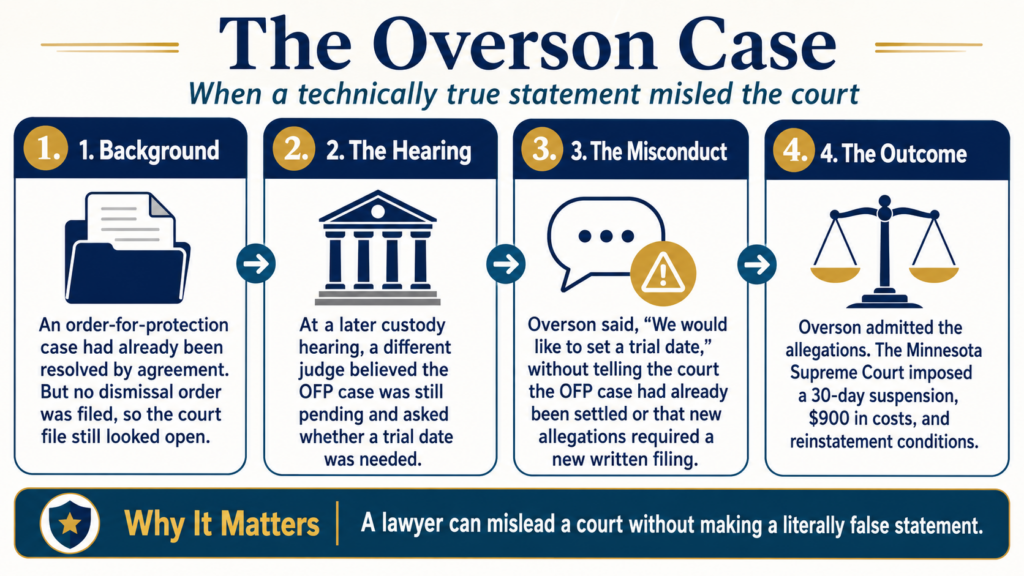
An Order-for-Protection Case That Had Already Been Resolved
The underlying matter began in June 2022, when A.B. filed a petition for an order for protection against J.B., with whom she had a child. J.B. disputed the allegations and requested a hearing. A separate custody proceeding was filed several days later.
By the time of the July 25, 2022 order-for-protection hearing, both parties were represented by counsel. Overson represented A.B.
Before the hearing began, the parties reached an agreement. Overson informed the court that the issues raised in the order-for-protection case would be addressed in the custody case and that the order-for-protection proceeding could be dismissed. Opposing counsel placed the agreement’s details on the record, and both parties confirmed that the agreement was correct.
The judge directed the attorneys to submit a dismissal order for signature.
But the attorneys did not identify who would prepare the proposed order. Neither attorney submitted one, and no written dismissal order was entered.
The case therefore appeared open in the court file even though the parties had already agreed, on the record, to resolve and dismiss it. (Petition for Disciplinary Action, at 2.)
New Allegations, but No New Petition
During the following months, Overson’s client told him about additional allegations that she believed justified an order for protection. She wanted a hearing on those allegations.
Overson did not file a motion or a new petition based on the additional allegations.
That distinction mattered. The original order-for-protection request had been resolved by agreement. The petition states that any hearing on new allegations required a written request setting them out. A verbal request during the separate custody proceeding could not revive the earlier case or place new allegations properly before the court.
The disciplinary petition alleged that Overson, an experienced practitioner, knew those requirements. (Petition for Disciplinary Action, at 2, 5.)
A Different Judge Saw an Open File
On September 2, 2022, the parties appeared by Zoom for an Initial Case Management Conference in the custody matter. A different judge presided. J.B. appeared without counsel, while Overson appeared with A.B.
Because no dismissal order had been entered in the order-for-protection case, the judge reviewing the files believed that proceeding remained unresolved.
The judge explained that the order-for-protection file appeared to be “in limbo.” He believed an initial hearing had occurred but that the requested trial had not yet been scheduled. He asked Overson whether his client still wanted a trial date.
Overson responded that he would consult with his client. The judge placed Overson and A.B. in a separate Zoom breakout room so they could discuss the issue.
According to the petition, A.B. again expressed fear of J.B. and said that she wanted an order-for-protection hearing. Overson did not tell her that the original request had already been resolved or that a new written request would be required to proceed on the later allegations, even though he knew both facts. (Petition for Disciplinary Action, at 3–4.)
“We Would Like to Set a Trial Date”
When Overson returned to the hearing, the judge asked where the order-for-protection matter stood.
Overson answered:
“Where that stands, Your Honor, is that we would like to set a trial date on that.”
He added that the date did not need to be immediate and suggested that the parties might work something out beforehand.
The judge agreed to look for a hearing date.
Overson never told the judge that:
- the parties had already agreed to dismiss the order-for-protection proceeding;
- they had agreed to address the relevant issues in the custody case without an order for protection;
- the only unfinished step in the original proceeding was entry of the written dismissal order; or
- no new written request had been filed concerning the later allegations.
The court therefore understood that an unresolved order-for-protection petition remained pending and could be set for trial. (Petition for Disciplinary Action, at 4–5.)
Not Literally False—Still Misleading
The petition makes an unusually important distinction:
“While none of respondent’s statements to the tribunal actually were false,” Overson knew and remembered that the parties had resolved and agreed to dismiss the order-for-protection matter.
His statement that his client wanted a trial date could be read as technically accurate in isolation. She did want a hearing.
But that answer concealed the controlling procedural facts. The existing petition had already been resolved, and the later allegations had never been placed before the court through a new written filing.
The disciplinary allegation was therefore not based on a demonstrably false sentence. It was based on a knowingly incomplete answer intended to cause the court to draw a false conclusion.
The petition alleges that Overson knew his statement would mislead the judge into believing the order-for-protection case had not been settled. It also allowed both his client and the self-represented opposing party to understand that a hearing would occur without disclosing the agreement to dismiss the case. (Petition for Disciplinary Action, at 5.)
The Court Relied on the Misleading Statement
The misleading answer had a practical effect.
The judge stated that he would work with the calendar, select a date, and issue an order addressing the order-for-protection proceeding. The petition expressly alleges that the judge acted in reliance on Overson’s statement.
The court was preparing to schedule a hearing on allegations that were not properly before it, in a proceeding the parties had already agreed to dismiss.
This was not simply an imprecise description that made no difference. It redirected judicial attention and court scheduling toward a hearing that should not have been arranged on the existing record. (Petition for Disciplinary Action, at 5–6.)
The Continuing Failure to Correct the Record
Overson did not correct the judge during the hearing.
He also did not correct the misleading impression afterward. He did not tell the custody judge that the parties had agreed to dismiss the order-for-protection case, and he did not submit the dismissal order that the first judge had requested.
Instead, J.B. contacted the attorney who had represented him in the order-for-protection proceeding. On September 8, 2022, that attorney wrote to the original judge and requested entry of the agreed dismissal. The court then entered the dismissal order.
The following day, the attorney wrote to the custody judge, enclosed the transcript of the July 25 hearing, and explained that the order-for-protection proceeding had been dismissed.
The record was therefore corrected by opposing counsel—not by the attorney whose statement had caused the court’s misunderstanding. (Petition for Disciplinary Action, at 6.)
The Rules Overson Violated
Overson unconditionally admitted that his conduct violated Rules 8.4(c) and 8.4(d) of the Minnesota Rules of Professional Conduct.
Rule 8.4(c): Dishonesty, Fraud, Deceit, or Misrepresentation
It is professional misconduct for a lawyer to engage in conduct involving dishonesty, fraud, deceit, or misrepresentation.
The word misrepresentation is significant here. The case did not depend on proving that Overson uttered a literally false sentence. His knowingly incomplete answer created and preserved a materially false impression.
Rule 8.4(d): Conduct Prejudicial to the Administration of Justice
It is professional misconduct for a lawyer to engage in conduct prejudicial to the administration of justice.
The court relied on Overson’s statement and began taking steps to schedule a hearing in a case that had been resolved and on allegations that were not properly before it.
Unlike some disciplinary matters involving false statements to a tribunal, the petition did not charge Overson with violating Rule 3.3(a)(1), the specific rule governing knowingly false statements to a tribunal. The admitted violations instead rested on the broader prohibitions against misrepresentation and conduct prejudicial to justice. (Petition for Disciplinary Action, at 6.)
A Prior Admonition
The petition also disclosed one item of prior discipline.
In August 2012, Overson received an admonition for withdrawing from a representation on the business day before his client’s deposition.
The public documents do not explain what weight the OLPR or the Supreme Court assigned to that prior admonition when evaluating the later misconduct. But its inclusion in the petition means the disciplinary authorities and the Court had it before them when considering the recommended sanction. (Petition for Disciplinary Action, at 1.)
How the Disciplinary Case Proceeded
The petition and stipulation were filed in the Minnesota Supreme Court on December 4, 2023.
Overson and the Director of the Office of Lawyers Professional Responsibility agreed to dispense with proceedings before a Lawyers Professional Responsibility Board panel and to permit the immediate filing of the disciplinary petition.
Overson also agreed that the matter would become public. He waived:
- his right to answer the petition;
- a hearing before a referee;
- referee findings, conclusions, and a recommended disposition;
- the right to contest such findings; and
- a Supreme Court hearing based on the record, briefs, and arguments.
Most importantly, Overson unconditionally admitted the allegations of the petition.
The parties jointly recommended a 30-day suspension. Overson acknowledged that the recommendation did not bind the Supreme Court and that the Court could impose any authorized disposition. (Stipulation for Discipline, at 1–2.)
The 30-Day Suspension
On February 23, 2024, the Minnesota Supreme Court issued its order in In re Petition for Disciplinary Action against Paul E. Overson, File No. A23-1828.
The Court summarized the admitted misconduct as knowingly making a misleading statement to a court during a hearing and subsequently failing to correct it.
After independently reviewing the file, the Court approved the jointly recommended disposition and ordered:
- a minimum 30-day suspension, effective 14 days after the order;
- compliance with the rule requiring notice of suspension to clients, opposing counsel, and tribunals;
- payment of $900 in disciplinary costs;
- compliance with continuing-legal-education and other reinstatement requirements; and
- successful completion of the professional-responsibility examination within one year.
The order does not include a detailed sanction analysis or identify specific mitigating circumstances. The publicly available stipulation likewise states the jointly recommended discipline but does not contain the type of supporting memorandum included in some other disciplinary cases.
The public record therefore establishes why Overson was disciplined and what sanction was imposed, but it does not fully explain the negotiations or considerations that produced the 30-day recommendation. (Supreme Court Disciplinary Order, at 1–2.)
Conditional Reinstatement
After the suspension period, Overson submitted an affidavit seeking reinstatement.
On June 4, 2024, the Supreme Court conditionally reinstated him. The order stated that he had represented that he complied with the reinstatement requirements except for successful completion of the professional-responsibility examination. The OLPR did not oppose his request.
The Court required Overson to file proof of successful completion of the examination by February 24, 2025. Failure to do so would result in automatic suspension until the required proof was submitted. (Conditional-Reinstatement Order, at 1–2.)
Why This Case Matters
The Overson case draws a line that is easy to miss.
A lawyer may mislead a court without making a sentence that is literally false. Selective answers, omitted context, and strategic silence can create a false understanding just as effectively as an express factual lie.
Here, the court directly asked about the status of a proceeding. Overson knew that the parties had already agreed to dismiss it. He knew that the later allegations had not been presented through the written process required for a new order-for-protection request. Yet he asked the judge to set a trial date without disclosing either fact.
He then allowed the misunderstanding to continue until opposing counsel corrected the record.
The disciplinary result reinforces three principles:
- Literal accuracy is not a safe harbor for intentional deception.
- A lawyer who creates or recognizes a material misunderstanding may have a duty to correct it.
- Misleading a court can warrant an actual suspension even when the lawyer later admits the misconduct and avoids contested disciplinary proceedings.
The case is therefore a useful addition to The Disciplinary Files. It shows that professional candor is measured not only by whether each spoken sentence can survive a technical truth test, but by whether the lawyer knowingly caused the tribunal to proceed on a false understanding of the record.
A Useful Contrast
The Catherine McEnroe disciplinary case involved a directly false explanation to a judge, followed by an effort to create a substitute note supporting that explanation. McEnroe received a 60-day suspension.
Overson’s case involved no statement the petition characterized as literally false. Instead, he used an incomplete answer to preserve a misunderstanding and then failed to correct it. He received a 30-day suspension.
The two cases illustrate different forms of misconduct toward a tribunal:
- an express false statement and attempted cover-up; and
- a technically true but intentionally misleading statement, followed by continued silence.
Both resulted in public discipline and temporary loss of the right to practice law.
Sources and Record Note
- In re Petition for Disciplinary Action against Paul E. Overson, A23-1828 — Petition for Disciplinary Action
- In re Petition for Disciplinary Action against Paul E. Overson, A23-1828 — Stipulation for Discipline
- In re Petition for Disciplinary Action against Paul E. Overson, A23-1828 — Disciplinary Order
- In re Petition for Disciplinary Action against Paul E. Overson, A23-1828 — Conditional-Reinstatement Order
Record note: The disciplinary petition identifies the participants in the underlying family-court proceedings by initials. This post follows that convention. The public record establishes the allegations Overson unconditionally admitted and the discipline imposed; it does not disclose all confidential investigative communications or provide a detailed memorandum explaining the recommended sanction.
