

The Candor Files:
When an Attorney Drives a False Narrative
How an Attorney’s False Claim Undermined Sworn Testimony
An attorney does not need to fabricate an entire event at the center of a lawsuit to distort a judicial decision.
Sometimes, one invented detail is enough.
A supposed trip. A supposed habit. A seemingly specific fact stated confidently to a judge—one that makes an opposing party appear dishonest, unreasonable, or unwilling to cooperate.
It should never happen. Rule 3.3(a)(1) of the Minnesota Rules of Professional Conduct is clear on this point: a lawyer shall not knowingly “make a false statement of fact or law to a tribunal, or fail to correct a false statement of material fact or law previously made to the tribunal by the lawyer.”
Comment [3] to Rule 3.3 goes further: when a lawyer states a factual assertion in open court as though it were within the lawyer’s own knowledge, the lawyer must know it is true or have a basis for believing it after a reasonably diligent inquiry.
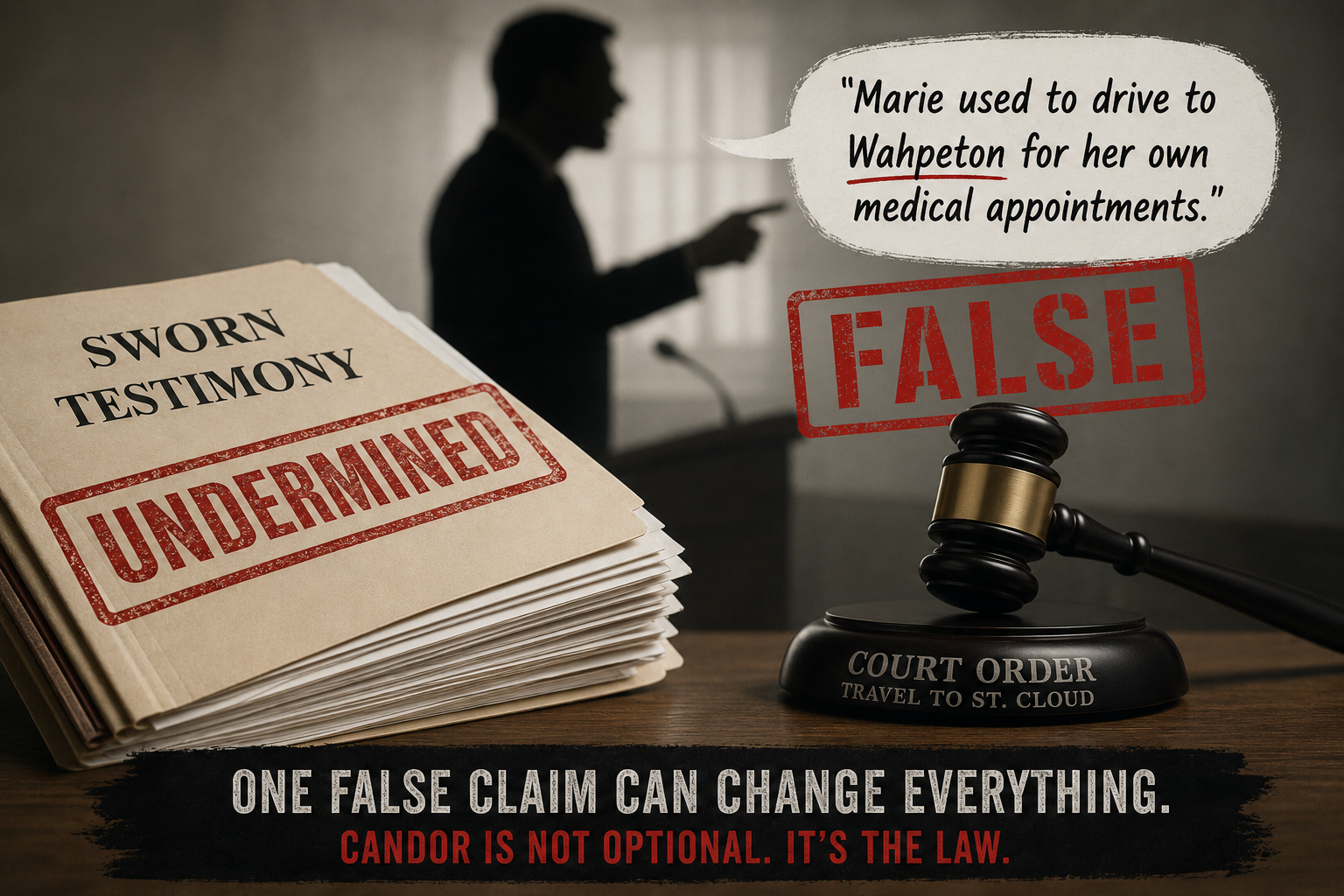
At a March 25, 2022 hearing in our case, defense attorney Ross Tentinger told the court that I had previously driven myself to Wahpeton for medical appointments. He used that supposed history to argue that I was capable of driving myself from our home in Fergus Falls to St. Cloud for an independent medical examination.
There was only one problem.
I had never driven myself to Wahpeton for a medical appointment.
Not once.
The statement was not supported by my deposition testimony. It was not contained in the Defendants’ motion papers. It was not supported by an affidavit, medical record, travel record, witness, or exhibit.
It was invented.
It had no basis in the record.
And it directly contradicted my sworn declaration.
Yet it was presented to the court as fact at the precise moment Judge Kevin M. Miller was deciding whether my medical limitations were genuine—or whether Craig and I were simply being unreasonable.
We Had Already Agreed to the Examination
The dispute was never about whether I would submit to an independent medical examination.
The Defendants had moved to compel a psychological IME because my claim for intentional infliction of emotional distress placed my mental condition at issue. We agreed that the Defendants could have an examination.
What we disputed were the conditions.
The Defendants initially sought an examination in Edina, nearly three hours from our home. Their proposed examination could last as long as four hours. When we objected, they offered St. Cloud as their compromise.
St. Cloud was still approximately 113 miles from our home—nearly two hours each way. With the examination included, the trip would consume approximately eight hours.
That was not a minor inconvenience for us.
I have peripheral neuropathy and paresthesias. For those of you unfamiliar with that diagnosis, it means that I struggle with numbness and tingling in my extremities. At times, I will undergo unexpected sensations ranging from bee stings to lightning bolts. I never know when they are going to hit and am mindful about not putting others – or myself – in unnecessary danger.
Although I maintain a driver’s license for emergencies, I do not ordinarily drive and rely upon Craig as my driver and escort. (Being struck with a lightning bolt sensation while driving 70 mph on the interstate would not be a safe situation.) Craig was also experiencing substantial pain when sitting for prolonged periods. Our attorney explained that he had been unable even to remain seated during a deposition and typically stood during meals to limit his pain.
We therefore proposed alternatives.
The examination could occur remotely by videoconference. It could be conducted in Fergus Falls. Or the Defendants could look for an examiner in a significantly closer location, such as Fargo, Alexandria, or Detroit Lakes.
We were not refusing discovery.
We were asking the court to impose reasonable conditions upon it.
A Remote Examination Was Not Hypothetical
Before the hearing, I had already been evaluated remotely by a forensic neuropsychologist and a forensic psychiatrist.
Craig did not sit in the room. He did not watch, observe, text, telephone, or otherwise communicate with me. He remained outside the building throughout both evaluations. The sessions occurred outside the range of our home security system, and the experts recorded them.
In my declaration, I expressly offered to follow those same procedures during the Defendants’ examination.
That evidence addressed the defense concerns about interference directly. It demonstrated that a remote evaluation could be conducted under controlled conditions without Craig’s involvement.
The Defendants nevertheless insisted that only an in-person examination would be sufficiently reliable.
At the time, we did not know what else an in-person examination would make possible.
What the Written Record Actually Said
The Defendants’ written reply relied on two facts to challenge my claimed inability to drive.
First, I had a driver’s license.
Second, I had testified that my neuropathy symptoms had moderated since their original onset.
Neither fact established that I routinely drove. Neither established that I could safely complete a four-hour round trip followed by a lengthy psychological examination. And neither established that I had ever driven myself to Wahpeton for medical appointments.
The written reply did not make that claim.
More importantly, the sworn evidence already before the court said virtually the opposite.
The Sworn Evidence Said the Opposite
On March 11, 2022—two weeks before the hearing—I submitted a declaration under penalty of perjury addressing my driving and travel limitations directly.
I told the court that I had experienced significant health problems affecting travel since late 2012. I explained that my paresthesias and neuropathy made it unsafe for me to operate a motor vehicle and that Craig drove for me. I stated that I maintained a driver’s license for emergencies only and had not operated a vehicle in years.
I also provided the court with a specific travel history.
I explained that Craig and I had not traveled farther than Eagle Bend, Minnesota, since November 2019. Since August 2021, we had not traveled farther than 22 miles round trip. Even short trips could aggravate Craig’s sciatic-nerve injury because of the vibration from the vehicle.
This was not an unsupported assertion made for the first time at oral argument. It was sworn testimony, submitted in direct response to the Defendants’ motion.
Nothing in my declaration said that I had driven myself to Wahpeton.
Nothing in my deposition said that I had driven myself to Wahpeton.
Nothing in the Defendants’ written memoranda identified such a trip.
Nevertheless, at the hearing, Attorney Tentinger confidently told Judge Miller:
“Marie has a driver’s license. She’s capable of driving herself. She used to drive to Wahpeton for her own medical appointments. She could drive herself to St. Cloud for the appointment, go back the same day, and pack one lunch.”
Doc. 234, Tr: 23:14-20
The statement did not simply lack evidentiary support. It contradicted the sworn evidence already in the record.
An Invented Fact Replaces Sworn Testimony
That distinction matters.
Lawyers often disagree about what evidence means. One attorney may argue that a medical condition is severe; another may contend that it has improved. One side may regard a two-hour drive as burdensome; the other may call it reasonable.
Those are arguments.
But whether I had previously driven myself to Wahpeton for medical appointments was not a matter of interpretation. It was a concrete historical assertion. It either happened or it did not.
It did not.
Yet the invented trips were more vivid and easier to remember than the actual evidence. Instead of weighing a declaration describing years without driving, neuropathy, paresthesias, and sharply limited travel, the court was given a simple counterstory:
Marie had driven to Wahpeton before – multiple times. She could drive to St. Cloud now.
A fabricated anecdote was placed in direct competition with sworn testimony.
A Fact Tailored to Defeat Our Argument
The false statement was not peripheral to the issue before the court.
It was almost perfectly designed to defeat our objection.
We told the court that my peripheral neuropathy and inability to drive made St. Cloud an unreasonable location.
The Defendants responded that I had personally driven comparable distances for medical appointments before.
If true, that would have been highly relevant. It would suggest that the St. Cloud trip was not materially different from travel I had voluntarily undertaken for my own care. It could make my stated inability to drive appear exaggerated. It could make our request for a closer location appear tactical rather than medically necessary.
In other words, the fabricated detail did not merely strengthen the defense position.
It undermined my credibility.
That is what makes false factual statements to a tribunal so dangerous. A lawyer can transform a dispute over reasonable accommodations into a referendum on whether the opposing party is telling the truth.
Our Attorney Challenged the Premise
Our attorney responded immediately that my medical conditions were well established in the record. She told the court that I had not driven while the case was pending and that requiring me to drive for two hours with paresthesia and neuropathy would be dangerous.
That response challenged the defense argument.
But it did not necessarily erase the effect of the specific Wahpeton story.
During oral argument, attorneys do not always have immediate access to every deposition page or piece of evidence necessary to identify a fabricated assertion and say, unequivocally, “That never happened, and there is no evidence supporting it.”
A specific factual representation from an officer of the court can therefore remain in the judge’s mind even when the opposing attorney disputes the larger conclusion.
Attorney Tentinger never withdrew the statement.
He never identified its source.
He never corrected the record.
The court was left to decide the motion with the false assertion still sitting among the facts it had heard.
From Medical Limitation to “Self-Imposed Restriction”
The language surrounding the falsehood is as important as the falsehood itself.
Attorney Tentinger did not simply argue that St. Cloud was the closest location available to the Defendants’ preferred examiner. He characterized our medical and logistical limitations as “self-imposed restrictions.”
That framing created two competing pictures.
Under our version, I was a woman with peripheral neuropathy who did not ordinarily drive and whose husband also had difficulty tolerating long periods in a vehicle. We had agreed to an IME and proposed several ways it could occur without requiring an eight-hour day away from home.
Under the Defendants’ version, I was a licensed driver who had previously driven herself to another city for medical care and was now manufacturing unnecessary obstacles to avoid a routine examination.
Tentinger’s fabricated account of repeated Wahpeton trips made the second version appear plausible.
Once the issue was framed that way, the dispute was no longer merely about distance.
It was about character.
Were we asking for a reasonable accommodation?
Or were we difficult litigants imposing artificial restrictions upon the Defendants?
That credibility judgment could affect not only the IME motion, but every later dispute in which we asked the court to believe our description of our health, our limitations, our evidence, or the Defendants’ conduct.
The Court Chose the Defense Conditions
Judge Miller ultimately ordered me to travel to St. Cloud for an in-person examination by a provider selected by the Defendants.
Craig was prohibited from attending.
The examination could not be recorded. (In a similar case regarding an IME, Judge Miller ruled that the Plaintiff had a right to record the IME, but in our case, I was not afforded this same right. You can read about the discrepancy here.)
The court also declined to limit the tests the defense examiner could administer.
In practical terms, the ruling adopted almost every condition the Defendants had requested.
The court had before it my sworn declaration stating that I had not operated a vehicle in years, maintained a license only for emergencies, and had not traveled more than 22 miles round trip since August 2021.
Yet the order did not address those sworn facts individually. It did not make a finding that my declaration lacked credibility. It did not explain why my inability to drive was medically insignificant. It did not discuss the conflict between the evidence and Attorney Tentinger’s assertion about the multiple Wahpeton trips.
It simply required the trip to St. Cloud.
That silence leaves no way to determine whether the court credited the sworn declaration, rejected it, overlooked it—or viewed it through the distorted lens created by a fabricated travel history.
A Falsehood at the Decisive Moment
Timing matters.
The Wahpeton assertion was made during the Defendants’ final argument at the hearing. It came after the written briefing and immediately before the court took the matter under advisement.
It was not buried in an exhibit.
It was not an ambiguous sentence in a long memorandum.
It was a concise, easily remembered story offered to resolve the central factual dispute.
Marie could drive.
Marie had driven herself to Wahpeton for multiple medical appointments.
Marie could therefore drive herself to St. Cloud, return the same day, and “pack one lunch.”
That narrative reduced an eight-hour medical ordeal to a simple day trip. It transformed documented health concerns into personal preferences. It portrayed our opposition as unreasonable.
And it did so by relying on an event that never happened.
What We Learned After the Case Was Dismissed
The questions surrounding the IME did not end when I completed the examination.
On May 18, 2022, Craig drove me to St. Cloud. We made the approximately four-hour round trip, and I underwent a four-hour psychological evaluation. Craig was excluded from the examination and no recording was made, as the Defendants had demanded.
More than a year later—after Judge Miller granted summary judgment dismissing our case—the Defendants submitted an invoice as part of their request for taxation of costs.
That invoice revealed something we had not known on the day of the examination.
The Defendants were billed for 21.75 hours of surveillance on the date of the IME.
I later described that surveillance in When Seeking Justice Means Surrendering Your Privacy. The Defendants sought reimbursement for $2,855 spent monitoring our activities that day. We don’t know if they monitored us from the time we left our home until the time we returned to it. But while I was inside undergoing a court-ordered psychological examination, Craig spent his time walking outside the building, watching birds, waving at passing cars, and making at least two trips to a gas station to use the restroom.
Someone was apparently watching.
Was the Trip Also a Surveillance Opportunity?
That later disclosure puts the Defendants’ earlier arguments in a different light.
They had argued that an in-person examination was necessary because a remote examiner could not ensure that no one was influencing me outside the camera’s view. They insisted that Craig could not be present. They opposed recording. And they persuaded the court to require us to leave our home and travel to St. Cloud.
We later learned that the trip also gave their investigator an opportunity to monitor us for nearly an entire day.
Does that prove the surveillance was the real reason the Defendants insisted upon an in-person examination?
No.
The record available to us does not establish who decided to conduct the surveillance, when that decision was made, or whether the attorneys advocating for the St. Cloud examination knew in March that surveillance would occur in May.
But the discovery raises a legitimate question about whether the arguments presented to the court disclosed the full picture.
If the Defendants had an additional strategic interest in forcing us out of our home—an opportunity to observe how I traveled, whether I drove, what Craig did during the examination, or how we behaved over an extended day—that interest was never disclosed while they portrayed our resistance as unreasonable.
A remote examination would have eliminated that opportunity.
An examination in Fergus Falls would have sharply reduced it.
The court-ordered trip to St. Cloud created it.
The surveillance also complicates Attorney Tentinger’s assertion that I could simply drive myself to St. Cloud. If I had done so, would an investigator have followed a woman whom the Defendants knew had asserted neuropathy and an inability to drive for more than 100 miles each way? Were they hoping to record me behind the wheel and use that footage to challenge my credibility?
We do not know.
But we do know that while the Defendants were telling the court that our restrictions were “self-imposed,” they were later willing to spend thousands of dollars watching us comply with the very trip they had demanded.
That does not establish dishonesty by itself. It does, however, make their presentation look potentially incomplete and strategic rather than merely concerned with the scientific reliability of the examination.
How Far Can a False Credibility Judgment Travel?
The harm from a false statement may not end when the motion is decided.
Once a judge comes to believe that a litigant has overstated a medical limitation, that perception can influence later disputes. Future descriptions of pain may receive less weight. Requests for accommodation may appear manipulative. Assertions that a task is unsafe or medically difficult may be treated with skepticism.
Here, the danger was especially pronounced because Attorney Tentinger’s false statement contradicted a declaration I had signed under penalty of perjury.
The court effectively faced two incompatible versions of my history.
My sworn declaration said that I had not operated a vehicle in years and maintained a license only for emergencies.
The defense attorney told the court that I had driven myself to Wahpeton for multiple medical appointments.
Had the judge accepted the attorney’s version, even subconsciously, the necessary implication would have been that my declaration was false or misleading.
That could do far more damage than merely deciding where an IME would occur. It could cause the court to question whether I was accurately reporting my health, my emotional distress, my travel history, or other events within my personal knowledge.
We cannot know whether that happened.
We cannot know what Judge Miller privately believed about the Wahpeton statement or whether he relied upon it when ordering the St. Cloud examination. Nor can we prove that this single false assertion caused him to question my credibility on every later issue in the case.
But that uncertainty is not a reason to dismiss the problem.
It is the problem.
When an attorney introduces a false but highly specific factual narrative and does not correct it, the opposing party may never know how far the resulting credibility damage traveled.
The falsehood may disappear from the written order while remaining embedded in the court’s perception of the person it described.
Possessing a License Is Not Proof of Ability
The defense argument also depended upon a dangerous simplification: because I possessed a driver’s license, I was capable of driving myself more than 100 miles to a lengthy psychological examination.
A driver’s license establishes legal authorization to operate a vehicle.
It does not establish how frequently a person drives.
It does not establish that driving is medically safe.
It does not establish that a person with peripheral neuropathy can tolerate a four-hour round trip.
And it certainly does not prove that the person previously drove herself to Wahpeton for medical appointments.
People maintain licenses for many reasons, including emergencies and identification. Turning the existence of a license into proof of physical capacity was already a questionable inference.
Adding an invented travel history made that inference appear factual.
Candor Matters Most When Facts Are Disputed
Courts rely heavily upon attorneys during motion hearings.
A judge may have hundreds or thousands of pages before the court. Counsel are expected to identify the important facts accurately and explain how the record supports them. Judges cannot pause every hearing to independently investigate the source of each factual representation.
Because judges must rely on attorneys to represent the record accurately, lawyers possess considerable influence over how disputed facts are understood.
That influence carries a corresponding duty.
The official commentary to Rule 3.3 addresses this exact situation. It explains that an assertion presented as within a lawyer’s own knowledge—“as in an affidavit by the lawyer or in a statement in open court”—may properly be made only when the lawyer knows it is true or believes it to be true after a “reasonably diligent inquiry.”
Attorney Tentinger’s statement was not framed as a possibility, an inference, or an allegation attributed to a client. He did not tell the court that someone had reported that I drove to Wahpeton or that the record suggested I might have done so. He stated it as fact: I “used to drive to Wahpeton” for my medical appointments.
That raises an unavoidable question: what reasonably diligent inquiry supported that assertion?
Nothing in my deposition said it.
Nothing in my declaration said it.
Nothing in the written motion papers identified even one such trip.
To the contrary, my sworn declaration stated that I had not operated a vehicle in years and maintained a license only for emergencies.
A lawyer should not tell a court that a party previously drove herself to another city for medical appointments unless evidence supports that statement. If the lawyer later learns that the assertion was false, silence is not an adequate response.
The duty of candor is not satisfied merely because the opposing attorney had an opportunity to speak.
It is the attorney who made the false statement who bears responsibility for correcting it, under Rule 3.3(a)(1) of the Minnesota Rules of Professional Conduct.
When One Invented Trip Alters the Map
The route from Fergus Falls to St. Cloud did not change because of what Attorney Tentinger said.
My neuropathy did not disappear.
My driving habits did not change.
My sworn declaration did not cease to exist.
The closer alternatives did not become farther away.
What changed was the story placed before the court.
According to that story, I had made comparable medical trips before and was capable of doing so again. Our objections were not genuine limitations but “self-imposed restrictions.” The lengthy journey required little more than a driver’s license and a packed lunch.
That story contradicted the declaration I had submitted under penalty of perjury. It also helped produce a trip that, as we learned much later, placed us under nearly twenty-two hours of surveillance.
We cannot prove that the fabricated Wahpeton statement caused Judge Miller to order the St. Cloud examination. The Defendants had other arguments, and the court did not disclose how it weighed each one.
We also cannot prove that creating a surveillance opportunity was the reason the Defendants insisted on an in-person examination. The invoice does not reveal when the surveillance was planned or what the attorneys knew when they argued the motion.
But we can say this:
The false statement gave the court an inaccurate basis for discounting my sworn description of my medical limitations. It could have caused the judge to view a legitimate request for accommodation as evidence of obstruction. The later revelation of nearly twenty-two hours of surveillance raises additional questions about whether the Defendants’ stated reasons for demanding the trip told the whole story.
And because the false statement remained uncorrected—and the surveillance remained hidden until after the case was dismissed—we have no way to know how far the resulting credibility damage traveled.
That is the lesson of this Candor File.
A false statement does not need to concern the ultimate merits of a lawsuit to damage justice.
Sometimes it needs only to convince a judge that a woman describing her own physical limitations cannot be trusted.
Sometimes it transforms sworn medical concerns into “self-imposed restrictions.”
And sometimes an entire credibility judgment—and nearly twenty-two hours of hidden surveillance—can begin with a drive that never happened.
