

Judicial Safety and Judicial Accountability Are Not Opposites
Justice-Denied condemns threats and violence without reservation. But protecting judges must not mean protecting the judicial system from peaceful criticism, public scrutiny, or demands for accountability.
A Message About Judicial Well-Being
On July 25, 2026, the Minnesota Judicial Branch published a social-media post recognizing the International Day for Judicial Well-being.
The Branch wrote:
“We want to recognize today as the International Day for Judicial Well-being and highlight the rise in threats against judges, judicial officers, and court staff. We greatly appreciate all of the members of the Minnesota Judicial Branch who provide fair and impartial access to justice for Minnesotans.”
The first part of that message should not be controversial.
Threats, intimidation, harassment, retaliation, and violence against judges, judicial officers, court employees, their families, attorneys, litigants, witnesses, public officials, or anyone else are unacceptable. Family members must never become targets because of a judicial decision, a person’s employment within the Judicial Branch, or the lawful performance of public duties. Such acts are not legitimate forms of protest. They are not substitutes for legal arguments. They do not advance judicial accountability, and they have no place in a society governed by law.
Justice-Denied unequivocally opposes violence of every kind.
Judges and court employees should be able to perform their work without fearing for their physical safety. Litigants, attorneys, witnesses, jurors, and members of the public should be able to enter a courthouse with the same assurance.
But condemning violence does not require silence about judicial conduct.
Judicial safety and judicial accountability are not opposites.
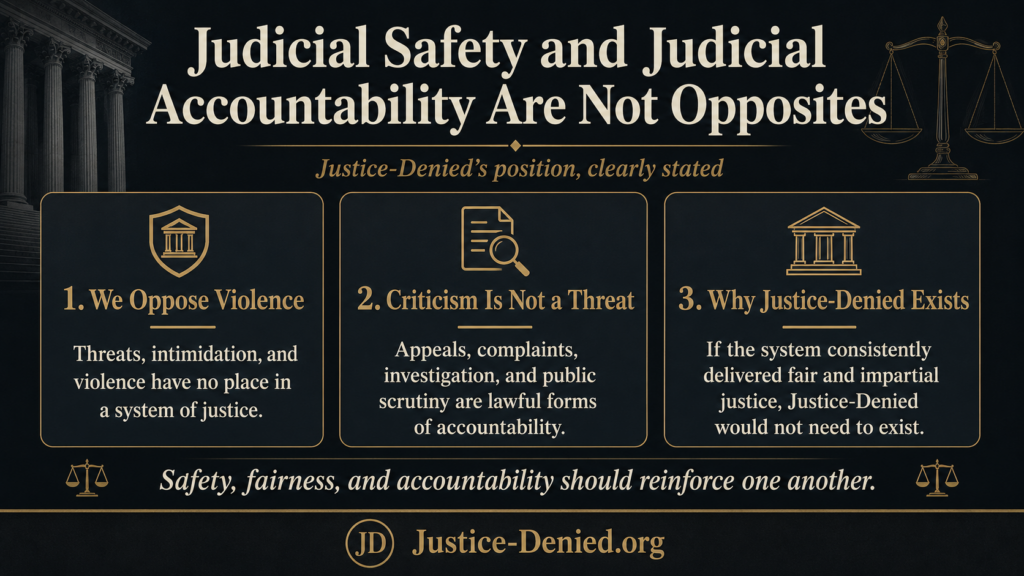
Criticism Is Not a Threat
There is an essential difference between threatening a judge and criticizing a judicial decision.
A threat seeks to frighten, punish, or coerce. Legitimate criticism seeks an explanation, a correction, an investigation, a change in policy, or greater public understanding.
Filing an appeal is not a threat.
Seeking judicial disqualification is not a threat.
Submitting a complaint to a judicial or attorney disciplinary authority is not a threat.
Requesting public records is not a threat.
Publishing a documented analysis of a judicial decision is not a threat.
Questioning whether the law was applied consistently is not a threat.
These are lawful methods of accountability. Several of them are mechanisms created by the judicial system itself.
Justice-Denied does not advocate hostility toward judges as people. It examines what judges, attorneys, and judicial institutions do in the exercise of public authority. That distinction is fundamental.
A judge should never be subjected to violence because of a ruling. But a ruling does not become immune from scrutiny merely because criticism may be uncomfortable.
Fairness Cannot Be Established by Declaration
The Minnesota Judicial Branch’s expression of appreciation is carefully worded. It thanks the members of the Branch “who provide” fair and impartial access to justice. Grammatically, it does not necessarily claim that every judge, every court employee, and every judicial proceeding has always satisfied that standard.
Nevertheless, the statement presents fair and impartial justice as the defining work of the institution. That is understandable. It is also an assertion that must ultimately be demonstrated through conduct, not accepted solely because the institution has repeated it.
Fairness is not something a judicial system can conclusively certify for itself.
It is measured by what occurred in an actual case:
- Were the parties treated consistently?
- Was the law applied as written?
- Was the decision based on evidence properly contained in the record?
- Were genuinely disputed facts preserved for the proper factfinder?
- Were significant relationships and potential conflicts disclosed?
- Were the parties meaningfully heard?
- Were judicial errors acknowledged and corrected?
- Were complaints examined independently rather than institutionally defended?
An institution’s confidence in its own fairness is not the same as public confidence earned through transparent and impartial conduct.
What Minnesota’s Judicial Rules Require
The importance of fairness is not merely aspirational. It is embedded in Minnesota’s Code of Judicial Conduct.
The Code begins with the recognition that an independent, fair, and impartial judiciary is indispensable to the system of justice.
Rule 1.2 requires judges to act in a manner that promotes public confidence in the independence, integrity, and impartiality of the judiciary. The Rule also requires judges to avoid both impropriety and its appearance.
Rule 2.2 states:
“A judge shall uphold and apply the law, and shall perform all duties of judicial office fairly and impartially.”
The accompanying commentary explains that judges must remain objective and open-minded.
Rule 2.6 requires that every person with a legal interest in a proceeding be accorded the right to be heard according to law. Its commentary recognizes that the right to be heard is an essential component of a fair and impartial system.
These duties are not fulfilled merely because a courthouse was open, a document was accepted for filing, or a hearing was placed on the calendar.
They require a fair process.
Access to a Courthouse Is Not Necessarily Access to Justice
The Judicial Branch’s post refers to “fair and impartial access to justice.” That phrase deserves careful consideration.
A person can have formal access to the court system without receiving fair adjudication.
A litigant may be permitted to file pleadings, submit evidence, attend hearings, and pursue an appeal while still having substantial reasons to believe that the process was not impartial.
Access alone does not answer whether important evidence was disregarded, whether disputed facts were improperly resolved, whether one party received procedural advantages denied to another, whether conflicts were disclosed, or whether the decision was based entirely on the record.
Nor does the existence of an appellate process automatically establish that the underlying proceeding was fair. Appellate courts operate under standards of review, preservation requirements, briefing limitations, forfeiture doctrines, and other procedural constraints. Not every serious concern receives a full examination on its merits.
A courthouse door can be open while meaningful justice remains out of reach.
Why Justice-Denied Exists
The Judicial Branch’s statement produced an immediate and unavoidable thought:
If Minnesota’s judicial system consistently operated as fairly and impartially as its public messaging suggests, Justice-Denied would have no reason to exist.
Justice-Denied does not contend that every Minnesota judge is unfair. We do not deny that many judges, judicial officers, court administrators, law clerks, and court employees serve conscientiously and attempt to perform difficult work with integrity.
Our criticism is not directed indiscriminately at everyone associated with the judiciary.
Justice-Denied exists because institutional assurances are not proof. It exists because judicial systems can fail individual litigants. It exists because those failures become more serious when the institutions responsible for addressing them appear unwilling to conduct an open and independent examination.
It exists because a judicial decision can carry the authority of the State even when the reasoning behind that decision appears inconsistent with the record, the governing law, or the standards applied elsewhere.
It exists because courts possess extraordinary power over property, privacy, reputation, family relationships, liberty, and sometimes life itself. The greater the power, the greater the need for transparent accountability.
And it exists because people who believe they were denied a fair process should not be forced to choose between silence and violence.
There is another path: documentation, lawful advocacy, careful analysis, public education, and persistent demands for institutional accountability.
That is the path Justice-Denied has chosen.
Judicial Well-Being and Litigant Well-Being
The International Day for Judicial Well-being recognizes that judicial officers face stress, isolation, intense workloads, difficult decisions, and concerns about personal safety. Those concerns deserve serious attention.
But a healthy justice system must also recognize the human consequences experienced by the people who appear before it.
Litigation can affect a person’s health, finances, family, reputation, privacy, livelihood, and confidence in government. When a litigant believes that the process was fundamentally unfair—and when the record provides substantial support for that belief—the effects can last long after a case has formally ended.
Those consequences are not equivalent to threats of physical violence, and they should not be portrayed as equivalent.
But they are real.
A justice system concerned with well-being must also consider whether it is protecting the people who come before it—particularly those who are already vulnerable or who turned to the courts because they had suffered serious harm.
Courts cannot eliminate every emotional or personal consequence of litigation. Nor can they guarantee that every party will emerge unharmed. But the judicial process should not become a means by which foreseeable harm is unnecessarily repeated, intensified, or prolonged.
Protection of litigants can take many forms. It can mean safeguarding medical, psychological, genetic, financial, and other intensely private information. It can mean enforcing protective orders and procedural safeguards as written. It can mean taking documented vulnerability seriously rather than treating it as an inconvenience. It can mean ensuring that a person seeking relief is not exposed to avoidable retraumatization through unnecessary disclosure, unequal procedures, or institutional indifference.
A judicial system should not measure its success solely by whether a case was processed, an order was entered, or an appeal was completed. It should also ask whether the exercise of judicial power protected the dignity, safety, privacy, and legal rights of the people compelled to place their lives in the court’s hands.
Judicial well-being and litigant well-being should not be treated as competing interests. Judges who are adequately supported, ethically grounded, transparent in their reasoning, attentive to the record, and willing to correct mistakes are better positioned to deliver justice.
Accountability should not diminish judicial well-being. Properly understood, it should support it by strengthening the legitimacy of the institution in which judges serve.
Public Confidence Must Be Earned
Courts frequently speak of maintaining public confidence in the judiciary. But public confidence cannot be manufactured through ceremonial statements, institutional slogans, or assurances that the system is fair.
Confidence is earned when the public can see that:
- Judicial rules are applied consistently.
- Potential conflicts are disclosed promptly.
- Decisions accurately represent the record.
- Serious allegations are independently investigated.
- Errors are corrected rather than defended reflexively.
- Critics are answered with facts rather than characterized as threats to the institution.
A judiciary that asks the public to trust it must also be willing to explain why that trust is deserved.
The Code of Judicial Conduct recognizes that judges occupy positions of public trust and are subject to public scrutiny. That scrutiny may be difficult. It may sometimes be mistaken, unfair, or expressed harshly. But legitimate scrutiny remains an unavoidable consequence of exercising governmental power.
The proper response to documented criticism is not to blur the distinction between criticism and intimidation. It is to address the evidence.
Accountability Protects the Judiciary
Judicial independence is essential. Judges must be able to decide cases without fear of retaliation, political pressure, personal intimidation, or popular coercion.
But judicial independence does not mean judicial insulation.
It does not mean that judges are independent of the law, the record, ethical standards, appellate review, disciplinary oversight, or public examination.
Accountability protects the judiciary by identifying problems before they become institutional habits. Transparency protects the judiciary by allowing the public to distinguish unsupported accusations from documented concerns. Meaningful corrective mechanisms protect the judiciary by demonstrating that no official is beyond review.
A court system is not weakened when credible criticism is carefully examined.
It is weakened when serious questions are ignored, minimized, or answered only with generalized assurances that the system is fair.
A Principle Justice-Denied Can State Without Qualification
Justice-Denied condemns threats, intimidation, retaliation, and violence against judges, judicial officers, court personnel, their spouses, children, relatives, and other loved ones, as well as attorneys, litigants, witnesses, public officials, and members of the public. No family member should be threatened, harmed, harassed, or made to fear for personal safety because of another person’s judicial office, court employment, legal representation, participation in litigation, or public service.
We also reject the suggestion—whether stated expressly or merely implied—that supporting judicial safety requires unquestioning acceptance of judicial conduct.
Both principles can be true:
- Judges, judicial officers, court employees, and their families are entitled to personal safety and freedom from retaliation.
- The public is entitled to examine whether judicial power was exercised fairly, impartially, and according to law.
Justice-Denied does not seek to weaken Minnesota’s judiciary. We seek to strengthen it by insisting that the standards invoked in public statements are honored in courtrooms, reflected accurately in judicial decisions, and meaningfully enforced when credible violations are identified.
If Minnesota’s judicial system consistently met those standards—and if its accountability mechanisms responded transparently when legitimate concerns arose—Justice-Denied would no longer be necessary.
Nothing would please us more.
