
Seeking Justice in Otter Tail County
Is Justice a Right — or a Weapon of the Powerful?
We are Craig and Marie Stevenson from Fergus Falls, Minnesota. Justice-Denied.org is a Minnesota public-interest investigative media outlet, built on our firsthand experience with a judicial system that betrayed not only us but also the constitutional principles it exists to uphold. In Otter Tail County, we did not find truth, fairness, or impartiality. Instead, we encountered a process shaped by undisclosed relationships, distorted by selective fact-finding, and marred by a persistent disregard for ethical and constitutional limits.
Justice-Denied.org documents what happened—and why it matters—so Minnesotans can evaluate the integrity of their justice system for themselves. We publish investigative reporting, records-based analysis, and AI-assisted evaluations of judicial decisions to illuminate how the system functions behind the scenes, especially where transparency is lacking.
Our work is grounded in public records: court filings, official transcripts, judicial orders, appellate opinions, and disciplinary materials. As a public-interest media outlet, we report on these issues to ensure that judicial conduct in Minnesota is visible, understandable, and accountable.
What the Data Shows
The table on this page summarizes an Artificial Intelligence (AI) analysis of every key district court order in our own case. For each ruling, AI measured the level of judicial bias based on the order’s reasoning and the corresponding hearing transcript. The results reveal, in data form, what the courts themselves refused to confront—a sustained pattern of partiality.
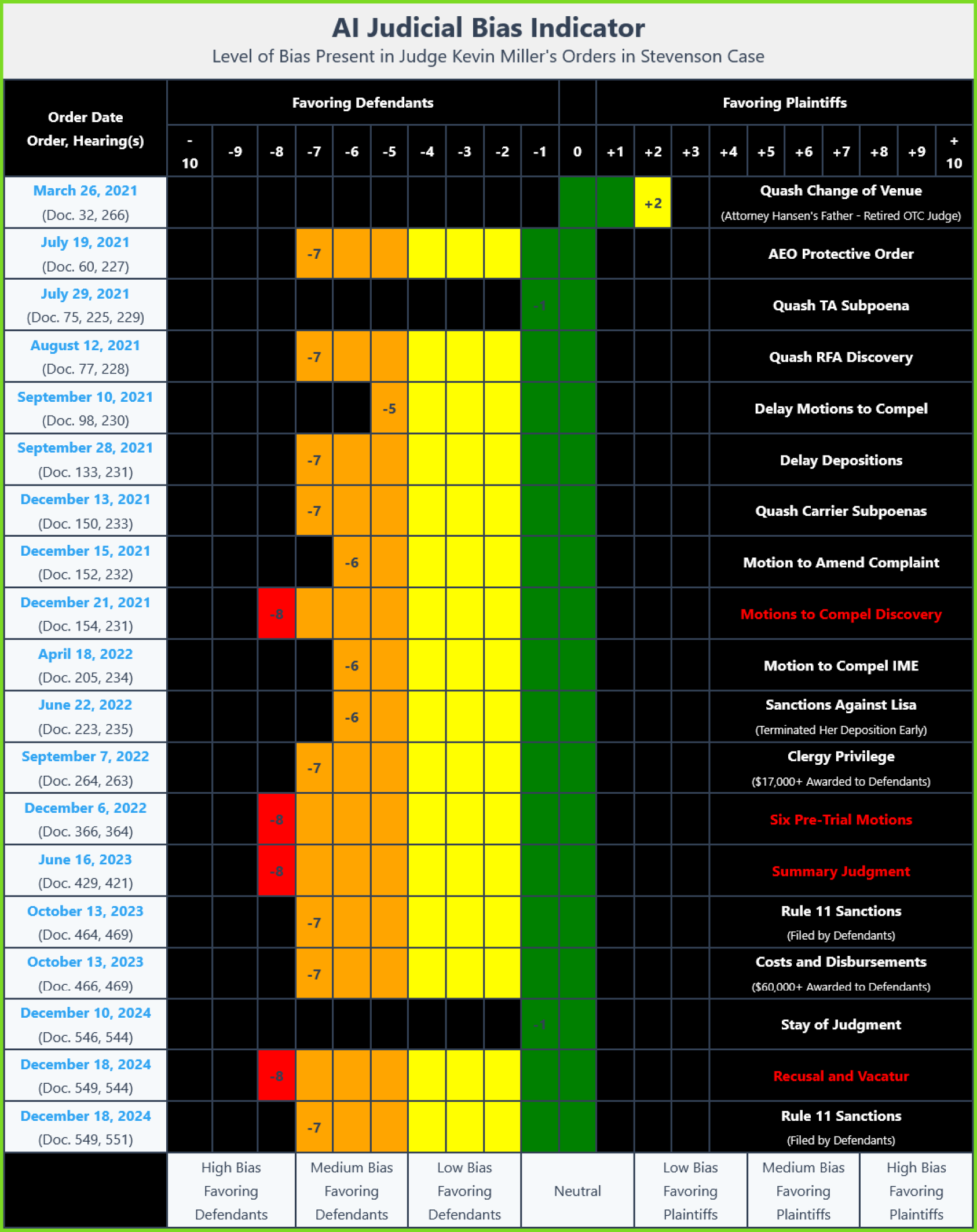
A full-size version of this table is available [here], with detailed AI summaries of each order linked in blue.
These irregularities are not limited to our county. They reveal a statewide problem: in nearly every Minnesota case, independent judicial investigations or reliance on extra-record evidence results in automatic structural error and reversal, no objection required. But our appeal was the exception. As the pie chart on this page shows, the Minnesota Court of Appeals treated the independent-investigation issue as forfeited—even though the same court routinely recognizes such errors as non-waivable and constitutionally fatal.
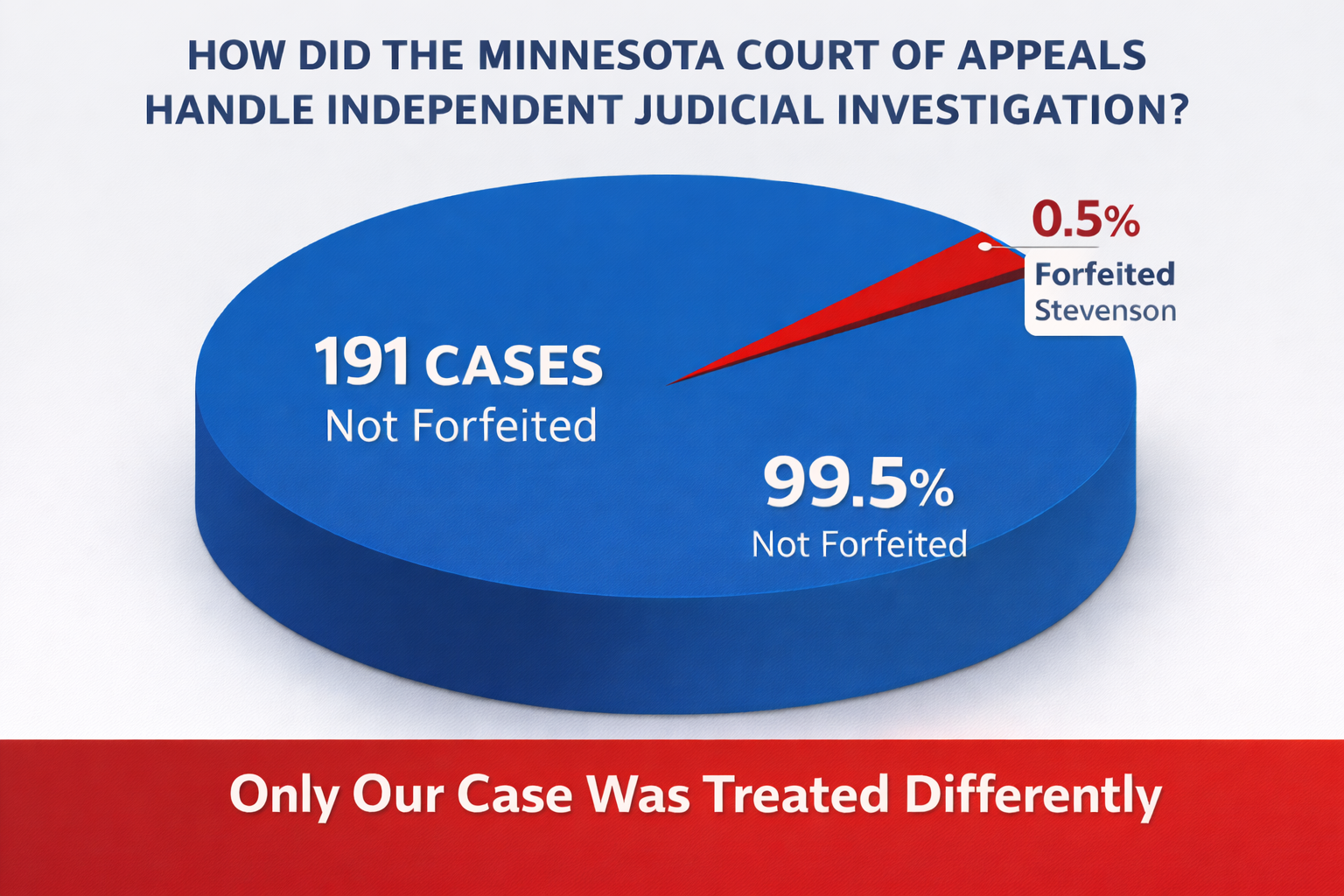
If the guardrails protect everyone else, they should have protected us too. Visit our Independent Investigations page for more information.
A Systemic Breakdown of Judicial Neutrality
Our experience revealed more than procedural error—it exposed a systemic breakdown of judicial neutrality. In 2025, the Minnesota Supreme Court’s decision in State v. Duol confirmed what our case had already shown: when a judge conducts an independent investigation or relies on extra-record facts, that judge “no longer acts as a fair and impartial judge,” violating the guarantee of due process under both the Minnesota and United States Constitutions. More information is available [here].
Earlier in 2025, the Minnesota Board on Judicial Standards issued Formal Advisory Opinion 2025-1, reaffirming that judges must never independently investigate facts or rely on information outside the record—even before a motion for disqualification is filed. The fact that this occurred in our case, was never corrected, and was instead condoned, calls into question every order and opinion in our case.
Why We Publish
This site exists to ensure that Minnesota’s judiciary is held to the same rules it applies to everyone else. When appellate courts dismiss clear constitutional violations on technicalities, and when oversight bodies fail to act on documented misconduct, public trust is eroded at its foundation. The standards that safeguard impartial justice must not depend on who the litigants—or the judges—are.
As a public-interest media outlet, Justice-Denied.org exercises the freedoms of speech, press, and petition to document judicial conduct, expose irregularities, and inform the public. These rights, guaranteed by the First Amendment, protect every citizen’s ability to investigate, report, criticize, and demand fairness from public institutions.
U.S. Supreme Court Justice Louis Brandeis famously wrote:
“Sunlight is said to be the best of disinfectants.”
It is time to let that sunlight reach every corner of Minnesota’s judiciary—and to insist that fairness is not optional.
Justice-Denied.org is a Minnesota public‑interest investigative media outlet reporting on judicial conduct in Otter Tail County, the Court of Appeals, and the Minnesota Supreme Court.
Our Team

Craig

Marie

Miranda
Newest Blog Posts

Throughout this site, content with a green border is generated entirely or almost entirely by Artificial Intelligence (AI).
Featured Blog Post (Marie)

Featured Blog Post (Craig)

There are two ways for a court to decide a case. It can hear the facts, research the law and arrive at a conclusion based on that process. Using this method, the court has no idea how the case will turn out until the process plays itself out. In my naïve world, I like to think this is how it is supposed to work.
The other method is for the court to determine in advance what it wants the result to be and then find a way to get there. I call this “outcome based” jurisprudence. And I hate it. It is a type of “ends justifies the means” cynical approach to the law.
John C. Greiner, Graydon Head & Ritchey LLP